Category: Industry News

  • The Facts on San Joaquin Valley Water Use & Realigning Priorities Amidst Drought

    The Facts on San Joaquin Valley Water Use & Realigning Priorities Amidst Drought

    In a panel discussion titled, “Water: What Real, What’s Not, What’s Next” at the Annual Convention of the Almond Alliance of California, Friant Water Authority CEO Jason Phillips shares his views on solutions to California’s water crisis based on the reality of the San Joaquin Valley’s water supply and use.

    Please thank this video’s sponsor Suterra for their industry support.

  • What Ag Employers Should Know about Firing Employees

    What Ag Employers Should Know about Firing Employees

    When is it appropriate to fire an employee and how should you go about doing it properly to prevent negative repercussions? At the Annual Convention of the Almond Alliance of California, Stacy Henderson, Almond Alliance’s go-to attorney for ag labor law, shared some key insights every ag employer should know. Watch this brief video with Stacy as she explains.

    Please thank this video’s sponsor Suterra for their industry support.

  • Chinese Consumers View Pistachios as Healthy “Happy Nuts”

    Chinese Consumers View Pistachios as Healthy “Happy Nuts”

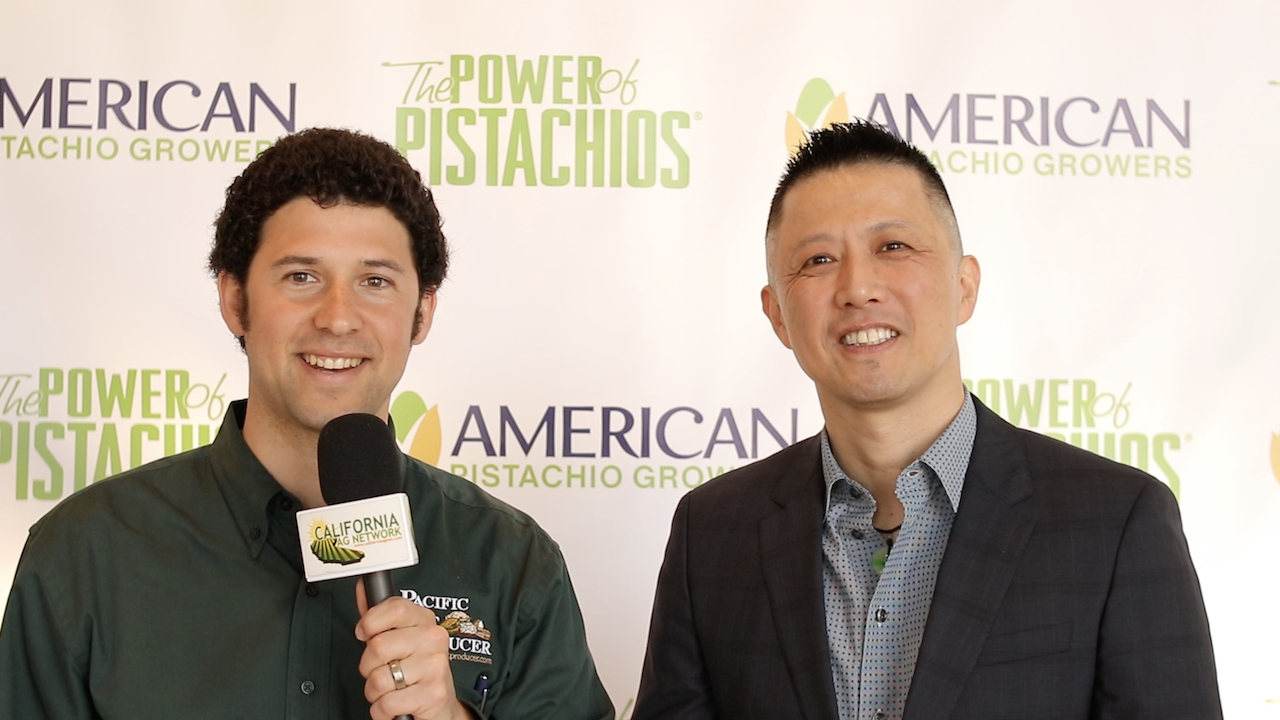
    Can an increasing Chinese appetite for U.S. grown pistachios help overcome trade barriers?  Possibly, but watch this brief interview with American Pistachio Growers’ in-country trade representative Roger Zhang as he shares pistachio consumer trends in China. Read more in Pacific Nut Producer Magazine.

    Please thank this video’s sponsor Suterra for their industry support.

  • Pest and Disease Management Considerations for Organic Hazelnut Growers

    Pest and Disease Management Considerations for Organic Hazelnut Growers

    Considering converting your hazelnut farm to organic production but not sure how to keep pest and disease pressure at bay? Watch this brief video with the organic grower Taylor Larson from the Oregon Organic Hazelnut Collective as he offers his personal insights and read more about it in Pacific Nut Producer Magazine. Don’t currently receive the monthly publication? Subscribe for free at: https://malcolmmedia.com/subscribe/

    Please thank this video’s sponsor George Packing Company for their industry support.

  • Pistachios Evolve from a Garnish to a Popular Snack in India

    Pistachios Evolve from a Garnish to a Popular Snack in India

    The Indian market is a relatively new one for U.S. pistachios, yet has tremendous potential as American Pistachio Growers continues to invest in it.  Watch this brief interview with American Pistachio Growers’ in-country trade representative Summit Saran as he explains. Read more in Pacific Nut Producer Magazine.

    Please thank this video’s sponsor Suterra for their industry support.

  • Pacific Nut Producer August Issue

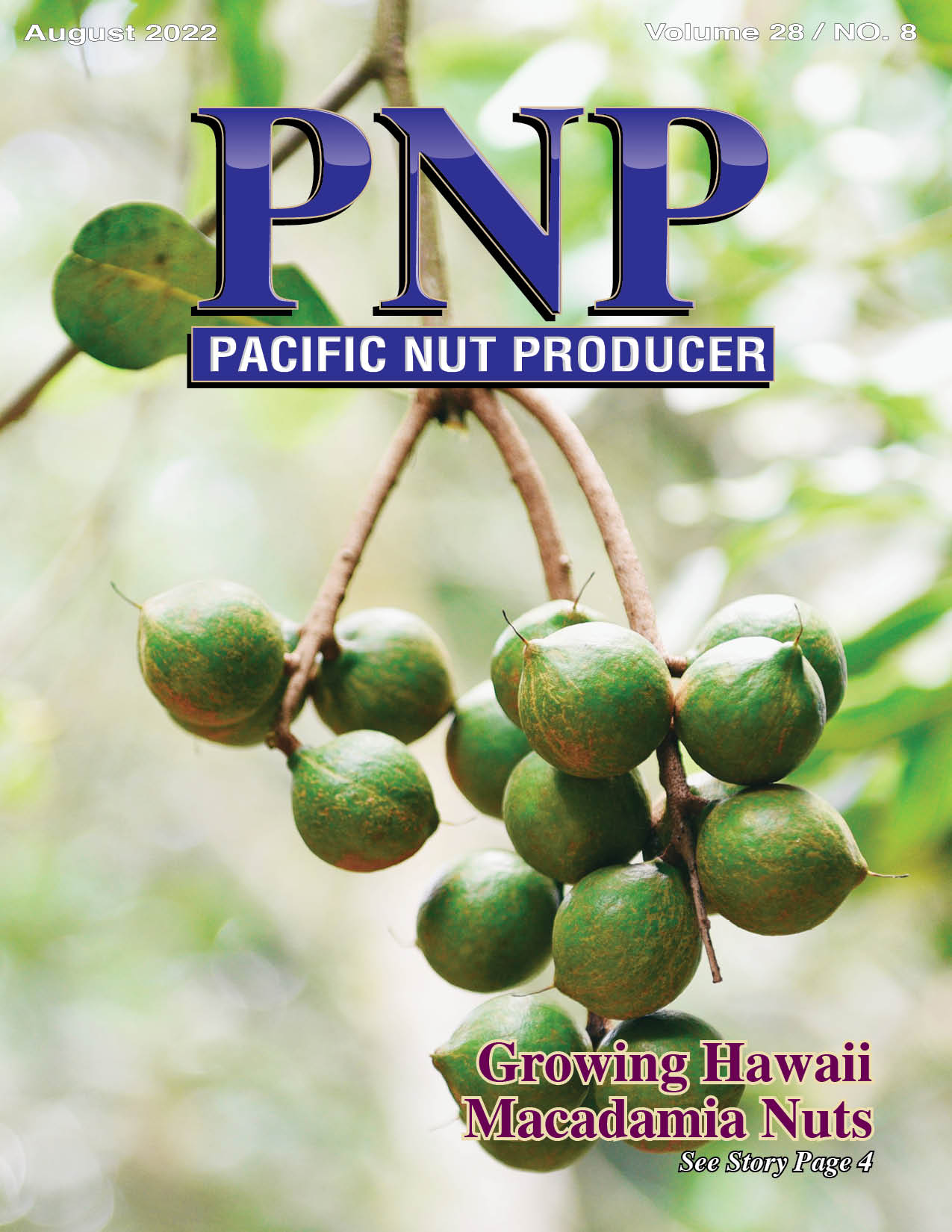
    Pacific Nut Producer August Issue

    Pacific Nut Producer August Issue

    [btn btnlink=”https://malcolmmedia.com/order-a-back-issue/back-issue-pacific-nut-producer-magazine/” btnsize=”full” txtcolor=”#ffffff” color=”#FFF” bgcolor=”#492500″ btnnewt=”1″ nofollow=”1″]Order A Back Issue[/btn]

    [btn btnlink=”http://malcolmmedia.com/pacific-nut-producer-magazine-subscriptions/” btnsize=”full” txtcolor=”#ffffff” bgcolor=”#492500″ btnnewt=”1″ nofollow=”1″]Subscribe Free[/btn]
    [three_fifth_last]

    Contents of the August Issue:

    Hawaii Macadamia Orchard Management Practices
    Insights from Agronomist Walter Parada

    Unlimited Potential in India Almond Export Market
    Almond Appeal for Skin Health, Nourished Hair & Weight Management

    When Do you Shake Almonds?
    Troubleshooting Considerations for Harvest this Year

    August Orchard Tasks
    Almonds, Hazelnuts, Pecans, Pistachios

    [/three_fifth_last]

  • GroPro Appoints Benito Varela as Chief Operating Officer

    GroPro Appoints Benito Varela as Chief Operating Officer

    GroPro Corp. announced that veteran agriculture industry executive Benito Varela joined the team as the new Chief Operating Officer on July 1. Varela has almost 30 years of experience in agribusiness, including 25 years at Dow Agrosciences. A driven executive with broad-based expertise in leading effective strategy, Benito has a strong background in biotech as well as international territory management, market and business development and strategic alliances through multiple M&A projects. His outstanding leadership, anchored by his high integrity and personal character form the basis of his long-term professional relationships.

    Mr. Varela has a Bachelor of Science Degree in Agricultural Engineering (University of Florida) and a Master of Science Degree in Professional Business Management (Honors, University of Miami). Varela is also a Certified Mentor for entrepreneurship and small business by The Venture Mentoring Team and Certified Six Sigma Black Belt.

    “Benito’s strong history of achieving large territory growth, managing corporate innovation in biotech for agriculture and leadership skills will help GroPro accelerate its mission to become a leading international agricultural biotech company.” – said James Lamoureaux, CEO of GroPro. ” We believe that his experience, deep understanding of operational excellence, best practices, and partnering for rapid expansion in Latin American agribusiness, and strong industry connections make him an excellent leader to help expand our business.”

    About GroPro Corp:

    GroPro is an international Biotech #BioFertilizer#BioStimulant, and #BioPesticide manufacturer with a headquarters in Austin, Texas (the USA). The company’s target regions are – the USA, the Middle East, Africa, the EU, and Central America. Our products have been competing and beating the bio-industry standards. Numerous field trial results with universities, researchers, and growers confirm our effectiveness. GroPro has also efficiently provided superior efficacy against traditional\chemical inputs, allowing us to offer product lines for all growers.

    Innovations Grow Here

    groproag.com

  • Winter Honey Bees Show Resistance to a Common Insecticide

    Winter Honey Bees Show Resistance to a Common Insecticide

    Winter honey bees, compared to newly emerged summer bees, have a better ability to withstand the harmful effects of a widely-used insecticide in pest management, according to a recent study published in Apidologie.

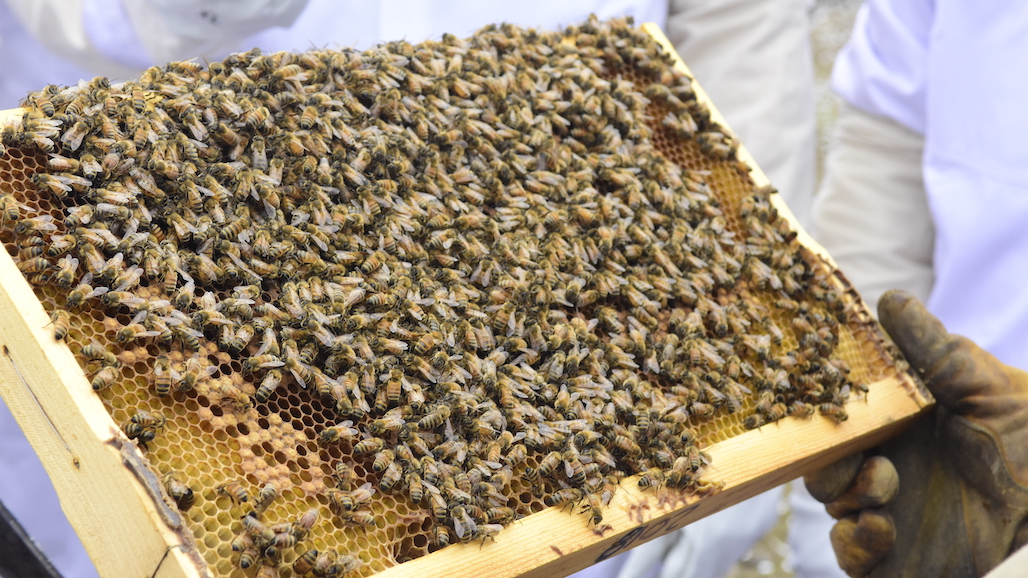
    Honey bees feed on imidacloprid during a cage experiment. (Photo by Mohamed Alburaki, ARS)

    United States Department of Agriculture (USDA), Agricultural Research Service (ARS) researchers from the Bee Research Laboratory in Beltsville, Maryland, found winter honey bees’ consumption of a nearly lethal, imidacloprid-laced syrup did not affect their survival during the study.

    Imidacloprid is an insecticide made to mimic nicotine and is toxic to insects. This powerful insecticide is widely used in agriculture for pest management control. Honey bees are likely to encounter imidacloprid while foraging in the field or through contaminated hive products.

    “Although imidacloprid toxicity to honey bees is an important concern for beekeepers, our results provide good news,” said Miguel Corona and Mohamed Alburaki, researchers at the ARS Bee Research Laboratory. “Our research shows that winter honey bees have unrecognized physiological mechanisms to counteract the effects of insecticides.”

    The study assessed differences in diet behaviors for summer and winter honey bees in a controlled laboratory setting. Researchers provided sublethal doses of the imidacloprid-laced syrup to bees as necessary. Winter bees showed a preference to consuming imidacloprid-laced syrup over untreated sugar syrup while summer honey bees made the safe choice and avoided consuming the laced syrup each time.

    According to Corona, it is important to study the differences of summer and winter honey bees’ diets.  Honey bee colonies survive extreme seasonal differences in temperature and forage by producing two seasonal phenotypes of workers: summer and winter bees. These seasonal phenotypes differ significantly in their psychological characteristics as well as their susceptibility to disease and ability to handle poisonous substances.

    “Winter bees and summer bees undergo physiological changes to cope with drastic seasonal changes in temperature and the availability of nutritional resources,” said Corona and Alburaki. “Our results suggest that long-lived winter bees are especially well-adapted to tolerate higher levels of chemical stressors.”

    Corona said that although the study’s results show that winter bees could tolerate more intoxication by imidacloprid, they are still susceptible to higher concentrations of this insecticide in field settings. — By the USDA-ARS

  • Top 5 Things to Consider at Almond Hullsplit

    Top 5 Things to Consider at Almond Hullsplit

    Hullsplit is a time when growers’ various orchard practices – proper irrigation, nutrient management, pest control and orchard monitoring – come together in an effort to maximize almond quality and yield. To assist during this busy season, we’ve pulled together a list of the top five things you should consider before hullsplit.

    1. Measuring Hullsplit Progress

    Proper detection is the first step in effectively managing the potential for myriad pest and rot issues that may occur following hullsplit.


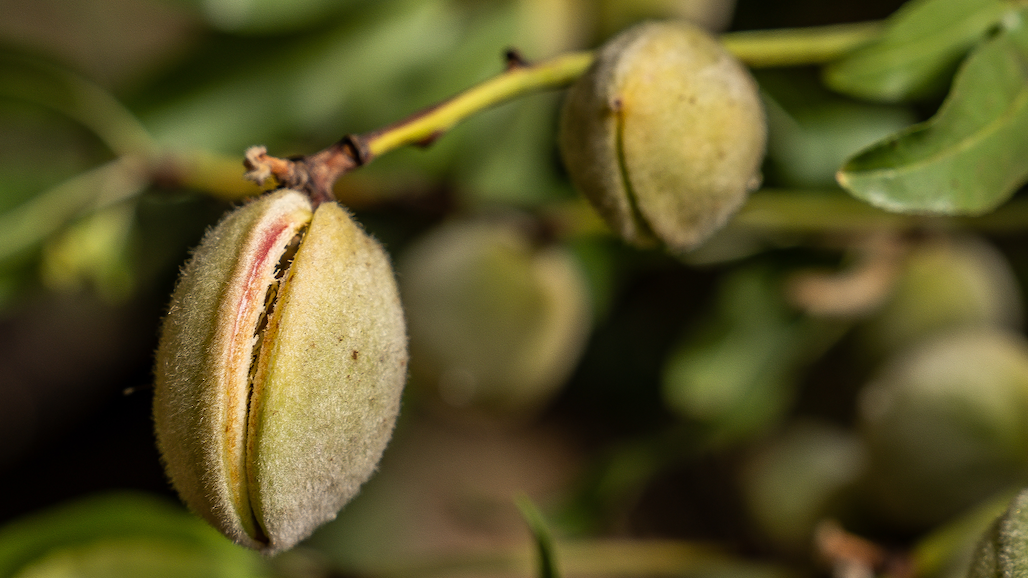
    • Hullsplit typically begins in early July, starting in the early growing regions and spreading to later growing regions accordingly. The splitting of blank nuts (as much as 3–5% of the almonds) will occur about a week ahead of hullsplit and serve as a “heads up” that split will soon occur.

    • Tip: A key to identifying hullsplit is to look for an initial split in the upper and outer portions of the canopy, particularly the southwest quadrant. Once the fruit splits, hullsplit has begun.


    2. Spraying to Target Navel Orangeworm (NOW)

    The most effective time to spray for NOW is during its second flight, which often coincides with the initiation of hullsplit. As a confirmation that flight activity is coincident with the beginning of hullsplit, check to see that eggs are being laid on egg or pheromone traps (note: mating disruption may affect trapping). Then, when spraying, make your application no later than at 1% hullsplit. Find out more about mating disruption for NOW.

    If your orchard experiences high NOW populations, a second insecticide application may be needed two-to-three weeks after the initiation of hullsplit, and a rotating of chemistries is advised to reduce resistance development pressure. As noted in the University of California (UC) Integrated Pest Management (IPM) guidelines, be sure to consider the following before conducting a second application:

    • varieties in the orchard, particularly late harvested varieties

    • anticipated harvest dates

    • pest pressure noted from egg and pheromone traps

    • overwintering mummy load

    • proximity to an external NOW source, such as neighboring pistachio or almond orchards managed by a different entity

    As indicated in the UC IPM guidelines, Intrepid (methoxyfenozide) and Altacor (chlorantraniliprole), are preferred materials for hullsplit sprays. Pyrethriods have been used in the past, but their use should be considered with caution as NOW resistance to these materials has emerged, and pyrethriods are toxic to beneficials. If pyrethroids are used, they should be applied only be once per season. It’s imperative that you also make sure your sprayer(s) are well calibrated to improve spray efficacy and minimize drift.

    3. Manage Hull Rot from Day One

    Almond hulls are susceptible to several hull rot fungi from the beginning of hullsplit until the hulls dry, typically a month-long period of time. This period may vary, however, depending on fertilization and irrigation. Successful hull rot control is based upon effective strategic deficit irrigation and nitrogen management.

    Strategic Deficit Irrigation (SDI) 

    SDI, also known as regulated deficit irrigation or RDI, is the practice of mildly drought-stressing almond trees at hullsplit. By managing SDI, growers can reduce hull rot by 60–90% and experience a more uniform hullsplit and timely harvest. These factors may contribute to less crop damage from weather and late-season NOW flights, leading to less aflatoxin contamination, as well. What’s more, SDI reduces water use for 2-3 weeks without impacting crop productivity.

    The target period of when growers should stress trees is from the start of hullsplit through 90% hullsplit, a period of about three weeks. The most accurate way to practice SDI is to use a pressure chamber to track and maintain slight tree water stress levels, between -14 bars and -18 bars, depending on the weather. Information about the pressure chamber is available on the UC Davis Fruit and Nut Research and Information webpage.

    Growers who do not rely on pressure chambers, particularly those with a history of hull rot and a visual baseline from which plant stress can be observed, may achieve similar results by irrigating at 50% of normal tree demand, using crop evapotranspiration (ETc) calculations during hullsplit.

    The onset of hullsplit will vary according to orchard conditions; stress levels vary with soil type and other factors. In shallow soils where trees may dry quickly, growers should initiate stress when blanks start to split, usually about a week before the onset of hullsplit. On deeper, well-drained soils, it can take up to 20-to-30 days to reach mild-to-moderate stress levels. In this case, growers may want to reference UC Agriculture and Natural Resources Publication 8515 to determine when to initiate water stress.

    Nitrogen Management 

    Almond Board-funded research has found that excessive nitrogen increases incidences of hull rot. It is critical that a proper nitrogen budgeting plan, which is a function of crop load, is in place for the growing season to ensure that only the necessary amount of nitrogen is applied. Growers should also follow their nitrogen budgeting plans throughout the whole season and update their plans as actual yields become more evident. Regular updating will also allow growers to focus their nitrogen applications to the key times of nitrogen demand in almonds: For instance, application(s) during kernel fill should typically occur the during end of May through early June.

    You can find more information on nitrogen budgeting and management at Almonds.com/Nutrients.

    4. If Applying AF36 Prevail, Aim for One-to-Two Weeks Before Hullsplit

    Recently approved for use in almond orchards, the Aspergillus flavus biocontrol agent AF36 Prevail offers a supplementary approach to reducing aflatoxin contamination in the orchard.

    If you plan to apply AF36 Prevail this season, plan to do so around early July and make the application on or close to the berms so that following irrigations can wet the Aspergillus-carrying seed. Learn more about AF36 Prevail and how it should be applied in this article from the Almond Board: “AF36, Biocontrol Agent for Aflatoxins, Now Approved for Almonds.”

    5. Aim for Timely Harvest

    Growers should keep in mind that a third-generation NOW flight poses one of the greatest threats to the orchard around harvest time, so almonds should be harvested as soon as possible. Timely harvest is when there is 95–100% hullsplit at eye level in the canopy and will avoid NOW infestations and subsequent aflatoxin contamination. Early-harvested varieties, such as Nonpareil, are much less likely to attract egg laying once they’re on the ground, reducing the risk to later harvest varieties remaining in the trees.

    Click here to learn more about NOW control and management strategies. More details on SDI and other irrigation best practices may be found in the Almond Board’s Almond Irrigation Improvement Continuum. You can download a free copy of the Continuum at Almonds.com/Irrigation.  — By the Almond Board of California

  • Almonds Prove Indispensable to New Product Innovation

    Almonds Prove Indispensable to New Product Innovation

    Almond Board of California — For the sixteenth consecutive year, almonds are the top nut in global new product development according to Global New Products data from Innova Market Insights, having been first recognized as the number one nut globally in 2006. With more forms than any other tree nut, almonds’ versatile taste, texture and health claim benefits align to consumers’ ever-changing tastes, lifestyles and preferences.

    This year’s Global New Products Report revealed that more than 12,000 new almond products were introduced in 2021, making up 40 percent of total nut introductions. Almonds are the number one nut in four of the top six global food introduction categories: bakery, bars, dairy and cereals. Of note, bakery’s growth at 15 percent is highest out of all introductions across global food, nut and almond introductions.

    The report also revealed introductions with almonds led to a higher likelihood of on-pack health claims with over 1 in 5 products with almonds featuring the top health label claim, “gluten-free,” specifically. The remaining four leading health label claims for products with almonds were “no additives/preservatives,” “high source of fiber,” “organic,” and “high source of protein.” Almonds remain the number one nut by a large margin for global introductions with label claims for “plant-based,” “vegan” and “vegetarian,” as plant-based food products continue to dominate consumer desires for health and lifestyle needs. 

    “We’re continually impressed to see manufacturers across the globe innovating with almonds to stay on top of consumer demands, trends and preferences coming out of the pandemic,” said Harbinder Maan, Associate Director, Trade Marketing and Stewardship at the Almond Board of California. “The versatility of almonds as an ingredient is truly unique, and we continue to see new innovations across product categories that really push the envelope.”

    The Global New Products Report also found that almonds are not only the number one nut in North America but also in Europe and Asia-Pacific. Europe is leading almond introductions for all top almond relevant categories except for cereals, where Asia-Pacific is the leading region. Globally, the top six almond relevant categories account for 82 percent of total almond introductions, while these categories account for only 43% of total food introductions.

    Confectionery is the leading category for almond product introductions in Europe and the Middle East & Africa, while bars is the leading category in North America, and bakery is the leading category in Asia-Pacific with a narrow margin over snacks. When it comes to regions where almond product introductions are growing fastest, the Middle East & Africa lead the charge at 15 percent, followed by Latin America at eight percent, and Asia-Pacific at three percent.

    The success of almonds as a key ingredient across product categories can partially be attributed to their texture versatility. The creaminess and contrasting smoothness of almond butter is a natural fit for spreads, which grew globally at 12 percent, whereas sliced or chopped almonds add crunch to a growing desserts and ice cream category. Most notably, to satisfy an increased demand for gluten-free and healthy indulgence options, almond flour is often utilized as a key ingredient in the ready meals and side dish category, particularly in products like frozen pizzas.

    “Coming out of two unprecedented years of pandemic-related change, it’s encouraging to see consumer expectations shifting towards a demand for a healthier lifestyle both in what and how they choose to consume,” said Lu Ann Williams, Global Insights Director at Innova Market Insights. “It’s no surprise that almonds have maintained their spot as number one for 16 years and counting, with the dynamic and various texture, flavor and health label claims they satisfy.”

    Almonds are a nutrient-rich and heart-healthy ingredient. When compared ounce for ounce, almonds are the tree nut highest in vitamin E and riboflavin, and a one-ounce serving of almonds provides six grams of protein, four grams of fiber, 13g of unsaturated fat and only 1g of saturated fat. Scientific evidence suggests, but does not prove, that eating 1.5 ounces of most nuts, such as almonds, as part of a diet low in saturated fat and cholesterol may reduce the risk of heart disease.

    Visit Almonds.com to view an infographic highlighting key data from the report.
     
    References:
    Innova Market Insights, Global New Products Introductions Report, 2021. May 2022.