Category: Industry News

  • American Pistachio Growers Employs Robust Campaign to Meet Record Harvest

    American Pistachio Growers Employs Robust Campaign to Meet Record Harvest

    With the high likelihood that U.S. pistachio growers will shake a record crop from their trees this fall, American Pistachio Growers (APG) is pulling out all of the stops to keep its wave of marketing success rolling in 2021 and well beyond.  APG’s marketing team has just put the final touches on a new advertising campaign that combines extensive television advertising in major markets across the U.S. as well as additional print and digital media advertising in all key export markets.

    APG’s strategy is to keep consumer demand running strong ahead of what appears to be a large 2020 crop. According to APG President Richard Matoian the U.S. pistachio crop that growers are currently harvesting could hit the 1-billion pound mark — setting a new production record.

    “We are investing in our biggest advertising and marketing campaign ever to capitalize on this expansion in U.S. pistachio production,” said Judy Hirigoyen, APG Vice President, Global Marketing. “We have great synergy from all of the work we have done in recent years collaborating with great partners in professional sports, the research community, and with some of the world’s leading nutritionists and researchers.”

    For the first time ever APG is employing an advertising and marketing push that combines television, print and digital advertising in major export countries as well as in major television markets in the U.S. Beginning in mid-November and continuing through next summer, ads extolling the virtues of U.S. pistachios will appear in 44 U.S. television markets — from Honolulu to Washington, D.C.  Included in the U.S. advertising effort is APG’s sponsorship of New Year’s Eve countdown celebrations in Las Vegas, Nevada and Dallas, Texas — covering 26 key television markets.

    “Consumers here in the U.S. as well as abroad are embracing the powerful stories of pistachios — that they are packed with important nutrients and have been recognized as being a “complete” protein source, putting pistachios in the company of other plant-based complete proteins, such as quinoa and soy,” Hirigoyen said. “We think these stories will really resonate with TV viewers across the nation.”

    As a California commodity, pistachios have been on a tear in recent years and now occupy sixth place on the state’s list of more than 350 commodities with a value of $1.94 billion, according to California Department of Food and Agriculture 2019 data. Pistachios rank as the state’s second leading export with a value of $1.1 billion. As interest in pistachios has grown in California as well as in Arizona and New Mexico, so has the need to market larger crops.

    “On top of the expected record harvest this year, with the expansion of new acreage comes into bearing, we know that will present greater marketing challenges in the years ahead,” said Alison Nagatani, Chair of the APG Marketing Committee and a pistachio grower from Earlimart. “The Rabobank report projects bearing acreage could reach 372,000 acres by 2024/25 — about 30 percent greater than in 2019/20. Clearly, we have our marching orders to keep blazing the marketing trail, both here at home and in our key international markets.”

    U.S. growers are keenly aware that their success depends on keeping export channels open in major countries around the world. Prior to the COVID-19 pandemic, pistachio exports were running strong. In the 2018/19 marketing year, U.S. pistachio shipments set a record in spite of stiff retaliatory tariffs imposed by China, according to the Rabobank report.

    Even with the effects of the pandemic and ongoing trade tensions with China, Rabobank analysts state that market demand for pistachios remains strong in both domestic and international markets.  Although total demand could be affected by a global economic downturn due to the COVID-19 pandemic, they state that the demand outlook is still “favorable” and is set to keep pace with the anticipated expansion in U.S. pistachio production in the years ahead, citing the nutrition research and promotional efforts as contributing factors to their prediction.

    There is also heartening news contained in the pages of APG’s April 2020 consumption/share of market report. The report’s data found that total consumption and market share from 2016-2019 are on an upward trajectory in several key markets. In China, for example, total consumption is up 573 percent and market share has surged to 57.5 percent. In Germany the report found total consumption had risen 288.5 percent and market share was 65.7 percent. In India, total consumption and market share were up 74.3 percent and 58.6 percent respectively.

    “Marketing ahead of production and capitalizing on the contributions of our industry partners and the incredible array of research that touts the unique and powerful health attributes of pistachios will all play a role in continuing our marketing success,” Nagatani said.

    For more information, read the September issue of Pacific Nut Producer Magazine featuring the current state of the pistachio industry and the continued efforts of APG to promote pistachios globally.

    APG is a non-profit trade association representing more than 800 growers and member processors in California, Arizona, and New Mexico.

  • Almond Alliance of California Strongly Opposes Proposition 15 – “Split Roll” Proposal

    Almond Alliance of California Strongly Opposes Proposition 15 – “Split Roll” Proposal

    The Almond Alliance of California strongly opposes the Proposition 15 “split roll” proposal on the November 3, 2020 ballot. California Proposition 15 is the Tax on Commercial and Industrial Properties for Education and Local Government Funding Initiative. We believe a split roll proposal will hurt the business community as well as employees and consumers, thereby having a negative impact on our entire economy.

    • A “yes” vote supports this constitutional amendment to require commercial and industrial properties to be taxed based on their market value, rather than their purchase price.
    • A “no” vote opposes this constitutional amendment, thus continuing to tax commercial and industrial properties based on a property’s purchase price, with annual increases equal to the rate of inflation or 2 percent, whichever is lower.

    “Split Roll” Will Hurt California’s Economy

    An almost $11 billion split roll tax increase will prevent businesses from hiring new employees and, potentially, from keeping existing ones. The stability and predictability brought by Proposition 13 has allowed California businesses to compete nationally despite the high cost of doing business in this state.

    What Is “Split Roll”?

    A tax roll is the official list of all the properties to be taxed. “Split roll” means applying a different tax formula, either tax rate, reassessment frequency, or vote requirement, to commercial and industrial properties than that applied to residential properties. Proponents of a split roll would remove some of the protections of Proposition 13 (from 1978) from nonresidential properties in order to raise taxes.

    How Will This Impact California Agriculture?

    Although the revised initiative includes a small business and agricultural land exemption, the “split roll” still would be crippling to a significant portion of businesses. The agricultural exemption language only applies to the “land.”  The current tax law defines “real property” as land, improvements, and fixtures, which for farmers means that real agricultural property is defined as not only the land, but also fixtures such as irrigation systems, and improvements — barns, processing facilities, nut and fruit trees and vineyards once they reach maturity.

    Under the California Constitution, vineyards are only exempt for the first three years after the season in which they are planted, and orchards are only exempt for the first four years after the season they are planted.  Other improvements would be subject to reassessment and would also require all food and agricultural processing facilities to be reassessed at their highest and best use.

    The initiative would not require row crops, such vegetables and cotton, to be reassessed, as those are exempt under the California Constitution, but they will face higher property taxes when the crops go to packing facilities and processing areas.

    Call To Action

    Proposition 15 would expose California’s farmers and ranchers to steep property tax hikes on “all fixtures and improvements.” You would face tax increases on a wide range of farm and ranch property.

    We ask you to:

    1. Vote No on Proposition 15;
    2. Please consider supporting our efforts financially with a donation to the fund to fight back against this initiative.

    For more information on how you can help, please contact the Almond Alliance at (209) 300-7140 or email staff@almondalliance.org.

  • USDA Assists Farmers, Ranchers & Communities Affected by Western Wildfires

    USDA Assists Farmers, Ranchers & Communities Affected by Western Wildfires

    The U.S. Department of Agriculture (USDA) today announced the availability of assistance for residents and agricultural producers affected by recent wildfires.
    As of today, wildfires have burned nearly 6.9 million acres across 11 states. More than 31,000 personnel from the local, state and federal levels are working to contain 61 large fires. The USDA Forest Service has more than 7,800 personnel committed to firefighting efforts along with airtankers, helicopters, and other air and ground firefighting resources.

    Food waivers and flexibilities

    On August 27, 2020, USDA’s Food and Nutrition Service (FNS) approved California’s waiver request to allow for the purchase of hot foods with Supplemental Nutrition Assistance Program (SNAP) benefits in select counties. As many California residents are not able to store food or access cooking facilities, households in those counties can purchase hot foods with SNAP benefits through September 23, 2020.

    On September 3, 2020, FNS also approved California’s request to issue automatic mass replacements of SNAP benefits to impacted households. This waiver allows households in certain counties and zip codes to receive replacement of 50% of their August SNAP benefits as a result of wildfires and power outages that began on August 17, 2020. For more information on either of these actions, contact the California Department of Social Services.

    Helping producers weather financial impacts of disasters

    When major disasters strike, USDA has an emergency loan program that provides eligible farmers low-interest loans to help them recover from production and physical losses. This program is triggered when a natural disaster is designated by the Secretary of Agriculture or a natural disaster or emergency is declared by the President under the Stafford Act. USDA also offers additional programs tailored to the needs of specific agricultural sectors to help producers weather the financial impacts of major disasters and rebuild their operations.

    Livestock owners and contract growers who experience above normal livestock deaths due to specific weather events, as well as to disease or animal attacks, may qualify for assistance under USDA’s Livestock Indemnity Program.

    Livestock producers who have suffered grazing losses due to a qualifying drought condition or fire on federally-managed land during the normal grazing period for a county may qualify for help through USDA’s Livestock Forage Disaster Program. Producers of non-insurable crops who suffer crop losses, lower yields or are prevented from planting agricultural commodities may be eligible for assistance under USDA’s Noninsured Crop Disaster Assistance Program.

    Helping operations recover after disasters

    USDA can also provide financial resources through its Environmental Quality Incentives Program to help with immediate needs and long-term support to help recover from natural disasters and conserve water resources. Assistance may also be available for emergency animal mortality disposal from natural disasters and other causes.

    Farmers and ranchers needing to rehabilitate farmland damaged by natural disasters can apply for assistance through USDA’s Emergency Conservation Program. USDA also has assistance available for eligible private forest landowners who need to restore forestland damaged by natural disasters through the Emergency Forest Restoration Program. USDA’s Emergency Watershed Protection Program can also help relieve imminent threats to life and property caused by fires and other natural disasters that impair a watershed. Orchardists and nursery tree growers may be eligible for assistance through USDA’s Tree Assistance Program to help replant or rehabilitate eligible trees, bushes and vines damaged by natural disasters.

    Producers with coverage through the Risk Management Agency (RMA) administered federal crop insurance program should contact their crop insurance agent for issues in filing claims. Those who purchased crop insurance will be paid for covered losses. Producers should report crop damage within 72 hours of discovering damage and follow up in writing within 15 days. The Approved Insurance Providers (AIP), loss adjusters and agents are experienced and well trained in handling these types of events. As part of its commitment to delivering excellent customer service, RMA is working closely with AIPs that sell and service crop insurance policies to ensure enough loss adjusters will be available to process claims in the affected areas as quickly as possible. Visit the RMA website for more details.

    Helping with the long-term recovery of rural communities

    USDA Rural Development has more than 50 programs available to rural and tribal communities for the rebuild, repair or modernization of rural infrastructure including drinking and waste water systems, solid waste management, electric infrastructure, and essential community facilities such as public safety stations, health care centers and hospitals, and educational facilities. Visit theUSDA Rural Development website for more information on specific programs.

    Visit USDA’s disaster resources website to learn more about USDA disaster preparedness and response. For more information on USDA disaster assistance programs, contact your local USDA Service Center.

  • CA Almonds: Global Shipments & Trends

    CA Almonds: Global Shipments & Trends

    Almond Board of the California — As California almond growers consistently produce yields at record or near-record levels year after year, it is important that those nuts find a home. Increasingly, that means expanding existing export markets and continuing to grow demand in those regions, while always keeping an eye on new opportunities globally.

    In the past year, the COVID-19 pandemic has presented a temporary challenge in moving nuts from California ports to export markets, a challenge coupled by situations like China’s continued tariffs. Still, the Almond Board of California (ABC) continues to strongly support the California almond industry through key marketing initiatives, education and negotiation with foreign trade officials, and frequent discussions with regulators in the U.S. and abroad.

    Take a deeper dive into how last year’s crop performed in terms of global shipments and hear from ABC program leads on market and trade trends, as well as ways that Almond Board staff are continuing to grow demand and support trade worldwide.

    Production: 2.55 Billion Pounds

    The U.S. Department of Agriculture (USDA) National Agricultural Statistics Service (NASS) has a challenging task in forecasting California almond production. Each July, USDA-NASS releases the Objective Measurement Report, which is based on samples of orchards gathered from throughout the state and measuring/weighing of kernels in order to estimate that year’s production. The production forecast reflects a range, which USDA-NASS has been within nine points of in the last 13 years. However, the 2018 report was narrowly outside the range and the 2019 report missed the mark by quite a bit.

    To address this issue, in the fall of 2019 ABC convened an Almond Forecasting Task Force made up of industry members, USDA-NASS officials and ABC staff to review almond forecasting procedures and identify potential changes to sampling methodologies to improve future crop estimates. To help USDA-NASS refine its production estimates, the task force recommended leveraging almond acreage information from Land IQ, a Sacramento-based agricultural and environmental scientific research and consulting firm that developed and maintains a comprehensive living map of California almonds. Implementing that and other changes, USDA-NASS has improved its data collection process, and hopes remain high that future Objective Reports will be closer to actual crop yields.

    Total Shipments: Domestic and Export

    This past year, the industry saw nearly parallel growth between domestic shipments (which grew 4.5%) and exports (which grew 5.0%). This growth comes despite the current challenging trade environment. The California almond industry’s investment in nutrition research and global market development has helped lay a strong foundation for demand around the world that has helped the almond community navigate through tougher times.

    And the work continues. In the past year, the Almond Board expanded its areas of nutrition research with its first study in the area of beauty. To ensure consumers are keeping almonds top of mind, the Almond Board is also continuing its efforts to build demand through consumer marketing programs in 11 countries, from India and Japan to the U.S. and Mexico. The past year’s programs included launching new advertising campaigns in multiple markets, including in the United Kingdom and India to continue building demand globally for California almonds.

    “One of the things that I first noticed when I joined the Almond Board four years ago was the passion and pride staff have in helping grow this industry,” said Vice President of Global Market Development Emily Fleischmann, “and that fire continues. It’s what has helped our teams launch innovative new campaigns like ‘Do You Almond’ in the UK this past year and what helps almonds remain the number one nut in new product introductions for 10 years running.”

    Fleischmann said ABC’s marketing staff will continue to create additional ways to spread the nutritional and health message associated with almonds.

    “Our teams keep pushing harder to make our programs stronger year over year,” she said. “In the year ahead, stay tuned for more on our U.S. partnership with Olympian Kerri Walsh Jennings as she works toward the Tokyo Olympics, as well as a brand new campaign in France and our first digital program in India.”

    Export Shipments: Top 10 Destinations

    Global trade tensions with China have changed the landscape of priority markets.

    “Five years ago, China was our second-largest export destination. It stayed as the third-largest market for several years, surpassed only by the strong growth of the Indian market,” said Julie Adams, vice president of Global Technical and Regulatory Affairs for the Almond Board.

    With an increasing middle class and economic growth, China was on track to expand, and ABC’s marketing investments helped spur that growth. But retaliatory tariffs implemented two years ago changed that momentum.

    “Starting in April 2018, we saw the impact of the trade war, which took almonds from a 10% tariff to the current 55% tariff,” Adams said. “Over the last two years, shipments to China/Hong Kong dropped 25% in crop year 2018-19 and another 23% in crop year 2019-20, with Australia benefiting.”

    The situation has resulted in China dropping to fourth in the line of U.S. export destinations. Taking a long-term view, however, China still is key to building demand for expanded crop production.

    “Many of the trade issues we face in our markets – from import controls to food safety standards or pesticide MRLs – take a long time to resolve,” Adams explained. “It is essential that we build good relationships with trade and regulatory authorities in these markets so we can engage quickly to find a solution that will allow almonds to continue to flow freely into consumer channels.”

    ABC is widely respected by authorities worldwide for being proactive in understanding market needs and its ability to provide technical, fact-based information across a wide range of issues. 

    Export Shipments: Regional Breakdown

    Global appeal among customers and consumers worldwide is clearly reflected in the almond industry’s regional shipments. Being well diversified helps counteract trade disruptions that can unexpectedly come up in one market or another.

    “There are so many growth opportunities around the globe,” Adams said. “For years, the Middle East and Africa were a small share of exports, but now they represent almost 20%.”

    While acknowledging the many challenges facing California almonds, Adams also believes “the opportunities are limitless.”

    Export Shipments: Product Type

    India remains the number one export market for U.S. almonds and the largest importer of in-shell almonds. Historically, India and China have been the primary destination for in-shell markets, but given the recent trade situation with China, India has absorbed much of those shipments.

    U.S. Agricultural Exports by Value

    Value Breakdown:

    • European Union (EU-27 + UK): Almonds are the number two export, at $1.8 billion, behind soybeans at $1.95 billion.
    • India: Almonds are the number one ag export at $732 million, accounting for 40% of all U.S. ag exports to India.
    • China and Hong Kong: Almonds are the second-largest tree nut export at $374 million and the seventh-largest ag product, overall. 
    • Japan: Almonds are the ninth-largest ag export.
    • United Arab Emirates: Almonds are the number one ag export and account for around 23% of total U.S. ag exports. 
    • South Korea: Almonds are the ninth-largest ag export. 
    • Mexico: Tree nuts are a small-sector category for exports to Mexico at $342 million total and $99 million for almonds. 

    Do you want to learn more about ABC’s global marketing and trade and regulatory work in countries across the world? Mark your calendar for Dec. 8-10 to attend The Almond Conference 2020. Held virtually for the first time this year, this ABC-hosted event will allow maximum global participation while offering the same quality information and engagement as past conferences. Learn more at almondconference.com.

  • Selecting the ‘Right’ Walnut Rootstock

    Selecting the ‘Right’ Walnut Rootstock

    Walnut rootstock options were historically seedlings, either Northern California Black (Juglans nigra), or Paradox (a cross between English Walnut, Juglans regia, and Northern California Black). Those two options still exist, but as research and technology advances in walnut cloning, clonal rootstocks are becoming more available. With this new advancement, growers have questions. Hopefully, I can  provide some answers.

    What is the difference?

    There is a large difference between clonal rootstocks and Paradox seedlings. This is due in part to the genetic variability, or genetic differences, in Paradox seeds. UC/UCCE/USDA Walnut researchers, specialists, and farm advisors studied the genetic background of Paradox seedlings and found high variability from one seed to the next. This means that each seed is different from the next one. One seed might be more vigorous, one seed might be  more susceptible to phytophthora , one seed might encourage more seed production, while another encourages more leaf and branch growth. This leads to a highly variable stand of trees in an orchard. Clonal rootstocks, on the other hand, are cuttings of the same plant. Walnut varieties are a good example of this process, as every Chandler tree in California came from one single mother tree which was originally produced by a seed. Much like how every Chandler tree tends to produce the same nut (some differences do develop depending on the growing conditions), every RX1 clonal rootstock will develop similar characteristics in the tree. Therefore, a Chandler orchard on a clonal rootstock tends to be more uniform in growth than an orchard on Paradox seedlings.

    What is the RIGHT choice?

    I honestly cannot think of a single “right choice” in agriculture, there’s just options. Options are nice, but they can also be confusing. Here is some background information that might help the decision in the future. RX1 and VX211 are both UC selections,  chosen from acres of single seedling crosses based on their potential benefits. These were developed as a part of the Paradox diversity study done by UC/UCCE/USDA researchers, specialists and farm advisors. RX1 appears to show some tolerance to Phytophtora, a root infecting fungus like organism, but if disease pressure is high, the rootstock may still succumb to Phytophthora. VX211 was selected based on its potential tolerance to some nematode populations, but again, much like RX1 and Phytophthora, if nematode pressure is high, VX211 may still succumb. Both RX1 and VX211 were field tested against a handful of other selections as well as Paradox and Vlach. Vlach was developed by a private party which originated from a Paradox seedling tree in our very own county of Stanislaus. The tree was selected based on its high level of vigor.

    Are any commercially available walnut rootstocks resistant to crown gall?

    Short answer: no. Long answer: Paradox seedlings, RX1, VX211, and Vlach can all be infected with the causal agent of crown gall (Agrobacterium tumefaciens) and develop galls. YET the production of clonal  material AVOIDS many opportunities for infection. Paradox seedlings are collected from the field as walnut seeds. Previous UC/UCCE/USDA research (funded in large part by nurseries) demonstrated that Agrobacterium  tumefaciens is picked up from the ground in seed orchards. Nurseries funded this research to find ways to make their production better and have since developed ways to reduce crown gall in new Paradox  seedling  rootstocks  by  incorporating the use of tarps or catch frames. That said, Paradox seedlings are highly susceptible to Agrobacterium tumefaciens and clonal material skips this field collection step. Please be advised that orchards on RX1, VX211, and Vlach still require proper sanitation, ie,  cleaning pruners/loppers with 10% bleach solution or 70% ethanol and avoid wounding  the crown, trunk, and roots during planting and other practices.

    Are these our only options?

    When excluding Blackline (please see my summer 2019 issue for further information http://cestanislaus.ucanr.edu/newsletters/ Walnut_News_-_Fruit_For_Thought80737.pdf), for now, yes, but not forever. The California Walnut Board in combination with the US Specialty Crop Research Initiative is currently funding ongoing research in the breeding and development of future rootstocks. We are looking at three to four selections for various reasons, one of  which being resistance to crown gall. These rootstocks are being field tested now and will  be made available in the future provided they prove themselves worthy, in other words capable of producing a good crop.— By Kari Arnold Ph.D. UCCE Area Orchard and Vineyard Systems Advisor, Stanislaus County

  • Request for Research Proposals to Support and Enhance Honey Bee Health

    Request for Research Proposals to Support and Enhance Honey Bee Health

    Scientific research provides us with the foundation of knowledge we rely on in order to understand honey bee health threats and address them.

    Project Apis m. and the National Honey Board are requesting research proposals to support and enhance honey bee health. Proposals will be accepted between September 1, 2020 and September 30, 2020. Please visit www.ProjectApism.org/rfps to view the full RFP. PAm and NHB supported research projects can be explored in detail at the Bee Health Collective.

    In June, 2016 Project Apis m. (PAm) and the National Honey Board (NHB) announced that PAm would begin administering the NHB Production Research funds. This collaboration has streamlined efforts to support the beekeeping industry, by connecting the NHB research funding opportunities with several other efforts coordinated by PAm. This collaboration allows opportunities to consider a broader spectrum of efforts linked to supporting the industry, to support collaborations and synergy, and harmonize and access deeper resources when necessary for projects that need larger time or money commitments. Merging efforts has also resulted in one less round of work for all of our hardworking bee researchers who write proposals, the scientific reviewers who read them, and selection committees and administrators who see these processes through.

    The National Honey Board (NHB) is an industry-funded agriculture promotion group that educates consumers about the benefits and uses of honey and honey products. NHB research, marketing and promotional programs are funded by an assessment on domestic and imported honey and are designed to increase awareness and usage of honey by consumers, the foodservice industry and food manufacturers. For more information please visit www.honey.com.

    Project Apis m. (PAm) is the go-to organization at the interface of honey bees and pollinated crops. Since 2006, we’ve infused over $8.5 million into honey bee research and $2.9 million into forage programs, resulting in better pollination and increased crop yields for growers, and lower losses and better honey production for beekeepers. We work closely with commercial beekeepers, growers, and top bee scientists in the USA and Canada to fund projects and direct strategic efforts focused on practical solutions. PAm funds studies, offers graduate scholarships to encourage careers in pursuit of science-based solutions to honey bee challenges, and has expanding efforts to put forage on the landscape where bees need it most. We are a 501(c)5 nonprofit organization governed by an eleven-member board of stakeholders representing major national and state industry organizations, and an additional seven-member Science Advisory Board. Learn more at www.ProjectApism.org

  • Tracking Almond Irrigation Improvement

    Tracking Almond Irrigation Improvement

    Almond Board of the California — For almond growers, better understanding your irrigation options and learning small ways to improve your practices has never been easier, thanks to the Almond Board of California’s (ABC’s) new Pathway to Irrigation Improvement guide.

    The guide – which can be downloaded or printed from ABC’s website – aims to help growers track their progress in implementing irrigation best practices, and is something growers can keep in their truck or office and to reference regularly. It is divided into four sections: Irrigation Systems, Water Use, Monitoring Soil and Plant Water Status, and Management. Each section has specific practices associated with it that are rated as Levels 1.0 (fundamental), 2.0 (intermediate) and 3.0 (advanced).

    For instance, under Irrigation Systems, a grower at level 1.0 would regularly record the pressure variation in his or her system and calculate an average application rate while irrigating. A 2.0 grower would employ more sophisticated practices – such as measuring distribution uniformity – to achieve “more crop per drop” of water, and then a 3.0 grower would be even more advanced as he or she would look to employ those efficient practices more regularly.

    Tom Devol, ABC’s senior manager of Field Outreach and Education, noted that all the information in the guide is culled from the 149-page Almond Irrigation Improvement Continuum, created by the Almond Board and the University of California’s Agriculture and Natural Resources team.

    “For this guide, we took the incredibly detailed Irrigation Continuum and restructured it with simplified visual cues,” Devol explained. “This way, when growers approach the Continuum and want to refer to specific sections that will help them reach the next level of efficiency, they can reference this guide to quickly understand where in the Continuum they should look. 

    How to achieve ‘more crop per drop’ 

    To be most efficient in optimizing your irrigation practices, Devol said the first step for any grower is to “know how your irrigation system uses water and evaluate how well your system performs.”

    Next, growers need to focus on understanding water use.

    “How much do your trees need?” Devol asked. “We walk you through three levels to determine that. Then you need to determine second part, which is to understand how much water you’re using.”

    From there, growers are encouraged to gain a stronger grasp of their soil moisture and then learn how to best manage it, which especially helps growers in times when the trees may be experiencing more stress.

    The final element of optimal practices is the execution of learnings and best practices so growers can best set themselves up for success.

    “When you know what you’re doing, you will know how to manage it,” Devol said. “You have to first know your need, how much water your system is putting out and how to measure it, and then you’ll determine how to manage it.”

    Devol and his team work closely with growers up and down the state on irrigation practices. They use the feedback they receive face-to-face as well as information provided by growers who participate in the California Almond Sustainability Program (CASP) to determine the focus of their outreach.

    “For instance, from information pulled in aggregate from the CASP database, I can see where California almond growers (as a whole) are excelling and where an increase in improved practices could be achieved – where I have more work to do,” Devol said.

    As an example, Devol said that about 75% of growers still use visual means to determine tree stress instead of using a pressure chamber, which can provide a more accurate analysis of stem water potential (how much water moves through a leaf).

    “That tells me I need to do more training,” he said, adding that grower understanding of soil physics and plant stress are two of the most challenging and complicated areas with which he deals.

    Recognizing that pressure chambers are expensive tools – costing as much as $4,000 each – Devol and his team have developed what he calls a “lending library.” Growers can “check out” a pressure chamber for a couple of weeks and use it in their orchard before making a commitment to buy one. Growers interested in “checking out” a pressure chamber should email fieldoutreach@almondboard.com for more information.

    Ultimately, the purpose behind this guide and the larger Irrigation Continuum is to give growers useful information they can act on and provide support along their growing journey, striving to help the industry as a whole achieve the Almond Orchard 2025 Goals, one of which is to reduce water use by an additional 20%.

    “We have a really diverse grower population,” Devol explained. “With some practices, it’s hard to get to Level 3.0, and some practices simply don’t work well for certain growers’ orchard systems. We’re therefore just trying meet everyone where they’re at and help them make improvements to ultimately help them ensure a more healthy, productive orchard.”

  • California Walnut Industry Gears Up To Market Record Crop

    California Walnut Industry Gears Up To Market Record Crop

    On August 28, USDA NASS released the Objective Measurement of the 2020 walnut crop at 780,000 short tons, an increase of 19% over the prior year. “The industry has been expecting increases given continued growth in new acreage, more densely planted orchards, and heavier yielding varieties and has planned accordingly,” stated grower Robert Driver, California Walnut Commission (CWC) Chairperson. “Demand creation for future crop utilization has been years in the making, with the industry’s strategic plan focused on growing sales in the U.S. domestic market and internationally.”

    To take advantage of the large crop and continued demand, a tremendous growth opportunity exists in the U.S. market to expand all sectors of the walnut business across retail, food manufacturing/industrial and foodservice. “We have been planning for these larger crops by expanding consumption through all sectors,” said Michelle Connelly, Executive Director/CEO of the California Walnut Board and Commission (CWB/CWC). “Despite what you might think, per capita consumption of walnuts is only 0.6 pounds per year in the U.S., leaving an exceptional opportunity to further develop consumers’ love of walnuts.”

    Efforts are underway to expand grocery retail presence through two national promotional campaigns, which include a program focused on growing the snacking segment. “While walnuts are not often thought of as a snack, our consumers are telling us otherwise with snacking becoming our top consumer use,” said Jennifer Olmstead, Marketing Director, Domestic PR at CWB/CWC. “Our goal is to make walnuts top-of-mind, not only for consumers, but for food manufacturers and foodservice as well. Not only are walnuts a versatile ingredient that can’t be overlooked, they are a powerhouse of nutrition – offering essential ALA omega-3 (2.5 g/oz.) and plant-based protein (4 g/oz.) – with benefits that are critical to consumers who are seeking healthy, clean, nutritious foods now more than ever.”
    The domestic market offers advantages to the industry: proximity, stability and risk prevention from some of the turbulent times that recent tariff issues have created. However, the industry’s export markets remain vital to the industry’s growth strategy, accounting for more than 60% of annual shipment volumes. The industry has continued to adapt to tariff market challenges, while pursuing new markets for walnuts. Export market diversification has been key to this strategy, and continuing to find and develop export markets is essential.

    “We know we can further diversify the segments of business – similar to the U.S. with growth in food manufacturing and foodservice – while propping up our retail channel. Interestingly, COVID-19 has actually helped increase sales in the retail segment. Retailers and consumers increasingly embrace e-commerce, opening new avenues for retail promotion, while also bolstering the importance of neighborhood grocery, in many countries like Spain and India,” said grower Todd Ramos, CWC Market Development Committee Chairperson.

    Core export markets in Europe and Asia remain critical to the industry and, despite their once-perceived mature status, present excellent opportunity. “But we aren’t stopping there,” stated Pamela Graviet, CWC Senior Marketing Director, International. “With expanded programs in the Middle East, the industry has identified untapped potential among markets that traditionally heavily consume nuts and dried fruits. Global population projections predict that 30% of the world’s population by 2050 will be new mouths to feed; therefore, market research will continue to identify opportunity in new and established markets.”

    To encourage handler investment to grow the walnut market through individual marketing activities, the industry pursued credit-back authority through a marketing order. “We know that the development of new walnut applications is critical to our expansion of the walnut market, and handlers are already making investments, but this program is poised to take that to the next level,” stated grower William (Bill) Tos, CWC Executive Committee Chairperson. The program authority, if approved by a vote of the growers, would come into effect this 2020/21 season.

    At a time when consumers globally are seeking healthy foods more than ever, walnuts offer a multitude of benefits further demonstrated by nutrition research. “Thirty years of research has established walnuts’ heart health benefits and more. But as with all things, the evolution of science is changing rapidly, and that change is also driven by what is important to consumers – gut health, sleep quality, mental health and obesity. Our health research program continues to identify how walnuts can play a role in these important consumer public health issues, while offering a simple, convenient way to potentially improve overall health,” stated Jack Mariani, CWB Market Development Committee Chairperson.

    Investment in production research remains foundational to helping growers produce a better crop, protect against disease and improve orchard management practices, ultimately enhancing the sustainability of the industry. Post-harvest research continues to identify potentially exciting means to improve shelf life, best practices to help manufacturers incorporate more walnuts, by-product utilization and food safety.

    “Our objective has been and continues to be to keep demand ahead of supply. The industry’s investment, careful planning and foresight have set the stage for continued success,” Tos went on to say. Walnut production has doubled in the last 15 years, with new acreage reaching 380,000 with an additional 75,000 acres set to come into production. California walnut growers’ investment in the future will allow more consumers worldwide to enjoy the benefits of consuming walnuts.

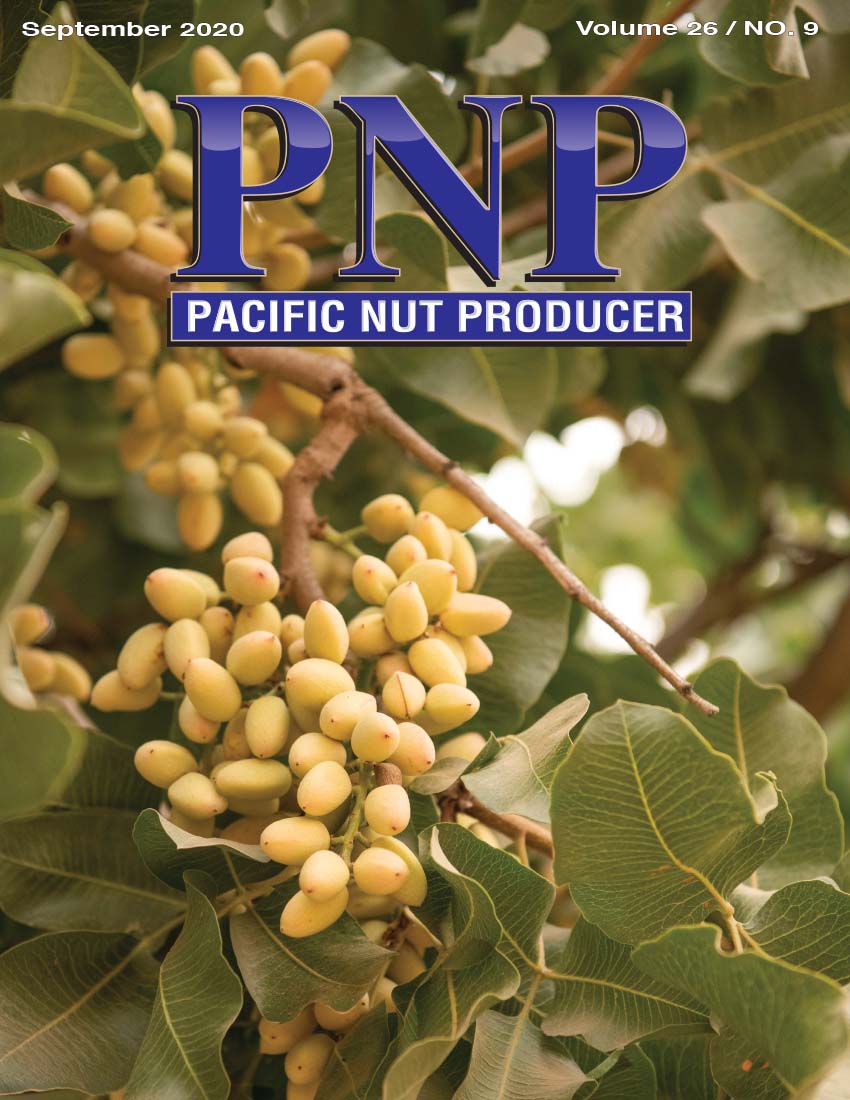
  • Pacific Nut Producer September Issue

    Pacific Nut Producer September Issue

    PNP920
    PNP920

    [btn btnlink=”https://malcolmmedia.com/order-a-back-issue/back-issue-pacific-nut-producer-magazine/” btnsize=”full” txtcolor=”#ffffff” color=”#FFF” bgcolor=”#492500″ btnnewt=”1″ nofollow=”1″]Order A Back Issue[/btn]

    [btn btnlink=”http://malcolmmedia.com/pacific-nut-producer-magazine-subscriptions/” btnsize=”full” txtcolor=”#ffffff” bgcolor=”#492500″ btnnewt=”1″ nofollow=”1″]Subscribe Free[/btn]
    [three_fifth_last]

    Contents of the September Issue:

    2020 Pistachios May Fall Short of 1 Billion Pounds
    Shipments Still Strong Compared to Last Year

    Protecting Young Trees from Herbicide Damage
    New Finding: White Latex Painting Doesn’t Help

    Retiring UCCE Tree Nut Farm Advisors
    Kurt Hembree, Allan Fulton, Rachel Elkins

    September Orchard Tasks
    Almonds, Hazelnuts, Pecans, Pistachios, Walnuts

    [/three_fifth_last]

  • Identifying Insect Pest Damage Through Harvest Sampling

    Identifying Insect Pest Damage Through Harvest Sampling

    With almond and walnut harvest underway, it is a good time to review harvest nut sampling strategy and protocols for the best estimation of field loss by common pests. It is a general understanding that the grade sheet from your processers only represents about half of what is  going on in the field. Also, the whole sum percent damage from the grade sheet does not identify which pest is causing the most economic loss. Insect population in orchards builds over time; therefore, knowing the history of damage helps to address potential risks and strategies to next  year’s pest management program.

    1. Harvest Sampling in Almonds

    Taking a minimum of 500-1000 sample nuts from an average-sized orchard, anytime between shaking and sweeping, is recommended. Infestation can vary among different sides of the tree, and between edges and interiors of the orchard. This is especially true for navel orangeworm damage. Use paper bags to collect samples from multiple spots (>10 sampling spots, if possible) within the orchard. Store the sample bags in a cold room or freezer until you  have time to do crack out. Look for damage signs associated with insect species described in the following paragraphs. Major insect pests for the damage evaluation are navel orangeworm (NOW), peach twig borer (PTB), oriental fruit moth (OFM), ants, leaffooted bugs (LFB), and brown marmorated stink bug (BMSB). BMSB is an invasive stink bug species, which is established and causing damage in almond orchards in the northern San Joaquin Valley.

    1.1. Worm Damage (NOW, PTB, OFM). NOW feed in the kernel (nutmeat) and create deep feeding tunnels. Feeding by NOW results in a significant amount of white frass, and webbings on the kernel (Fig. 1a). Since NOW and PTB often infest the same nut, NOW feeding damage often masks the PTB damage. Feeding damage signs by PTB and OFM on the nutmeat are similar (i.e., the presence of the shallow tunnels and surface grooves on the kernels, and no webbings) (Fig 1b & 1c), except OFM leaves a small amount of reddish frass on the hull, which is absent in PTB damaged nuts.

    Fig. 1. Almond kernels (nutmeat) damaged by: a) navel orangeworm, b) peach twig borer, c) Oriental fruit moth

    1.2. Ant Damage. The percentage of almond  damage by ants at harvest depends on the duration the nuts are on the ground after shaking. The longer almonds are left on the ground gives more time for ants to feed on them, results in more damage. Also, more damage is likely in orchards with drip or sprinkler irrigation compared to orchards with flood irrigation. Cover or vegetation in the orchards also favors ant activity. Nuts with tight shells or with narrower (<0.03-inch wide) hull split have less ant damage. Ants can completely hollow out the nutmeats and leave only thin skin (i.e., pellicle). Other signs of ant feeding damage include scraped or peeled pellicle and presence of “sawdust”, with the absence of webbings and frass (Fig 2a).

    1.3. Leaffooted Bug and Brown Marmorated  Stink Bug Damage. Most nuts infested by the leaffooted bug or BMSB, early in the season (mid- March to mid-May), abort and drop. A small percentage of those infested nuts do not drop but end up becoming shriveled and gummy kernels at harvest (Fig  2b).  Both  LFB  and  BMSB  feeding  after  the shell hardening can result in sunken dark spots on kernels (Fig. 2c), although the degree of damage tends to be higher with BMSB feeding than LFB. Late-season feeding (July-August) by BMSB, can cause dark stained kernels (Fig 2d). Varieties with soft shells such as Fritz, Sonora, Aldrich, Livingston, Monterey, and Peerless are more susceptible to bug damage and for a longer period during the season.

    Fig. 2. Almond kernels damaged by: a) ants, b-d) leaffooted bug and brown marmorated stink bug

    2. Harvest Sampling in Walnuts

    It is recommended to take a minimum of 1000 nuts at the harvest and evaluate for the damage caused by navel orangeworm , codling moth, ants, husk fly, and sunburn. It is important to have representative samples (>10 samples with a minimum of 100 nuts/sample) from the orchard for better estimation of the infestation. The damage signs associated with these specific insect pests and sunburn are described as follows:

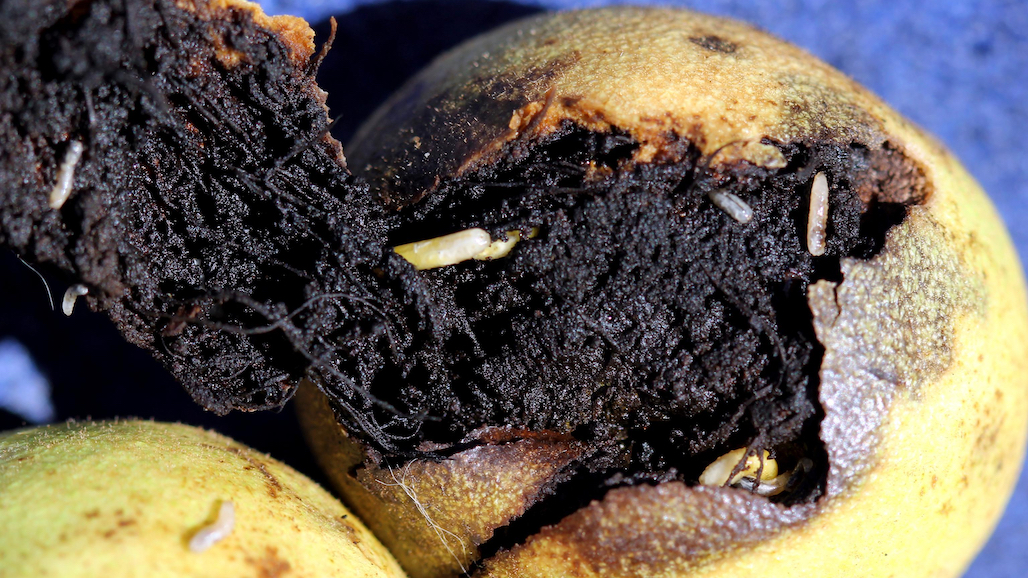
    2.1. Worm Damage (NOW, CM). Navel Orangeworm damage can be identified by the presence of a large amount of frass and webbings (Fig 3a). NOW larvae are present in groups and can bore deeply into the kernel. Heavy infestation may give a nutshell an oily appearance. In contrast to NOW, a single codling moth larva infest the nut, and has a lot cleaner damaged area inside the nut. Frass is evident, but only at the entry  point  on  the  husk;  very  little  webbing present (Fig. 3b). If larva is present, look for crescent-shaped marking just behind the head to confirm navel orangeworm.

    Fig. 3. Walnut damaged by: a) navel orangeworm, b) codling moth

    2.2. Ant Damage. Similar to almonds, nut damage by ants increase as the duration of the harvested nuts on the ground increase. Ants enter the nuts from the soft tissues (i.e., stem end) and/ or through a codling moth injury. Ant damage on nuts is identified by the presence of deep chewing channels with clean kernels (i.e., no frass, no webbings, no deep boring) (Fig 4a).

    Fig. 4. Walnut damaged by: a) ants; b) walnut husk fly; c) sunburn
    Fig. 5. (Left) Brown Apical Necrosis is shown on the left, not to be confused with Walnut Blight, shown on the right, and caused by the bacterial pathogen, Xanthomonas arboricola pv. juglandis (Figure provided by Themis Michailides).

    2.3. Husk Fly Damage. Walnut husk fly larvae (technical term: maggots) feed in groups by boring into the husk. Early season damage results in shriveling and darkening of the kernels, with  the increased potential for mold growth. Late- season infestation causes little kernel damage  (Fig. 4b), although it may stain the shell and make the husk removal process difficult.

    Fig. 6. (Right) Moldy, off color nuts which lead to economic loss due to downgrading (Figure provided by Themis Michailides).
    2.4. Sunburn Damage. Sunburn damage on nuts can be confused with husk fly damage. In the case of sunburn, nutmeat is shriveled and darkened on one side of the nut — no evidence of frass, webbings, or larval presence (Fig. 4c). Husks  from sunburn damaged nuts can be removed from the shell during processing, which is not the case for the nuts damaged by husk fly.
    — Article by Jhalendra Rijal, PhD, UCCE IPM Advisor, Stanislaus, Merced & San Joaquin Counties