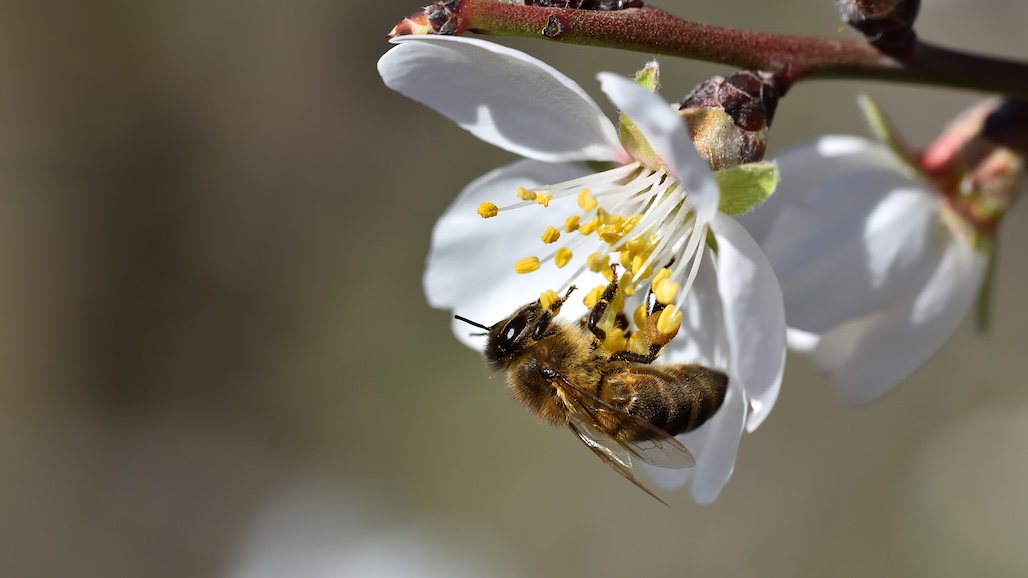
As almond growers prepare for pollinating their orchards — one of the most important tasks for establishing the new crop — here are insights from the Almond Conference to consider. A “Honey Bees & Pollination” panel was moderated by Josette Lewis of the Almond Board of California (ABC).
Hives Per Acre for Self-Fertile Cultivars: Elina Niño
Following a string of bee losses over the past twenty years, 2025 was especially severe, with a 62% loss. According to Elina Niño, apiculture scientist at UC Davis, the losses are becoming unsustainable.
Niño pointed out that, in spite of having only 0.6 million of the 2.5-2.7 million colonies in the US, California ranks third in honey production, after North and South Dakota.
Niño conducted a study of the pollination needs of self-fertile cultivars. She excluded bees from some trees and for others used one or two hives per acre. She counted the number of bees per flower per hour and after harvest she measured the kernel mass of 100 nuts per tree.
The results showed that the number of visits per flower was similar for one hive as for two hives per acre. Although the trees set more nuts and yielded more weight when one or two hives were present, kernel mass was higher where bees were excluded, presumably due to spreading the trees’ resources over fewer nuts.
State of the US Commercial Beekeeping Industry: Matt Beekman
The biological state of the beekeeping industry is precarious, according to Matt Beekman, a beekeeper based in Hughson, California who spends summers in North Dakota. He presented a biological and financial State of the Beekeeping Industry report.
Parasites & Pathogens: Varroa Mites & Viruses
The varroa mite parasite continues to afflict beehives. Reproducing quickly, the mites vector viruses that then spread from bee to bee in the densely populated hive. The viruses can also spread in semen. Area-wide applications of miticide help manage the mites.
Only one chemical had been approved to suppress varroa mites since 2005. That chemical, Amitraz, was registered for beehive use in 2013 in California, the last state to do so. Some softer chemistries are available, but they are temperature dependent.
California approved two new products in 2025, one oxalic acid-based and the other RNA-based. They are expensive, though, costing $74 per colony per year.
Nutrition: Where Have All the Flowers Gone?
Each hive needs about 50 pounds of pollen and 100 pounds of nectar year. With fewer acres enrolled in the federal Conservation Reserve Program, pollen and nectar may be scarce.
Alternatively, almond growers can plant cover crops in the orchards to meet the need. Seeds for Bees supplies free, appropriate cover crop seeds the first year and a discounted price the second year. Many growers continue buying the seeds annually after seeing how effective they are.
Pesticides: No to Organosilicon Adjuvant
Used to amplify the effectiveness of pesticides, organosilicon surfactants harm bees. Growers should ask their PCA to use one of the available alternatives instead.
Beekman said that fungicides need to be sprayed during bloom, but advised using no tank mixes, adjuvants or insecticides during bloom, and applying fungicides in the early evening when bees are not flying.
Financial Snapshot
The net profit for beekeepers in 2024 was $11 per hive. Overtime wages adversely impacted beekeepers, who need workers to do nighttime maintenance and overnight travel. US honey production is declining due to fewer locations where bees can be placed to collect nectar. The bees need more access to public land.
Meanwhile, honey imports are increasing. Imported honey is sometimes cut with synthetic sugar syrups. Since honey is one of the few commodities for which the US does not have a standard definition, ambiguity and adulteration occur.
India is now the largest exporter of honey into the US, with prices of $0.99-1.08/lb. The US price is $2.69/lb., and the yield is declining.
Endangered Pollinator Species: Alexi Rodriguez
Some insect species have been proposed for endangered species status for the first time, according to Alexi Rodriguez of the Almond Alliance. One such insect is the monarch butterfly, which has little overlap with agriculture except for coastal sites in winter.
A 2018 petition proposed adding four bumblebee species.
Rodriguez said that if growers take reasonable, research-based steps to support pollinators, they will be immune to prosecution if incidental harm occurs. The steps include using IPM (Integrated Pest Management) and planting pollinator habitat.
Questions from the Audience
Q: Is it worth getting mason bees to complement honeybees?
A: Yes — blue orchard bees (a type of mason bee) — but you have to contract it separately. They fly in colder temperatures and in rain.
Q: Was there a bee shortage in 2025?
A: That was not studied, but growers were saying that they did not get the number of frames they contracted for. It’s possible that insufficient bees caused the lower yield last year, because everything else was good in 2025.
Q: What about indoor cold storage of bees in empty warehouses to break the varroa mite cycle?
A: It did not go well when tried in Kern County.
Q: Does supplementing the almond orchard with pollen help with pollination?
A: There is no research on that, but it is unlikely to help based on flower anatomy and the need for insects to get into the blooms to move pollen.
Q: Does it help to move hives around during pollination?
A: Yes, but it is a tradeoff economically due to the cost of labor to move the hives. The most important variable is having morning sun on the hive to warm the bees enough to fly. The bees will fly over the entire acre once they are warm.
Q: What is a fair contract between grower and beekeeper?
A: Eight frames average per hive; four to five frames minimum, 60% coverage.
Q: Do herbicides impact bees?
A: There is no research on that, but herbicides are not needed during bloom anyway.
For more information about preparing for pollination, see Honeybee ABC. – By Nancy Power, PhD, Assistant Editor, Pacific Nut Producer