Category: Economics

  • Almond Board Mummy Shake Video Contest

    Almond Board Mummy Shake Video Contest

    Halloween will come and go, but mummy nuts are here to stay… unless you shake them away!

    To help remind growers to break the link between mummy nuts and overwintering navel orangeworm (NOW), the Almond Board of California (ABC) created a parody song that’s sure to be an “orchard smash,” just in time for the most spooky holiday of the year. It’s The Mummy Shake — listen now (lyrics here) and submit a video of your family dancing along to this “orchard smash” for a chance to win a $500 Amazon gift card!

    How to Enter: Video Specifications  

    • Create a video with family dancing – and, if desired, singing – to The Mummy Shake. You can film this video anywhere, though an orchard backdrop is encouraged.
      • Entry videos must be at least 30 seconds in length (approximately a verse and a chorus) and up to the duration of the full song.
      • Entries will be judged based on enthusiasm, creativity and composition.


    How to Upload Your Video

    • You have TWO OPTIONS when submitting your video:
      • Get Up and Dance: Don’t worry about singing; just get out in the orchard and show us your moves and/or lip-sync the lyrics. We’ll add the audio to your video!
      • Sing-Along Style: Get out in the orchard, play the Mummy Shake video and sing along with the lyrics!
    • Submit your entry in one of two ways:
      • Upload the video in .MP4 or .MOV format to this ABC webform.
        • MAKE SURE TO INCLUDE THE CONTESTANT’S NAME AND EMAIL ADDRESS IN THE FILE NAME
      • Post the video on the Almond Board of California Facebook page 
        • DON’T FORGET to include the hashtag #MummyShake in your post to ensure your video is considered for the $500 Amazon gift card!

    Read on below for complete contest eligibility guidelines.

    Mummy Shake Video Contest – OFFICIAL RULES

    NO PURCHASE NECESSARY TO ENTER OR WIN. MAKING A PURCHASE OR CONTRIBUTION WILL NOT IMPROVE CHANCE OF WINNING. VOID WHERE PROHIBITED.

    1. Preliminary Information and Contest Period: The Mummy Shake Video Contest (Campaign) is open for entries starting October 26, 2020 at 12:01AM Daylight Pacific Time (PT). All entries must be submitted by the contest deadline: 11:59PM PT on November 20, 2020 (Contest deadline). Campaign is subject to all applicable federal, state and local laws. This Campaign is sponsored by the Almond Board of California (Sponsor), 1150 9th St. #1500, Modesto, CA 95354.

    2. Agreement to Rules: By participating, the Contestant agrees to be fully and unconditionally bound by these Rules and decision of Sponsor, which shall be final and binding. Contestant represents and warrants that they meet the eligibility requirements. In addition, Contestant agrees to accept the decisions of Sponsor as final and binding as it relates to the content of this Campaign.

    3. Eligibility: Contestant may enter to win if he or she is a legal resident of the state of California, age 18 or older at the time of entry, and is a member of the California almond industry, which includes growers, handlers, hullers/shellers and allied industry members. Contestant’s submission may include family member and/or friend of a Contestant provided that such family member or friend consents to being featured in the submission. If Contestant chooses to feature his or her children under the age of 18 in his/her submission, Contestant grants Sponsor permission to display, broadcast and/or share video for promotional purposes of this Campaign or future Campaigns. Employees, officers, directors, agents, representatives and their immediate families (parents, children, siblings, spouse and each of their respective spouses, regardless of where they live) or members of the households of the Almond Board of California/Sponsor, their parent companies, subsidiaries, agencies and anyone connected with the production and distribution of this Campaign may submit an entry for use by Sponsor solely to promote the Campaign, but are not eligible to win or be awarded a prize.

    4. How to Enter: To enter, Contestants must create a video featuring themselves and/or family or friends dancing to the Almond Board of California’s “Mummy Shake” song, in an almond orchard or another setting of their choosing. Entry videos must be at least 30 seconds in length (approximately one verse and one chorus) and up to the duration of the full song. Entries will be judged based on enthusiasm, creativity, and composition. Judges will be comprised of employees of the Almond Board of California. Submit your video entry in one of two ways:

    • Upload the video in .MP4 or .MOV format to this ABC webform
      • MAKE SURE TO INCLUDE THE CONTESTANT’S NAME AND EMAIL ADDRESS IN THE FILE NAME.
    • Post video on Sponsor’s Almond Board of California Facebook page: http://facebook.com/AlmondBoardofCalifornia/
      • DON’T FORGET to include the hashtag #MummyShake in your post to ensure your video is considered for the $500 Amazon gift card!
    • Email industry@almondboard.com with questions

    Multiple entries per person or household will be accepted and judged, but only one (1) prize will be awarded per person or household. Entries that are incomplete or that contain errors, copyrighted images or inappropriate/derogatory/defamatory images or language, dogs in the orchard, guns/firearms, nudity, violence or profanity will be automatically disqualified in Sponsor’s sole discretion. Sponsor is not responsible for lost, late, misdirected, altered or destroyed entries. The odds of winning depend on the number of eligible entries received and/or the number of contestants participating in the contest. If Contestant uses fraudulent methods or otherwise attempts to circumvent the rules, the submission may be removed from eligibility at the sole discretion of Sponsor. The Contestant may be asked to provide all appropriate clearances, permissions and releases for the submission.

    All entries become the property of Sponsor and will not be returned. Proof of sending will not be deemed proof of receipt by Sponsor. Sponsor reserves the right to edit or summarize the submission or any written description or picture prior to posting to Sponsor’s website and/or social media channels.

    5. Prize: The Winner of the Campaign (“Winner”) will receive a Grand Prize consisting of a $500 Amazon gift card.

    The prize will be sent to Winner’s provided email address within two (2) weeks of notification. Any applicable Federal, State or Local taxes are solely the responsibility of the winner and paying any expenses associated with any prize which are not expressly included as part of the prize. Prizes are not transferable. Sponsor reserves the right to substitute a prize package with another prize of equal or greater value if advertised prize or any component thereof is not available.

    6. Winner Selection and Notification: Winner will be selected under the supervision of the Sponsor. Winner will be notified by email or by direct message on Facebook within five Sponsor business (5) days following selection of Winner. Sponsor shall have no liability for Winner’s failure to receive notices due to spam, junk email, or other security settings or for Winner’s provision of incorrect or otherwise non-functioning contact information. If Winner cannot be contacted, is ineligible, fails to claim the prize within seven (7) Sponsor business days from the time award notification was sent, or fails to timely return a completed and executed declaration and release as required, the prize may be forfeited, and an alternate Winner selected. Receipt by Winner of the prize offered in this Campaign is conditioned upon compliance with any and all federal, state, and local laws and regulations. Any violation of these official rules by winner (at Sponsor’s sole discretion) will result in Winner’s disqualification as Winner of the Campaign, and all privileges as Winner will be immediately terminated.

    7. Rights Granted by Contestant: By entering this Campaign, Contestant understands and agrees that Sponsor, anyone acting on behalf of Sponsor, and Sponsor’s licensees, successors, and assigns, shall have the right, where permitted by law, to print, publish, broadcast, distribute, and use in any media now known or hereafter developed, in perpetuity and throughout the World, without limitation, Contestant’s entry, name, portrait, picture, voice, likeness, image, statements about the Campaign, and biographical information for news, publicity, information, trade, advertising, public relations, and promotional purposes, without any further compensation, notice, review, or consent. By entering this Campaign, Contestant represents and warrants that entry is an original work of authorship and does not violate any third party’s proprietary or intellectual property rights or right of publicity. If entry infringes upon the right of any third party including, without limitation, any intellectual property right or right of publicity, Contestant will be disqualified at the sole discretion of Sponsor. If the content of the entry is claimed to constitute infringement of any proprietary or intellectual proprietary rights or right of publicity of any third party, Contestant shall, at his or her sole expense, defend or settle against such claims. Contestant shall indemnify, defend, and hold harmless Sponsor from and against any suit, proceeding, claims, liability, loss, damage, costs or expense (including attorneys’ fees), which Sponsor may incur, suffer, or be required to pay arising out of such infringement or suspected infringement of any third party’s right.

    8. Terms & Conditions: Sponsor reserves the right, in its sole discretion, to cancel, terminate, modify or suspend the Campaign should virus, bug, non-authorized human intervention, fraud, or other cause beyond Sponsor’s control corrupt or affect the administration, security, fairness, or proper conduct of the Campaign. In such case, Sponsor may select the Winner from all eligible entries received prior to and/or after (if appropriate) the action taken by Sponsor. Sponsor reserves the right, in its sole discretion, to disqualify any individual who tampers or attempts to tamper with the entry process or the operation of the Campaign or website or violates these Terms & Conditions. Sponsor has the right, in its sole discretion, to maintain the integrity of the Campaign, to void entries for any reason. Any attempt by a Contestant to deliberately damage any website or undermine the legitimate operation of the Campaign may be a violation of criminal and civil laws. Should such attempt be made, Sponsor reserves the right to seek damages to the fullest extent permitted by law.

    9. Limitation of Liability: By entering, Contestant agrees to release and hold harmless Sponsor and its subsidiaries, affiliates, advertising and promotion agencies, partners, representatives, agents, successors, assigns, employees, officers, and directors from any liability, illness, injury, death, loss, litigation, claim, or damage that may occur, directly or indirectly, whether caused by negligence or not, from: (i) such Contestant’s participation in the Campaign and/or his/her acceptance, possession, use, or misuse of any prize or any portion thereof; (ii) technical failures of any kind, including but not limited to the malfunction of any computer, cable, network, hardware, or software, or other mechanical equipment; (iii) the unavailability or inaccessibility of any transmissions, telephone, or Internet service; (iv) unauthorized human intervention in any part of the entry process or the Promotion; (v) electronic or human error in the administration of the Promotion or the processing of entries.

    10. Disputes: This Campaign is governed by the laws of the United States of America and California, without respect to conflict of law doctrines. As a condition of participating in this Campaign, participant agrees that any and all disputes that cannot be resolved between the parties and causes of action arising out of or connected with this Campaign, shall be resolved individually, without resort to any form of class action, exclusively before a court located in California having jurisdiction. Further, in any such dispute, under no circumstances shall participant be permitted to obtain awards for, and hereby waives all rights to, punitive, incidental, or consequential damages, including reasonable attorney’s fees, other than participant’s actual out-of-pocket expenses (i.e. costs associated with entering this Campaign). Participant further waives all rights to have damages multiplied or increased.

    11. Privacy Policy: Information submitted with an entry is subject to the Privacy Policy stated on the Sponsor’s website. To read the Privacy Policy, click here.
  • Main Fungal Canker Diseases Affecting California Almonds

    Main Fungal Canker Diseases Affecting California Almonds

    In California, fungal canker diseases have long been known to affect almond trees. However, they have become an increasing concern to growers in recent years as they are affecting a greater extent of young trees, eventually resulting in significant tree losses. Canker diseases can also become prevalent in mature orchards, impacting yield, the lifespan of trees, production costs and overall profitability of almond orchards. Ultimately, trunk and scaffold canker diseases constitute a major cause of tree death and branch dieback in California almond orchards.

    As the University of California (UC) Assistant Cooperative Extension Specialist in Plant Pathology for fruit and nut crops when I receive calls from farm advisors, almond growers and Pest Control Advisers (PCAs) the questions they most frequently have are in relation to canker diseases, asking how can it be diagnosed, and how can it be treated.

    Symptoms on affected trees are very conspicuous and often alarming to growers. Moreover, field diagnosis of canker diseases is difficult as symptom delineation among the various canker diseases is not clear. Hence, laboratory tests are usually required to obtain accurate disease diagnosis, which is essential to the implementation of appropriate management strategies.

    With support from the Almond Board of California (ABC) and with the help of farm advisors, my laboratory conducted statewide surveys to characterize canker diseases in almond orchards and to get a thorough understanding of the main diseases and pathogens present. This work has provided molecular tools and a database for the accurate identification of fungi commonly isolated from almond cankers.

    This article will provide an overview of the main canker diseases that impact almond trees and how they can be recognized. But first, let’s review some general concepts about canker diseases.


    What is a canker?

    A canker in woody plants generally refers to a lesion produced in the bark of a plant’s stem, twig, or branch, often resulting in a dead area that can block water and nutrient transport to portions of the tree, thus causing parts of the plant to die back. Most cankers are caused by fungi, which invade bark tissue and the current season’s wood. However, some fungi colonize in both bark and internal wood tissue, causing canker rot or wood cankers that persist for years.

    Wood cankers typically consist of brown-to-dark brown discoloration of xylem tissues and may vary in shape from wedge-shaped to round, or irregular. 


    What are the main infection pathways and disease cycles of canker diseases?

    In orchard systems, cankers usually originate around wounds such as pruning wounds, mechanical injuries, sunscald and sunburn lesions, as well as wounds caused by insect borers. In almonds, canker pathogens infect trees mainly through pruning wounds made for primary and secondary scaffold selection to provide the general structure of trees. Cracks in the tree crotch or on the trunk as well as shaker injuries provide other entry points for canker-causing pathogens in almonds. Canker diseases may go unnoticed during the early stages of infection, though symptoms become more visible as the trees age.

    Most fungal canker pathogens produce fruiting bodies on dead wood of infected host plants. The spores produced by these fruiting bodies serve as inoculum for new infections, mostly during wet weather. The vegetation present in the vicinity of orchards, particularly trees in riparian areas or neighboring orchards of susceptible crops, may serve as inoculum sources for fungal canker pathogens affecting almonds. Once a canker disease has been established in an orchard, infected almond trees can provide additional inoculum for further infection. 


    Does stress play a role in the exacerbation of canker disease?

    Recent outbreaks of canker diseases in perennial crops have been attributed in part to drastic changes in production practices, climate change and increased plant stress, the continuing adaptation of pathogens to new environments, and, most importantly, the global movement of plant material. Ultimately, though, trees suffering environmental stresses are more susceptible to canker diseases.

    Microorganisms that usually do not cause disease in non-stressed hosts may become opportunistic pathogens of stressed plants. Increases in canker diseases are common during extended periods of drought or following sudden temperature fluctuations. Drought stress can also impair the plant’s ability to defend against fungal invasion. Conversely, excessive watering can kill roots and predispose plants to canker pathogens.


    What are the main canker diseases in California almonds, and what are their symptoms?

    Ceratocystis canker

    Ceratocystis canker, caused by the fungal pathogen Ceratocystis destructans (formerly known as Ceratocystis fimbriata), is one of the most prevalent canker diseases in California almonds – it occurs statewide in all almond producing counties. While this disease is generally associated with shaker damage and bark injuries on trunks during harvest, C. destructans is also capable of infecting branches from fresh pruning wounds and if left untreated can kill branches, scaffolds and entire trees. Ceratocystis is spread by several species of sap-feeding beetles and fruit flies.

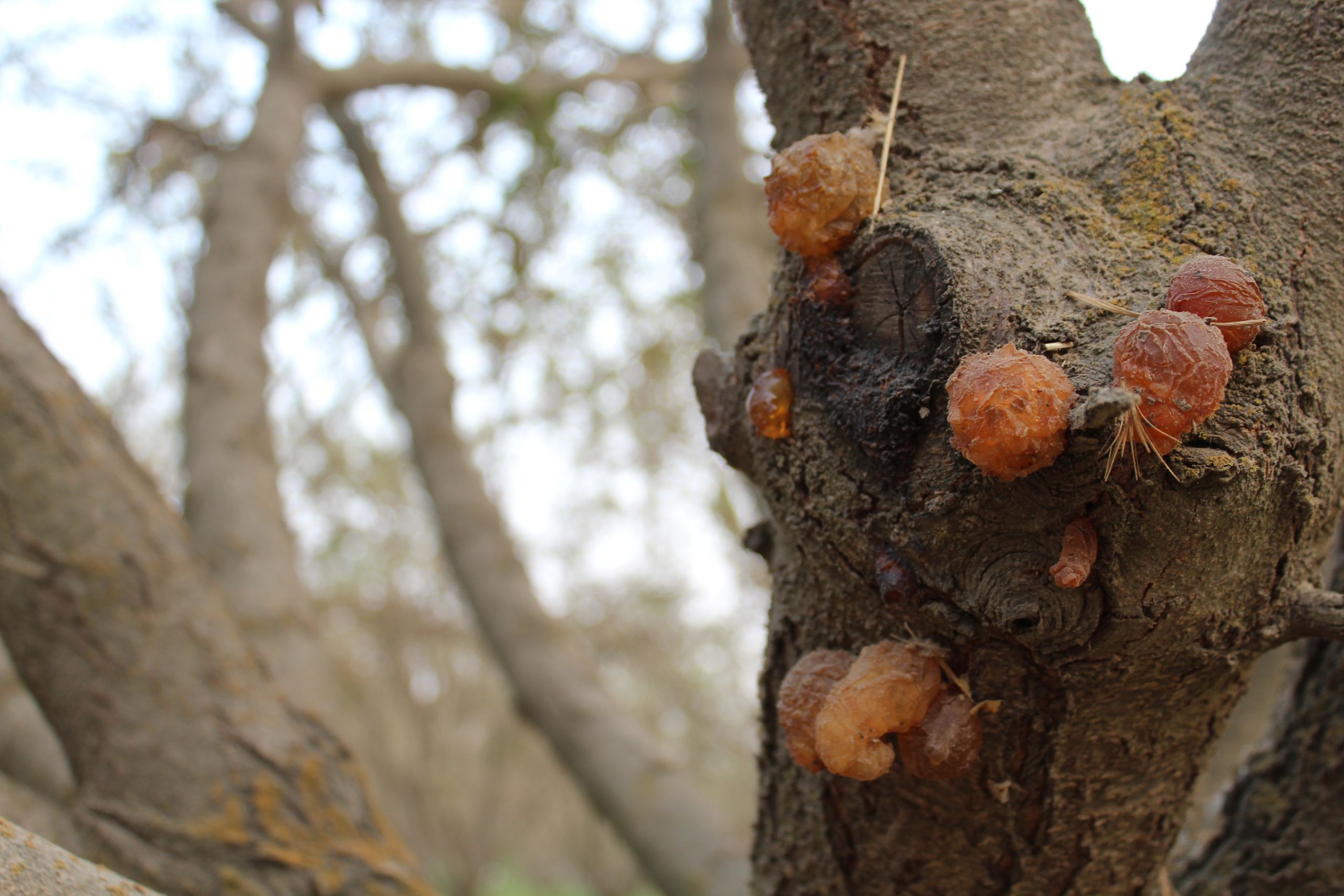
    Ceratocystis canker starts as water-soaked injuries that are darker than the surrounding healthy tissue. Symptoms of established infections include amber-colored gumballs that are produced around the margin of the canker, where the fungus is most active. The cankers are perennial, persist over several years, and are most active during the growing season. Young trees infected with Ceratocystis canker may die rapidly while infections in older trees usually progress slowly. 


    Band canker and other Botryosphaeriaceae cankers

    Although band canker was first reported years ago as a disease in almonds, it’s appearance had been very sporadic up until the last decade, when this disease was suddenly being reported in large numbers of commercial orchards and causing severe damage.

    Band canker

    Band canker produces unique symptoms that include oozing amber sap that forms in a ring around the circumference of the tree. Young, vigorous varieties that grow quickly from aggressive nitrogen and water inputs are especially prone to band canker. Solid sprinkler irrigation or micro-sprinklers that wet the tree trunk can create conditions favorable for infection.

    Band canker is often an annual disease that occurs when trees are in their second-to-fifth leaf and usually does not necessarily reappear the following year. However, an increasing number of cases have been reported lately where cankers are being re-activated in following year. Tree death due to band canker has become more common as multiple bands can develop as the canker continues to grow from one growing season to the next.

    Botryosphaeriaceae cankers are characterized also by gumming around pruning wounds made near the trunk or in main scaffold branches. Band canker and Botryosphaeriaceae cankers are particularly common in young almond orchards in the northern San Joaquin Valley and well as in the Sacramento Valley.

    Infections by Botryosphaeriaceae fungi are usually associated with growth cracks or pruning wounds on the trunk and main scaffold branches. Studies have revealed there are at least 12 different Botryosphaeriaceae species in almonds, each with various levels of virulence. Among them, Neofusicoccum species, including N. parvum and N. mediterraneum, are the most common in California. Neoscytalidium dimidiatum also occurs frequently in cankers developing around pruning wounds on the trunk. This pathogen also can cause shoot blight and fruit rot in almonds.


    Eutypa dieback

    Eutypa dieback in almonds occurs sporadically in the Sacramento Valley and in the northern San Joachim Valley. Eutypa dieback is caused by the fungus Eutypa lata and is a common disease in apricots, sweet cherries and grapevines. Eutypa dieback in almonds is usually found in young trees.

    Cankers mostly originate from pruning wounds on limbs or trunks as well as from cracks formed at the junction of scaffold branches and the trunk, extending downward toward the graft union or upwards into one or more scaffold branches. Amber-colored gum turning dark brown to reddish brown normally exudes around the cracks. Irregular-shaped to wedge-shaped, brown-colored cankers are observed from cross sections of limbs and trunks.

    Limb dieback may occur several months or years after infection. The fungal fruiting bodies, i.e. the perithecia of E. lata. are rare in almond orchards, suggesting sources of inoculum for this disease most likely originate from surrounding susceptible hosts including apricot and grapevine as well as natural host plants in riparian areas such as willows. 


    Cytospora cankers

    Cytospora species have been isolated sporadically in almond orchards in California, Cytospora canker is generally associated with pruning wounds in the branches of third-leaf trees or older. At least five species of Cytospora have been associated with cankers in California almonds. Symptoms of Cytospora canker include longitudinal cankers in branches and scaffolds often associated with pruning wounds, vascular discoloration of the wood and moderate gumming.

    Florent Trouillas, UC Davis Plant Pathologist

    Cytospora species have been traditionally thought to be secondary to sunburn and other stresses or injury in stone fruits. However, their prevalence in cankers together with pathogenicity studies suggest that this group of fungi constitutes virulent pathogens. Overall, Cytospora pathogens are of increasing concern in recent years in many fruit and nut crops in California.— By Florent P. Trouillas (Through the Almond Board of California), Assistant Cooperative Extension Specialist in the Department of Plant Pathology at the University of California, Davis

    Stay tuned for a follow-up article from Trouillas on how growers can manage different types of canker diseases in their orchards. Growers are also encouraged to check out the Univeristy of California IPM website for more information on various types of canker diseases.

  • Japan Grants Market Access for All Varieties of US In-Shell Walnuts

    Japan Grants Market Access for All Varieties of US In-Shell Walnuts

    As of September 16, 2020, Japan allows imports of all varieties of U.S. in-shell walnuts to Japan. Back in 1986, the Ministry of Agriculture, Forestry and Fisheries (MAFF) granted market access to Hartley, Payne and Franquette varieties of U.S. in-shell walnuts. Since then, the United States had requested that Japan expand market access to all U.S. walnut varieties.

    On September 16, 2020, Japan revised the Ordinance for the Enforcement of the Plant Protection Act with immediate effect. This revision allows exports of all varieties of U.S. in-shell walnuts to Japan.

    Due to Japan’s phytosanitary concern about codling moth in the United States, U.S. in-shell walnut exports to Japan must be fumigated. Furthermore, a phytosanitary certificate issued by APHIS is required to import fresh and frozen in-shell walnuts to Japan. For detailed import requirements for in- shell walnut, please consult MAFF’s Standards and Regulations; for U.S. walnuts (available in Japanese only). — By Tomohiro Kurai, USDA Foreign Agricultural Service

  • American Farmland Trust Shares Tool Kit to Quantify Soil Health Benefits

    American Farmland Trust Shares Tool Kit to Quantify Soil Health Benefits

    Today, American Farmland Trust, the organization that for 40 years has been saving the land that sustains us and advancing the principles of regenerative agriculture has launched online access to the methods, tools, and training resources it used in developing case studies featuring soil health successful farmers in its Quantifying the Economic and Environmental Benefits of Soil Health project funded by a USDA Natural Resource Conservation Service Conservation Innovation Grant.

    Becoming all the more evident this year, farmers face enormous challenges. Extreme weather, a trade war and pandemic-related market disruptions have made it difficult for many to make a living. In a normal season, farmers work just to maintain yield, keep costs under control and try to improve the profitability of their operations. And, now we are asking farmers to respond to society’s call to improve environmental outcomes like water quality and help to mitigate climate change.  Soil health practices like cover crops, no-till and nutrient management can help address these challenges.  However, despite farmers’ belief in the science underpinning the practices, they are often reluctant to change management techniques without knowing how much the practices will cost and what the financial benefits will be.

    “AFT encourages our fellow conservationists to use this suite of tools and training resources to produce their own case studies demonstrating the economic and environmental benefits of soil health,” said Michelle Perez, AFT water director. “Our hope is that farmers, who have been considering adopting soil health practices, will find the economic evidence quantified for a farmer in their area, sufficiently compelling, to get them to “say yes” to trying the soil health practices.

    Specifically, partners will be able to use  AFT’s Retrospective Soil Health Economic Calculator (R-SHEC) Tool, an 11-tab Excel-spreadsheet tool, to evaluate the costs and benefits of soil health conservation practices including no-till or reduced tillage, cover cropping, nutrient management and conservation crop rotation on row crop farms that have adopted any combination of the practices, ideally for more than four years and within the last 10 years. The tool presents the net economic benefits in a partial budget analysis table and an estimate of the Return on Investment, or ROI, in the soil health practices. The R-SHEC Tool and the case studies that AFT published underwent a review by five NRCS Economists, five NRCS Soil Health Specialists, three university economists, among other experts.

    Materials explain how to use the R-SHEC and how to identify and interview a soil health successful farmer to obtain the data needed to run the tool.  Additional resources are provided to instruct conservationists how to estimate the water quality and climate benefits associated with the already adopted soil health practices using USDA’s Nutrient Tracking Tool and USDA’s COMET-Farm Tool, and then how to assemble all the findings and present them in a compelling two-page case study. A six-part series of training videos provides instructions on each aspect of the process. To access the methods, tools and videos, go to link.

    In spring and summer 2021, AFT will release several new tools:

    • An almond version of the R-SHEC tool that aids estimation of the economic effects of almond-specific soil health practices such as conservation cover, nutrient management, mulching, and compost application.
    • A Predictive Soil Health Economic Calculator (P-SHEC) Tool that will enable conservationists to partner with farmers who are “on the fence” about soil health practices to estimate the potential short-term and long-term economic effects of an investment in practices which will hopefully give the farmers the information they need to overcome their apprehension.
    • An online, user-friendly, web-based version of the R-SHEC Tool.American Farmland Trust is the only national organization that takes a holistic approach to agriculture, focusing on the land itself, the agricultural practices used on that land, and the farmers and ranchers who do the work. AFT launched the conservation agriculture movement and continues to raise public awareness through our No Farms, No Food message. Since our founding in 1980, AFT has helped permanently protect over 6.5 million acres of agricultural lands, advanced environmentally-sound farming practices on millions of additional acres and supported thousands of farm families.


  • CDFA Walnut Handlers Annual Report

    CDFA Walnut Handlers Annual Report

    California Department of Food & Agriculture — Walnuts produced by handlers in 2019 totaled 10,902 tons, down from the 11,992 tons reported in 2018. This figure does NOT include walnuts purchased from other handlers or producers.

    The total 2019 walnut crop purchased from producers, for whom pricing had been finalized, reached 624,890 tons at an average price of 95.0 cents per pound, up from the 67.3 cents per pound average in 2018. This price is rounded to the nearest tenth of a cent per pound and includes all bonuses and allowances.

    Purchases from producers, for whom pricing was NOT finalized, totaled 18,763 tons. The average “good faith” estimate of the final weighted average price for this tonnage was 83.8 cents per pound.

    The quantity of all walnuts purchased from producers was 643,653 tons for the 2019 crop. This figure does not include walnuts produced by the handler or purchased from other handlers. 

    The tonnage produced by the handler plus tonnage purchased from producers for the 2019 walnut crop was 654,555 in-shell tons.

    Information contained in this report was supplied by walnut handlers to fulfill reporting requirements of Sections 55601.7 and 55601.8 of the Food and Agricultural Code. The report includes all tonnages of walnuts that were either produced by the handler or purchased from producers. The final weighted average price, including bonuses and allowances, has been reported for all contracts which were finalized.

    All 2019 crop transactions completed through the close of business on August 31, 2020 are included in this report. A “good faith” estimate of final weighted average price was reported for those contracts which were not final on the same date. The data are shown by major varieties at the State level only.

    DEFINITIONS

    Producer: A person or operator who is responsible for the walnuts in the unprocessed state.

    Handler: Firm that processes and markets walnuts.

    Finalized Purchases: Tonnage purchased from producers, for which a pricing contract has been completed.

    Non-Finalized Purchases: Contracted tonnage, for which a final price has not yet been determined.

    Free Tonnage: Tonnage received by a handler, for which the only Federal marketing order regulation is a minimum quality or size standard. Reserve tonnage is the tonnage set aside as authorized by a Federal marketing order.

    Weighted Average Price: Weighted average price reflects prices or “good faith” estimates of prices as reported by handlers and include any bonuses or allowances. 

  • Five Steps for Ag Processors to Adapt their COVID-19 Incident Response Approach

    Five Steps for Ag Processors to Adapt their COVID-19 Incident Response Approach

    COVID-19 is a health crisis in the United States but major industries, like agriculture, chemical manufacturing, oil and gas exploration and production, all need to keep functioning as essential businesses in the midst of the crisis.  The response to COVID-19 has core parallels to major industrial accident response, which involves deploying the right resources for the task.  Every incident, be it a fire, explosion, or a government inspection and citation for regulatory compliance failures involves four key elements of response:  (1) the immediate response; (2) the extended response; (3) compliance and prevention; and (4) preparedness/lessons learned to improve.  This lifecycle of an incident applies equally to a COVID-19 contact among your employees or customers.  Make no mistake.  The stakes are high.  Recently, Cal/OSHA issued COVID-19 related citations to two companies of over $200,000 each, one to a frozen food manufacturer and the other to a temporary employment agency.  New legislation that becomes effective next year gives Cal/OSHA expanded authority to issue Orders Prohibiting Use for workplaces that pose risk of an “imminent hazard” relating to COVID-19.  In other words, they can shut your plant down if you don’t have the right procedures in place to respond to a COVID-19 incident.

    Processing plant managers are accustomed to incidents, such as injuries, agency inspections, or citations (hopefully not too frequently with respect to citations); applying the process in the context of COVID-19 can work extremely well, even where handling these situations requires adjustment for the particular crisis at hand.  In every crisis, the approach needs to be tailored, and COVID-19 incidents are no different.

    Examples of how a COVID-19 response needs to be tailored include determining work-relatedness to a positive test to COVID-19, identifying close contacts, identifying the agencies to whom notifications must be provided, and contact tracing for potentially exposed employees, testing, and implementing isolation protocols.  In the context of COVID-19, agriculture companies need to be keenly aware of increased Cal/OSHA oversight, as the agency has identified agricultural processing as a priority for enforcement because agricultural processing facility workers have been disproportionately impacted.

    When confronting a COVID-19 incident, follow these useful tips to help minimize liability and potential for citation by the government.

    1. Familiarize yourself with the Extensive Government Guidance Issued, Especially that Tailored to Your Industry

    There’s a saying in incident response:  your greatest exposure is not the incident itself but whether you follow the regulations for reporting and responding to the incident.  That’s true for a major chemical release from your operations and a COVID-19 incident, alike.  When the crisis emerged, several federal and state agencies provided guidance documents to companies on how to address potential cases of COVID-19.  Like the crisis, the guidance is evolving.  The government continues to update its approach and has even offered tailored to specific industries.  Following the agency guidance will put a facility in a much stronger compliance position when faced with a compliance inspection or determination of work-relatedness.

    Some key recent government guidance specific to the agricultural processing industry is listed below:

    • September 18, 2020, California Department of Public Health (CDPH) updated Guidelines intended for use by employers experiencing an outbreak of COVID-19 in their workplace.  It emphasizes that employers should be proactive and keep in mind that identification of even a single positive case among employees may quickly develop into an outbreak.
    • July 29, 2020, California COVID-19 Guidance for the agriculture and livestock industry to support a safe, clean environment for workers.  Recommendations include that an employer investigate any COVID-19 illness and determine if any work-related factors could have contributed to risk of infection;    identify close contacts (within six feet for fifteen minutes or more) of an infected worker and take steps to isolate COVID-19 positive worker(s) and close contacts; implement the necessary processes and protocols when a workplace has an outbreak, in accordance with the CDPH guidelines.
    • July 21, 2020, Cal/OSHA updated Guidance for the agriculture industry.  This provides:
    • COVID-19 Daily Checklist for Agricultural Employers
    • COVID-19 General Checklist for Agricultural Employers
    • Infection Prevention for Agricultural Employees and Employers
    1. Make Required Government Notifications

    Understand requirements for reporting employee cases to Cal/OSHA.  Any serious injury, illness, or death occurring in any place of employment or in connection with any employment must be reported by the employer to the local Cal/OSHA district office immediately.  For COVID-19, this includes inpatient hospitalizations and deaths among employees.

    On September 17, 2020, Governor Newsom also signed into law AB 685 which enhances reporting requirements to local health authorities in the event of a COVID-19 outbreak in the worksite.  The law takes effect on January 1, 2021.

    Employers should also check local guidance to determine if there are other investigation, reporting, or recording obligations triggered by a positive COVID-19 case.

    Finally, recognize that if an employee is out with COVID-19 or quarantined, other government obligations, like environmental reporting may fall by the wayside in their absence.  Develop a plan to ensure your ongoing government reporting obligations are being met, even those not COVID-19-related.  Having an employee out due to COVID-19 is likely not going to serve as an acceptable excuse for environmental noncompliance.

    1. Do the Investigation

    To comply with Cal/OSHA requirements, plant managers should ensure their companies are investigating positive COVID-19 determinations in a timely manner to identify any work-related factors and to identify close contacts.  This will protect employees, comply with Cal/OSHA requirements, and provide information that may be needed to in regards to the “disputable presumption” that exists in California for an employee who suffers illness or death resulting from COVID-19 on or after July 6, 2020 through January 1, 2023.

    COVID-19 related citations recently issued by Cal/OSHA included a failure to investigate about 20 COVID-19 illnesses and one death for a food manufacturer. Cal/OSHA’s news release highlighted that Cal/OSHA created guidance for many industries in multiple languages including videos, daily checklists and detailed guidelines on how to protect workers from the virus. This guidance is meant to provide a roadmap for employers on their existing obligations to protect workers from COVID-19.  If you don’t conduct required investigations, you will be placing your company at risk of being shut down through Cal/OSHA’s expanded authority to issue Orders Prohibiting Use for workplaces that pose a risks of an “imminent hazard” relating to COVID-19.

    1. Meet Requirements for Identifying and Notifying Potentially Affected Employees

    As part of the investigation, additional employee cases and close contacts (within six feet for fifteen minutes or more) should be identified in accordance with the regulations and guidance.  The facility will then need to conduct testing or alternative methods (e.g., contact tracing or quarantining) in consultation with the local health department to control the outbreak.

    All potentially exposed employees must be notified and employers must meet obligations regarding confidentiality of employees with suspected or confirmed COVID-19 infection as required by the Americans with Disabilities Act (“ADA”) and Health Insurance Portability and Accountability Act (“HIPAA”).

    1. Review and Update the Facility COVID-19 Plan to Apply Lessons Learned and Improve

    In the July 29, 2020 COVID-19 Guidance for agriculture and livestock, the state of California  recommended that each facility establish a written, workplace-specific COVID-19 prevention plan, perform a comprehensive risk assessment of all work areas and work tasks, and designate a person at each facility to implement the plan. The plan should include sanitation practices, physical distancing, individual control measures, screening, and other incidental practices to prevent the spread amongst workers. Upon completion of the incident investigation, the facility should update the plan as needed to prevent further cases.

    Conclusion

    COVID-19 presents unique challenges to processing plant managers responding to incidents because of the difficulty in determining the source of infection, agency notification and attention, contact tracing, employee notification, testing, control measures, and return to work. Like any incident, COVID-19 incident response should focus on:  (1) the immediate response by making required agency notifications and dealing with the immediate employee concerns including contact tracing; (2) the extended response by conducting an incident investigation; (3) compliance and prevention by conducting testing or implement isolation protocols; and (4) preparedness/lessons learned to improve by reviewing and updating the facility COVID-19 plan. Processing plant managers who work quickly and diligently to respond to a COVID-19 incident will reap the benefit of minimizing regulatory scrutiny protecting employees and comply with legal reporting and notification requirements. They should also regularly check local, state, and federal guidance to determine if there are new or revised investigation, reporting, or recording obligations triggered by a positive COVID-19.   By Daniel J. Grucza & Shannon S. Broome

    Dan Grucza is Counsel with Hunton Andrews Kurth LLP. He regularly advises companies on health and safety issues and has been a speaker and author on COVID-19 response issues and is a lead member of the firm’s incident response practice.

    Shannon S. Broome is the Managing Partner of Hunton Andrews Kurth’s San Francisco office and leads its environmental practice in California.  She routinely advises clients on Cal/OSHA compliance issues and on major accident and other incident response for industrial facilities.

  • Wildfire Impact on CA Almond Harvest & Crop Update

    Wildfire Impact on CA Almond Harvest & Crop Update

    Are California almond growers really going to reach their record 3 billion pound crop this year? How have the wildfires impacted the harvest season? What kind of pest pressure levels are growers experiencing this year? What should almond growers expect at the virtual Almond Board Conference this year?  Watch this brief interview with Richard Waycott from the Almond Board of California to find out and read more about it in Pacific Nut Producer Magazine.

    Please thank this video’s sponsor Suterra for their industry support.

  • Orchard Sanitation is key to a Quality Almond Crop

    Orchard Sanitation is key to a Quality Almond Crop

    Navel orangeworm (NOW) is the key pest of almonds, causing more income loss due to reject nuts than any other pest. Pesticide sprays, alone, cannot control this pest. A combination of several specific practices has been proven to reduce NOW damage and limit loss of grower income. These practices are winter sanitation, timely harvest and pesticide sprays (where needed). Mating disruption is an additional option that is seeing increasing adoption. The first of these practices on the orchard calendar is sanitation.

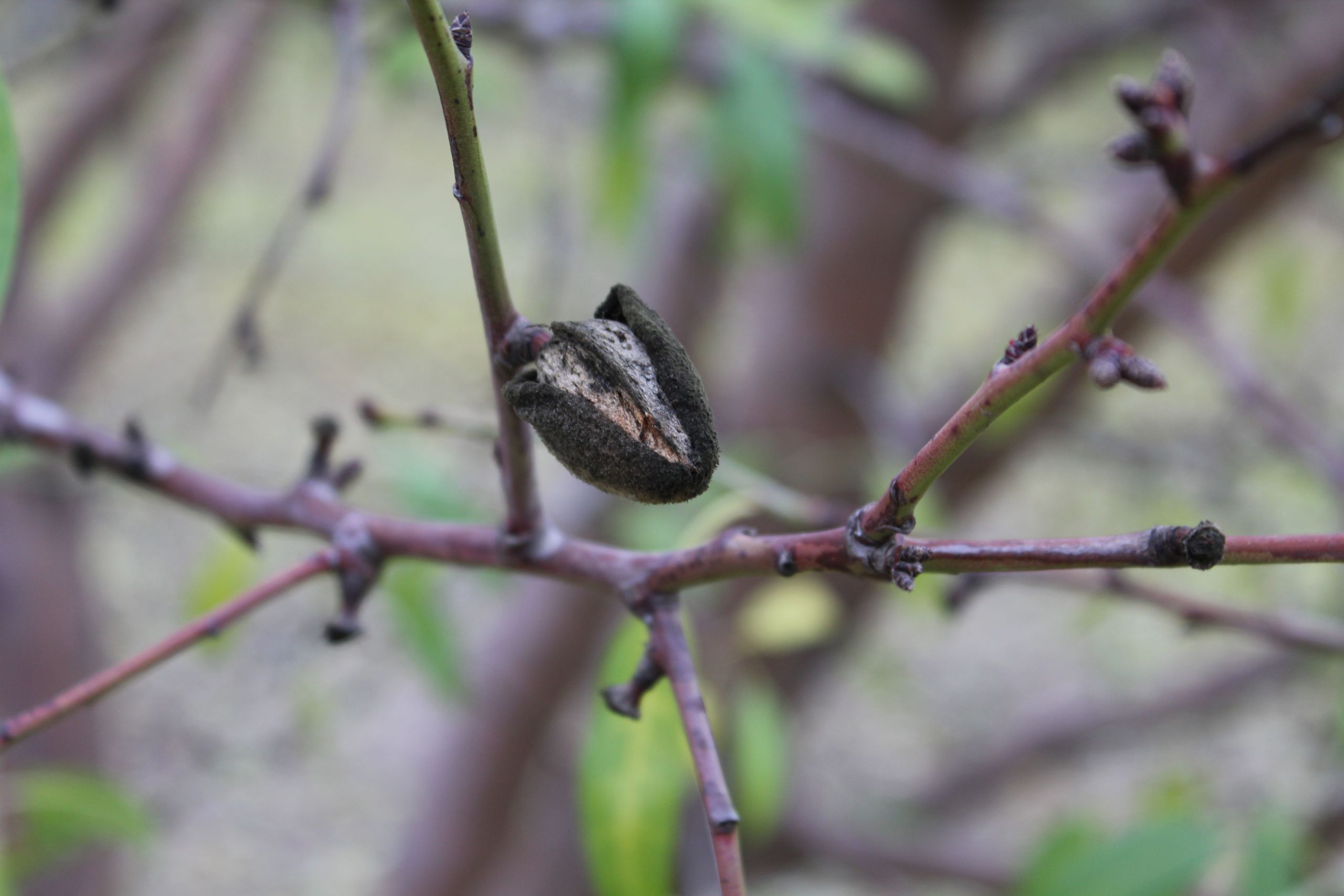
    Navel orangeworm find food and shelter in unharvested (“mummy”) nuts through the winter and spring, making those mummies a bridge of trouble from one year to the next in your orchard. Multiple research studies show that NOW damage increases with increasing mummy counts the previous winter. Destroying mummy nuts is the first step towards a cleaner crop and improved grower returns through quality incentives from processors. The goal of orchard sanitation is to turn that “NOW bridge” from a four-lane highway (no sanitation at all) into a narrow footbridge.

    Orchard sanitation is practiced by removing mummy nuts from the trees by February 1 and destroying (flail mow or disc) all nuts on the orchard floor no later than March 1st. In light of the expected reduced nut price for the 2020 crop, some growers may consider eliminating this key step in NOW management to “save money”. This is a risky move. The Sacramento Valley 2021 crop has a good chance to be lighter than the record 2020 crop resulting in 1) fewer nuts/tree and so higher % damage even if NOW populations stay the same and 2) larger nuts, on average, with the potential for poor shell seal and greater risk of NOW damage. Don’t play Navel Orangeworm Russian Roulette with your next crop. Sanitize.

    The following steps are needed for effective orchard sanitation:

      Before January 15, scout an orchard and count mummy nuts in 20 trees per acre. Include all varieties in this count.

      If average number of mummy nuts/tree exceeds 2, sanitation is recommended. The <2 mummies per tree target was developed in the early 1980’s, when industry average NOW damage was around 3.5%, much higher than today’s range of 1.3%. In the high pressure area of the southern San Joaquin Valley, the recommendation is to limit mummies to 1 per 5 trees (0.2 nuts/tree) and 8 or fewer mummies on the ground per Nonpareil tree, based on research from in 2003-2006 in Kern County. However, in 2019, northern California had higher % rejects level than the “high pressure” south San Joaquin Valley. Simply put, the fewer mummy nuts in an orchard, the lower NOW pressure at the start of the season.

      To sanitize, shake trees to remove nuts by January 31. Shaking can remove flower buds as they begin to swell and gain weight in late January/early February. Unless it is an early bloom season and buds begin to swell ahead of normal timing, shaking can be done into early February without reducing yield. Some buds are removed by shaking in early February, but since only 25% flower set = good commercial crop, some bud loss does not mean less crop at harvest. Some growers hand poll after shaking if too many nuts remain.

      Sweep downed nuts into windrows and mow or disc by March 1. Mow slowly (2 MPH) and check for intact nuts after mowing. If some nuts remain intact, mow again. NOW can survive if the nut is intact.

    Final thought. NOW overwinter in almond, walnut and pistachio mummies. NOW are also strong flyers, traveling at least a quarter of a mile to lay eggs. If you sanitize, but your neighbor(s) don’t, your orchard is at risk from NOW damage due to mated female moths, ready to lay eggs, flying over from the neighbors. Talk with your neighbors about sanitizing all orchards in the area and removing seedling “wild” almonds along fence lines as these can harbor NOW, too. — By Franz Niederholzer, UCCE Farm Advisor, Colusa & Sutter/Yuba Counties

  • After a Hard-Working Harvest, Trees Need Water to Remain Healthy

    After a Hard-Working Harvest, Trees Need Water to Remain Healthy

    Almond Board of California — Growers have a lot to think about leading up to and during harvest – prepping the orchard floor, timing the first shake in relation to hull split and achieving optimum moisture content during drying are just a few of the many important factors growers will consider from July to October.

    Even as this season’s bounty is being harvested, the foundation for next year’s crop is already being developed through fruiting-bud differentiation. The period from July to October, in normal years, is when floral buds develop and the next year’s crop yield potential is set. The principle is simple: more buds = likely more flowers = likely more almonds. 

    Many factors can affect crop yield, such as pollination, weather, and nutrient management decisions. But this year, especially, with a record projected crop on the way, one key practice growers should implement to maximize yield potential is optimized post-harvest irrigation. Because growers typically stop irrigating in the weeks leading up to harvest, their trees can be rather dried out come late September and early October.
    “The sooner you can get water back on your trees, the more you’ll be able to support tree health,” said Sebastian Saa, Ph.D., associate director for Agricultural Research at the Almond Board of California (ABC). “We know next year’s buds already are on the tree – water reduces the stress on the tree and therefore allows those buds to further develop.”

    One way for growers to think of post-harvest and late-season irrigation is that they are “paying it forward” for next year’s crop. During this critical time, trees’ water needs are significant and severe water stress can drastically affect bloom, fruit set and yield.

    Saa said growers who have self-compatible varieties may have more flexibility when it comes to post-harvest irrigation. Because there will only be one harvest per block in self-compatible orchard configurations, growers will not necessarily need to wait for the harvest of the pollinizer to irrigate again. Similarly, Saa also said that off-ground harvest (catching the nuts and drying them outside of the orchard) or semi-off ground harvest (catching them and re-allocating them to the middle of the row) also may provide flexibility when it comes to post-harvest irrigation.

    One key resource available to help growers better understand irrigation management – both post-harvest and year-round – is ABC’s 
    Almond Irrigation Improvement Continuum. This resource, developed by the Almond Board in partnership with many trusted and respected technical experts, provides a wide-ranging look at a grower’s site-specific irrigation system with the goal of improved efficiency and effectiveness. In the Continuum, growers and irrigation experts will find a step-by-step explanation of irrigation management and scheduling practices related to the following concepts:

    • measuring irrigation system performance and efficiency,
    • estimating orchard water requirements based on evapotranspiration,
    • determining applied water,
    • evaluating soil moisture, and
    • evaluating plant water status.

    Tom Devol, ABC’s senior manager of Field Outreach and Education, is available to help almond growers reach their goals of increased water efficiency. Devol and his team can meet growers in-person for in-orchard consultations to discuss irrigation systems, address challenges, and share ABC’s print and online irrigation tools. To schedule your own irrigation consultation, email Devol at tdevol@almondboard.com or call (530) 570-5558.

    More post-harvest irrigation information
    More information about the impacts of water stress on fruit bud development in relation to growing regions and varieties is available in the University of California Agricultural and Natural Resources publication 8515, “Drought Tips: Drought Management for California Almonds,” found at Almonds.com.

  • Soil Compacted Post-Harvest? Look to Cover Crops

    Soil Compacted Post-Harvest? Look to Cover Crops

    Almond Board of California — For the third year in a row, Chris Rishwain is preparing to plant cover crops in the windrows of his 150-acre almond orchard near Manteca. Although his original intent was to provide forage for honey bees during pollination, Rishwain has discovered multiple additional benefits to cover crops, one of the most impactful being the positive effect they have on compacted soil.

    “Soil compaction has been a problem for us,” Rishwain explained. “My goal to reduce soil compaction is aimed at helping improve the orchard’s water retention, allowing the roots of our trees to penetrate deeper in the soil to obtain water and minerals, and also to allow for better soil aeration, which supports the microbes in the soil.”

    Like many other almond growers, Rishwain just completed harvest, a time when shakers, sweepers, tractors and other heavy equipment can contribute to pre-existing issues of soil compaction in orchards up and down the Central Valley. Compaction also can be a greater problem in soils that have more silt.

    Soil compaction – coupled with other contributing factors – can negatively affect tree development and subsequent tree productivity. While there is work that can be done to prevent or decrease the severity of soil compaction before trees are planted in an orchard, once an orchard is established those options become more limited. That’s where cover crops can help.

    The Almond Board of California (ABC) continues to fund research into the impacts of cover crops. Much of that scientific work has been conducted by a team led by Amélie Gaudin, Ph.D., an associate professor of agroecology in the UC Davis Department of Plant Sciences, as well as researchers from UC Riverside.

    Seed money available to growers

    One of the most enthusiastic promoters of cover crops in California is Project Apis m., which has managed the popular Seeds for Bees program for many years. Seeds for Bees encourages the use of cover crops to increase the density, diversity and duration of pollinator forage in California agriculture, while also improving soil health.

    “The seed mixes available through Seeds for Bees are designed to bloom at critical times of the year when natural forage is scarce but managed and native bees are active,” said Billy Synk, the organization’s director of pollination programs.

    Through the Almond Board’s Bee+ Scholarship Program, 100 almond growers can receive up to $2,000 each in FREE cover crop seed through the Seeds for Bees program. Funding provided by ABC’s Bee+ Scholarship will allow growers to plant an estimated 3,500 acres of quality pollinator forage statewide – that’s in addition to the cover crop seed Project Apis m. typically distributes directly to almond growers through their Seeds for Bees program each year. Applications are being accepted now, so growers are encouraged to visit Almonds.com/Pollinationto learn more.

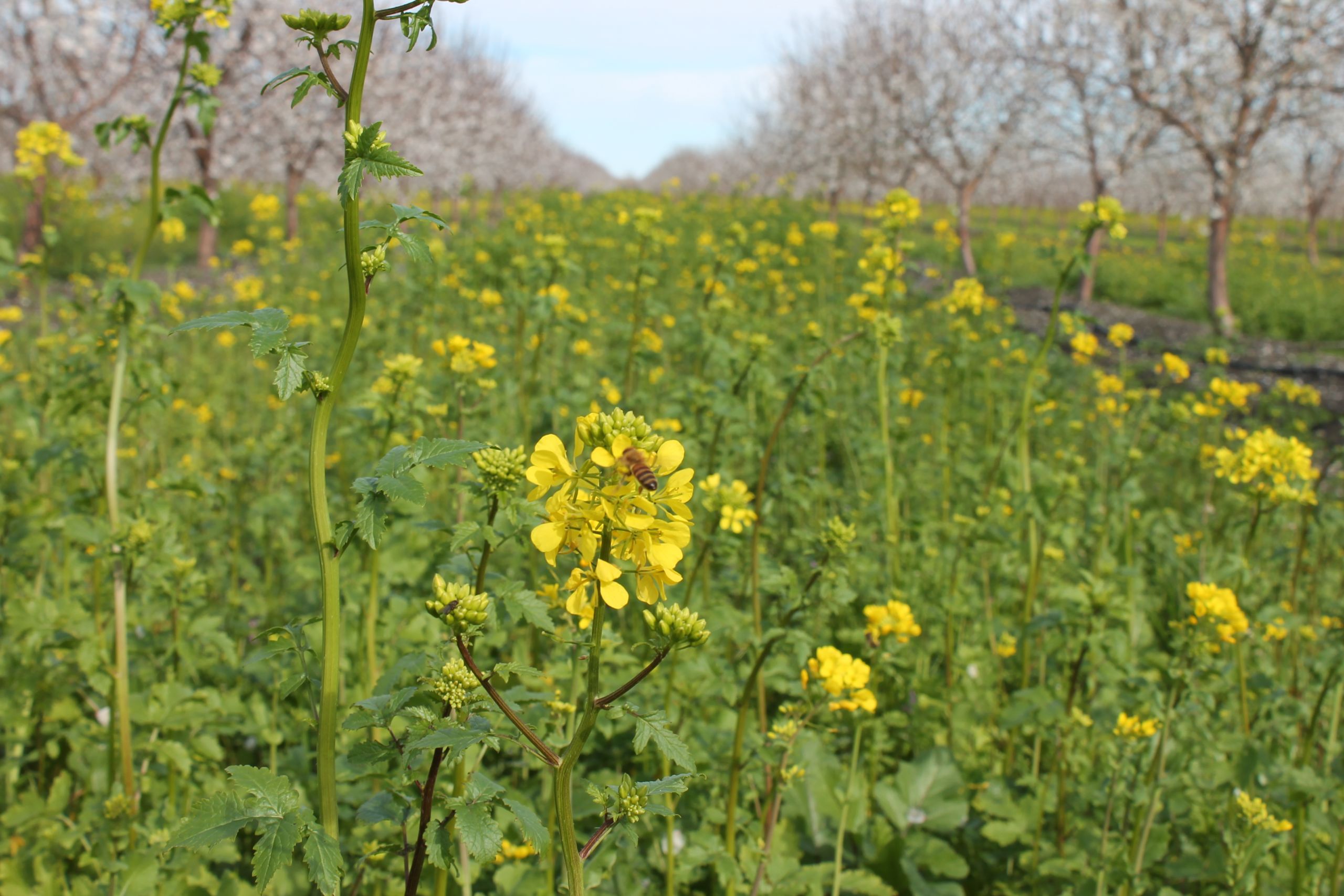
    Rishwain started participating in the Seeds for Bees program two years ago. He planted Project Apis m.’s Soil Builder mix, which includes brassicas, legumes and grains. In addition to the cover crops’ positive impact on honey bees, he also likes this mix because of its combination of shallow hair-like roots that help prevent erosion in addition to strong tap roots that grow deep into the soil, breaking up compacted areas.

    “I will use this mix again this coming year. I liked how it has a diversity of species that can improve soil health in our orchard in many different ways,” said Rishwain, adding that the experts from Seeds for Bees make choosing the right seed mix easy for any orchard situation.

    Synk said the most popular Seeds for Bees seeds mix that growers typically use to deal with compacted soils is the Mustard mix, which includes canola, white mustard, two kinds of yellow mustard and Diakon radish.  He also said 75% of Seeds for Bees participants list breaking up compacted soils as one of their primary reasons to plant cover crops.

    Similarly, Gaudin’s research shows that a mixture higher in legumes (such as clover and vetch) can boost nitrogen levels in the soil; conversely, grasses can help reduce nitrogen losses, decrease compaction and improve water infiltration.

    Typically, cover crops are planted in the fall – after harvest – and sprout naturally following the first rain of the new crop year. Their flowers provide additional forage for honey bees when almond trees are in bloom and their roots add organic material to the soil. The cover crops are then typically mowed down in late spring so orchard floors can be readied for harvest later in the year. Rishwain also uses a conditioner before harvest to filter out organic debris.

    Josette Lewis, Ph.D. , the Chief Scientific Officer for the Almond Board, said the organization expects to publish a practical guide on best management practices for cover crops at the start of 2021. In the meantime, growers are encouraged to participate in the Almond Board’s Bee+ Scholarship and visit the Seeds for Bees website to learn more about the benefits of planting cover crops in or near their orchards.