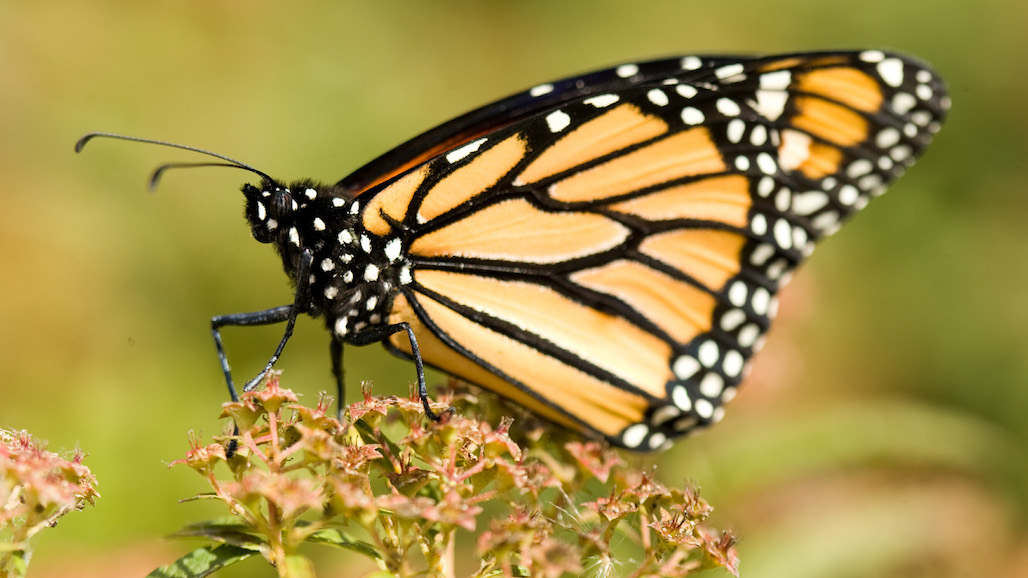
Today, the U.S. Fish and Wildlife Service (USFWS) proposed listing the monarch butterfly as a threatened species under the Endangered Species Act (ESA). According to the proposed listing rule, its purpose is to reverse the population decline of this pollinator species.
While we have concerns about the potential impacts of this listing on growers and their operations, we are committed to working with the USFWS to develop solutions that protect the monarch while supporting our growers.
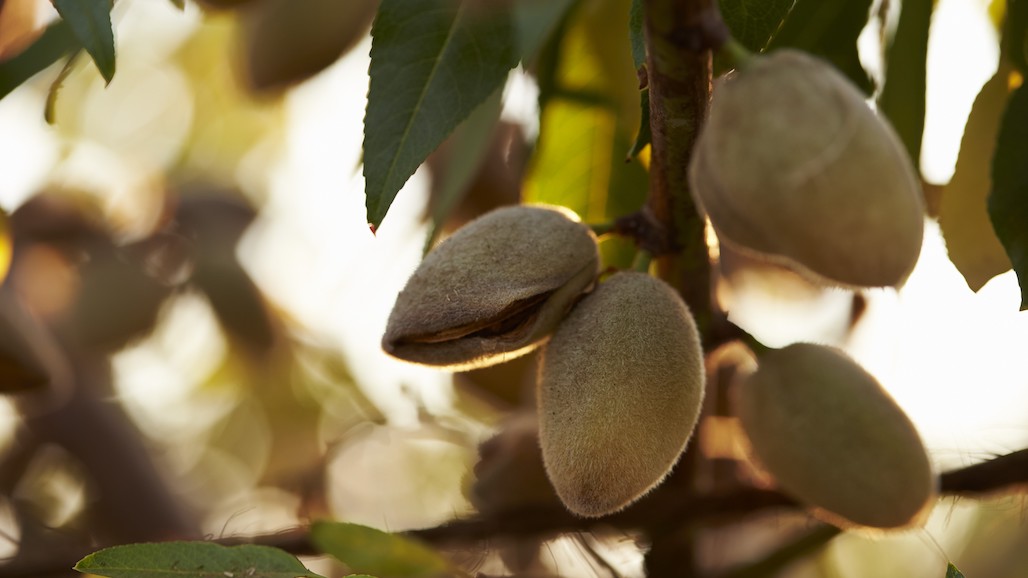
As a leader in pollinator conservation, almond growers have made significant contributions, including:
Leading the nation in Bee Friendly Farming certification, ensuring sustainable and supportive environments for pollinators. In fact, 86% of all U.S. bee-friendly certified farms are almond farms.
Providing more than 35,000 acres of permanent pollinator habitat managed by family-owned farms.
Additionally, 20% of California almond orchards plant blooming cover crops between tree rows to provide more than 130,000 acres of seasonal pollinator nectar resources.
California’s working lands will be essential to the monarch butterfly’s recovery. Almond growers have shown that proactive pollinator conservation and sustainable farming can coexist. We welcome the opportunity to collaborate with USFWS to accelerate the monarch’s recovery while continuing to provide benefits to ecosystems, farming communities, and sustainable food production.
Almond Alliance is the leading authority in state and national policy, championing American almond farmers, industry, and community for the continued global growth, innovation, and success of American almonds and agriculture.
Established in 1980, the Almond Alliance is a non-profit trade association with a local and international network of almond processors, hullers/shellers, growers, and allied businesses. The Alliance is dedicated to providing resources and solutions for our members, ensuring industry success and growth opportunities. Learn more at almondalliance.org.
The U.S. Department of Agriculture (USDA) Farm Service Agency’s (FSA) $2 billion Marketing Assistance for Specialty Crops (MASC) program, aimed at helping specialty crop producers expand markets and manage higher costs, is now accepting applications from Dec. 10, 2024 through Jan. 8, 2025. Funded by the Commodity Credit Corporation, MASC was announced in November alongside the $140 million Commodity Storage Assistance Program for facilities impacted by 2024 natural disasters.
“Specialty crop growers have typically faced higher marketing and handling costs relative to non-specialty crop producers due to the perishability of fruits, (nuts), vegetables, floriculture, nursery crops and herbs,” said FSA Administrator Zach Ducheneaux. “Through this marketing assistance program, we can expand U.S. specialty crop consumption and markets by providing specialty crop producers the financial support needed to help them engage in activities that broaden and enhance strategies and opportunities for marketing their commodities.”
MASC helps specialty crop producers meet higher marketing costs related to:
Perishability of specialty crops like fruits, vegetables, floriculture, nursey crops and herbs;
Specialized handling and transport equipment with temperature and humidity control;
Packaging to prevent damage;
Moving perishables to market quickly; and
Higher labor costs.
MASC Eligibility
To be eligible for MASC, a producer must be in business at the time of application, maintain an ownership share and share in the risk of producing a specialty crop that will be sold in calendar year 2025.
MASC covers the following commercially marketed specialty crops:
Fruits (fresh, dried);
Vegetables (including dry edible beans and peas, mushrooms, and vegetable seed);
Tree nuts;
Nursery crops, Christmas trees, and floriculture;
Culinary and medicinal herbs and spices; and
Honey, hops, maple sap, tea, turfgrass and grass seed.
Applying for MASC
Eligible established specialty crop producers can apply for MASC benefits by completing the FSA-1140, Marketing Assistance for Specialty Crops (MASC) Program Application, and submitting the form to any FSA county office by Jan. 8, 2025. When applying, eligible specialty crop producers must certify their specialty crop sales for calendar year 2023 or 2024.
New specialty crop producers are required to certify 2025 expected sales, submit an FSA-1141 application and provide certain documentation to support reported sales i.e., receipts, contracts, acreage reports, input receipts, etc. New producers are those who began producing specialty crops in 2023 or 2024 but did not have sales due to the immaturity of the crop, began producing specialty crops in 2024 but did not have a complete year of sales or will begin growing specialty crops in 2025.
MASC applicants, established and new, must also submit the following information to FSA if not already on file at the time of application:
Form AD-2047, Customer Data Worksheet.
Form CCC-902, Farm Operating Plan for an individual or legal entity.
Form CCC-941, Average Adjusted Gross Income (AGI) Certification and Consent to Disclosure of Tax Information.
Form FSA-942, Certification of Income from Farming, Ranching and Forestry Operations, if applicable, for the producer and members of entities.
A highly erodible land conservation (sometimes referred to as HELC) and wetland conservation certification (Form AD-1026 Highly Erodible Land Conservation (HELC) and Wetland Conservation (WC) Certification) for the ERP producer and applicable affiliates.
Other Documentation if requested by FSA to support reported specialty crop sales.
Most producers, especially those who have previously participated in FSA programs, will likely have these required forms on file. However, those who are uncertain or want to confirm the status of their forms or producers who may be new to conducting business with FSA, can contact their local FSA county office.
For MASC program participation, eligible specialty crop sales only include sales of commercially marketed raw specialty crops grown in the United States by the producer. The portion of sales derived from adding value to a specialty crop (such as sorting, processing, or packaging) is not included when determining eligible sales. Further explanation of what is considered by FSA for specialty crop sales as well as an online MASC decision tool and applicable program forms, are available on the MASC program webpage.
MASC Payments
For established specialty crop growers, those who certify crop sales in 2023 or 2024, FSA will calculate MASC payments based on the producer’s total specialty crop sales for the calendar year elected by the producer. Payments for new producers will be based on their expected 2025 calendar year sales. Payment calculation details and examples are available on the MASC webpage or related questions can be directed to local FSA county office staff.
FSA will issue MASC payments after the end of the application period. If demand for MASC payments exceeds available funding, MASC payments may be prorated, and the payment limitation of $125,000 may be lowered. If additional funding is available after MASC payments are issued, FSA may issue an additional payment.
Specialty crop producers interested in applying for MASC benefits, are encouraged to review the program fact sheet for detailed information on program eligibility, required documentation, payment calculations and more.
More Information
Additional information on MASC is available in the Notice of Funding Availability, which went on public inspection in the Federal Register on Dec. 9, 2024.
FSA helps America’s farmers, ranchers and forest landowners invest in, improve, protect and expand their agricultural operations through the delivery of agricultural programs for all Americans. FSA implements agricultural policy, administers credit and loan programs, and manages conservation, commodity, disaster recovery and marketing programs through a national network of state and county offices and locally elected county committees. For more information, visit fsa.usda.gov.
In spring 2023, we established two organic blocks, one with almonds and one with blueberries, to further evaluate the weed control efficacy and crop safety of the Zasso unit in newly established tree and berry systems. In these trials, we tested different combinations of speed and power to control the total current/energy flowing into the ground. This approach is similar to herbicide trials where we often test at different rates to evaluate crop injury (e.g., 2X, 4X rates). Both experiments included comparisons with standard organic weed control practices such as organic herbicide (Suppress EC), mowing, and hand weeding.
In the blueberry experiment, we also applied two mulching types (sawdust and plastic), and each plot with different mulching types was treated with all the EWC treatments to evaluate the interactions between these two practices. Since blueberries are planted on berms, we only treated the berm shoulders with EWC (Figure 2).
Figure 1. Organic blueberry field with three different mulching types as treatmentsFigure 2. EWC treating the shoulder of the sawdust mulching blueberry plot
2023 Findings
During the 2023 growing season, all EWC treatments showed promising weed control results. In the almond block, the highest-energy EWC treatment kept the floor weed-free for 35-40 days. In the blueberry block, where we used one drip line (versus two in the almond block), the shoulders stayed dry for most of the summer. After our first EWC application in late May (almond) and early June (blueberry), weed pressure in all EWC-treated blueberry plots remained low throughout the season, with some plots staying weed-free even longer than the same treatment in the almond block. We measured tree height, trunk diameter, and blueberry plant canopy volume, finding no significant differences in plant growth across treatments for either crop.
Figure 3. EWC in organic almond block
2024 Focus
In 2024, we continued measuring growth data and collected soil samples for soil health analysis in both blocks. One of my research goals is to address a key grower concern about this technique by assessing the impact of EWC on soil microbes. While soil physical properties should remain unchanged (due to no soil disturbance), soil microbes—which play a crucial role in nutrient cycling—could be sensitive to electric shocks and surface temperature spikes. Then, we will look at how two years of more than 10 EWC applications will impact weed species distribution.
Figure 4. EWC untreated (top) and treated (bottom) almond plots in April 2024
2025 Plans
Coming into 2025, we plan to continue the blueberry and almond work on campus and also conduct additional research in growers’ fields and test it out in additional tree crops. We will continue to collect weed control efficacy data on an array of common orchard weeds in California. Lastly, we plan to start an experiment to examine how soil moisture at the time of EWC treatment affects the weed control efficacy and whether there are any effects from different irrigation regimes.
Figure 6. Equipment testing in non crop area before EWC treatment in organic almond and blueberry at UC Davis.
Frequently Asked Questions about EWC Technology
Q: Are there any safety concerns with EWC?
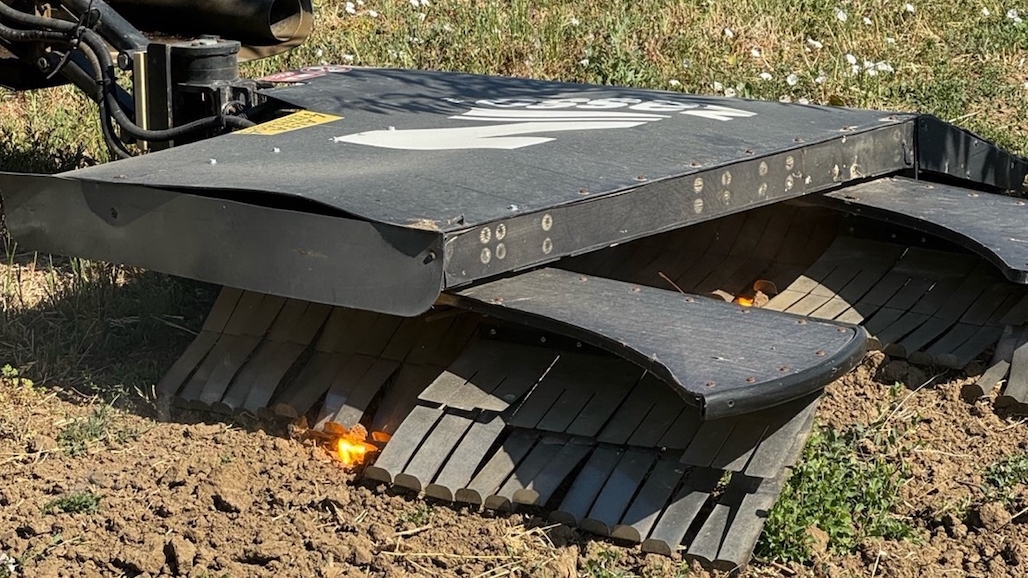
A: Yes, since this is a high-voltage application targeting above-ground vegetation, the circuit can create arcing and potentially cause fires. The manufacturer requires scouting behind the tractor during applications. Multiple EWC applications and mowing operations over a season leave dead vegetation on the ground, which can easily ignite, especially at higher power settings. We have noticed a seasonal pattern, with more fires occurring in fall than summer, and we are still investigating the causes.
Q: How does soil moisture affect EWC operation?
A: Soil moisture is an important factor. Soil that is too wet can cause generator overload by drawing too much energy. In contrast, overly dry soil has high electrical resistance, reducing current flow through plants. Our unit includes a setting to adjust power based on soil moisture, so selecting the right setting is essential for effective application. This is an area of ongoing research in California and with our collaborators in Oregon and New York.
Q: How do different weed species respond to EWC?
A: The weed growth stage matters more than species. EWC is effective on most weeds at the seedling stage but start losing efficacy with mature or flowering weeds that are woody or have less tissue moisture because electrical conductance is lower. Grasses can be challenging if they are matured and developed multiple tillers, as central tillers may avoid direct contact with the EWC applicator electrodes.
Q: How effective is EWC on perennial weeds?
A: EWC can manage bindweed and yellow nutsedge with multiple applications throughout the season. Regrowth and reemergence can occur if the vegetation does not directly contact with the electrode due to obstacles like soil clumps or overlapping plants. We are running an experiment to quantify perennial weed regrowth and reemergence.
Q: Is this unit available on the market?
A: Zasso has partnered with New Holland to bring this technology to the US. Please check out their website https://yellowblueandyou.newholland.com/en-gb/pf-global-2024/xpower-xps to look at the unit for the vineyard (XPower XPS). We will have a vineyard trial in 2025 in partnership with the farm operation and equipment distributor to evaluate the cost-efficiency of EWC in a large scale site.
Since I have been working and studying this unit for two years, I truly believe it is a valuable option for organic berry and tree fruit and nut production. It can also become an alternative to some of the post-emergent herbicides used in integrated pest management (IPM) programs in sustainable agriculture.
Our EWC project is funded by USDA NIFA Organic Research and Education Initiative. Please check out our website: https://eorganic.info/node/35946 for interviews and research updates from our collaborators: Moretti Lab at Oregon State University and Sosnoskie Lab at Cornell University. We are testing the same unit but on different crops. We also want to thank New Holland for the tractor support. — By Tong Zhen & Brad Hansen, UC Davis
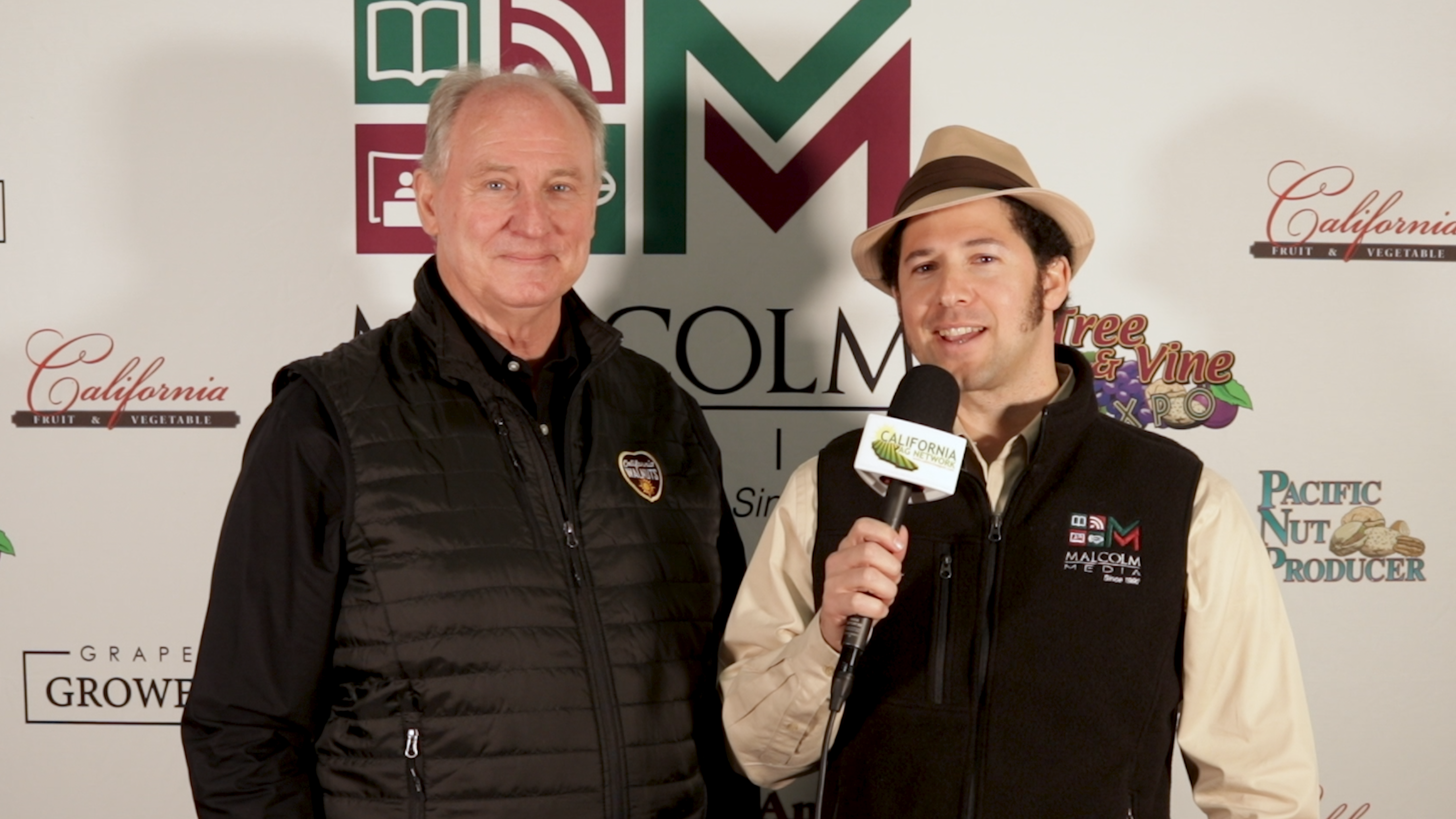
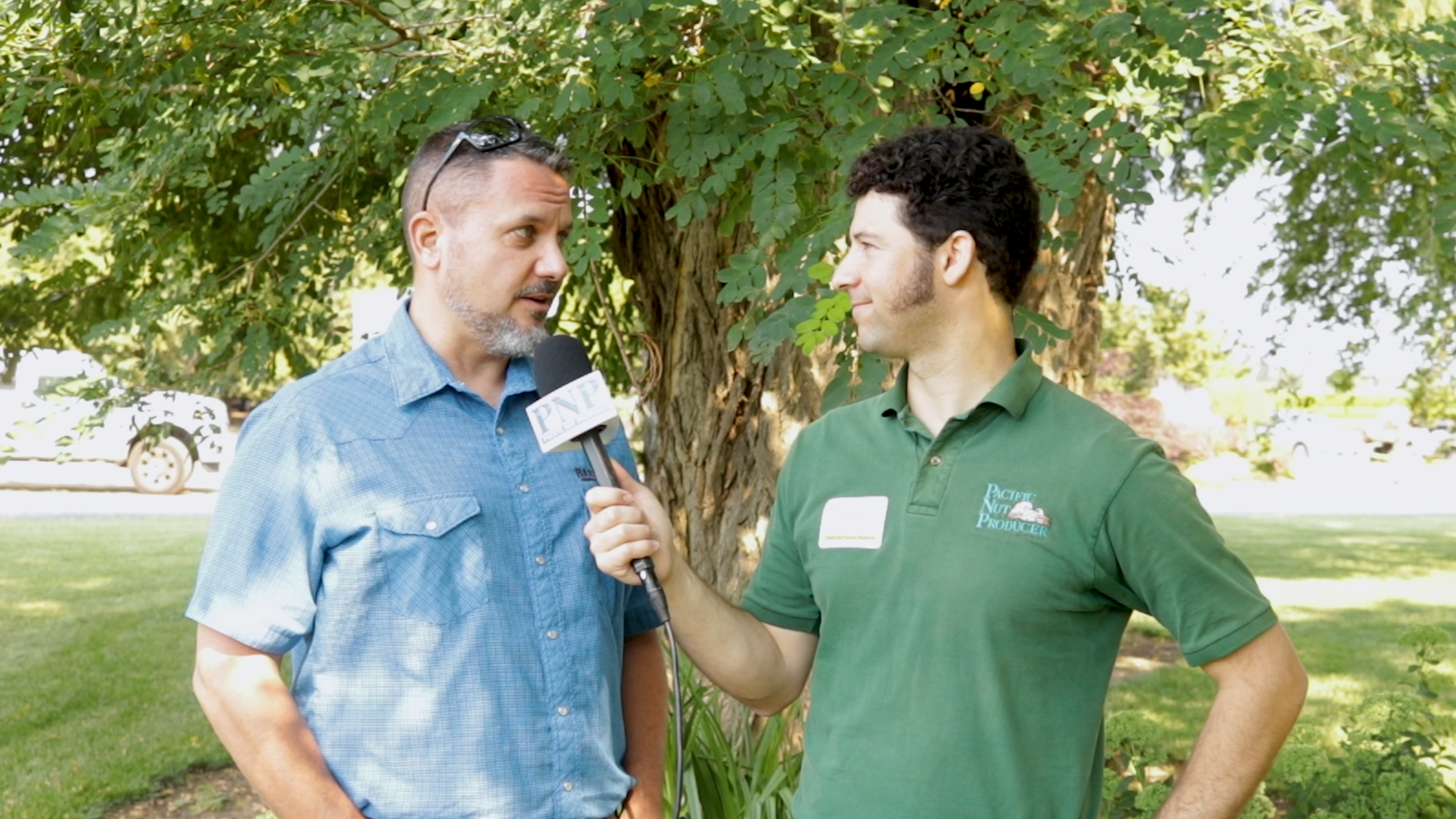
Did you miss the State of the Walnut Industry address at Malcolm Media’s recent Grape, Nut & Tree Fruit Expo in Fresno or the Tree & Vine Expo in Turlock? Following his presentation, Robert Verloop, CEO of the California Walnut Board & Commission met with Matthew Malcolm on California Ag Network to share highlights from this year’s walnut harvest and improving global market conditions. Watch this brief interview, and read the full State of the Industry report in the coming issue of Pacific Nut Producer Magazine.
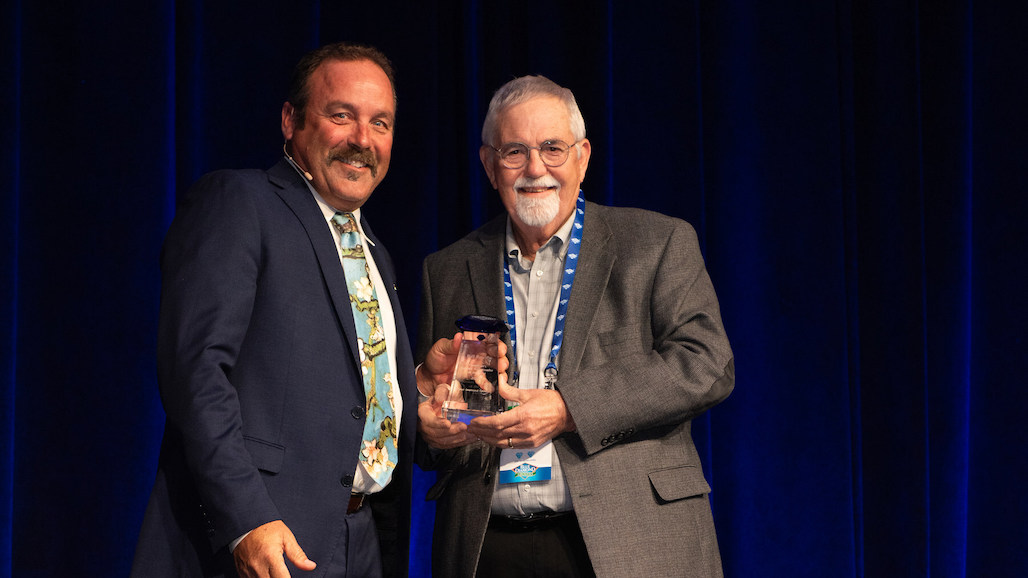
Blue Diamond Growers held their 114th Annual Meeting on Nov. 20 in Modesto, CA. President and CEO, Kai Bockmann, highlighted the farmer-owned cooperative’s successes over the last year and the progress made against its strategic growth plan. Blue Diamond Grower, Bill Brush of Modesto, received the Chairman’s Grower Ambassador of the Year Award, presented by Blue Diamond Chairman Steve Van Duyn – also of Modesto.
Kai Bockman, President and CEO, Blue Diamond Growers
With nearly 1,000 farmer-owners in attendance, Bockmann and Van Duyn reflected on the year noting that despite continued challenges facing the industry, Blue Diamond achieved great successes against its strategic plan to deliver a competitive return to its growers.
“This year, amidst the challenges, Blue Diamond has fought for its members by tapping into every opportunity to strengthen our portfolio and increase demand for our almonds,” said Van Duyn. “I am confident that through the excellent leadership of our Board of Directors and the Blue Diamond team good times are ahead.”
Alongside several company executives – Carmen Bourgaize, Chief Commercial Officer, Tony LaurenzanaSenior Vice President, Ingredients and Branded International Sales, Steve Schult, Vice President, Supply Chain, and Mel Machado, Vice President, Member Relations – Bockmann shared how the Cooperative is strengthening its core business while creating new opportunities for growth by expanding its international footprint and product portfolio.
“What drives us every day is to deliver the highest return for your almonds,” said Bockmann. “Our ability to adapt swiftly to changing market conditions, paired with our strategic planning and forward-thinking approach, enabled us to navigate through difficult circumstances and see positive returns from our strategic plan.”
Over the last year, Blue Diamond drove strategic investments in key international markets including Canada, Mexico, Japan, Europe and the Middle East. A new partnership with Japanese company, Kagome®, is set to position Japan to be a top international market for Blue Diamond’s Almond Breeze® almondmilk. The Cooperative successfully launched their large format for club stores in Mexico and established a new distributor in the Middle East, catering to markets across the region. In Europe, new flavored almonds are being introduced, offering customers additional flavors and forms.
Domestically, Blue Diamond’s focus on innovative offerings continues to make an impact in the market, captivating consumers with their unique flavors and textures. Broadening its presence in the grocery store, Blue Diamond released two new product lines – a tasty array of almond and almond fruit blends for retail produce departments and Almonds and More mixed nut products. A new snack nut, Ranch flavor, launched and was picked up by major retails across hundreds of stores, while consumer favorites Chile n’ Lime and Snickerdoodle launched nationwide.
“Blue Diamond’s products have tremendous value to offer consumers – innovation, flavor, nutrition, and convenience,” said Carmen Bourgaize, Chief Commercial Officer. “We are leveraging these strengths to entice consumers and drive consumption.”
In addition to outlining progress made on the strategic plan, the executive panel noted the company’s focus on maximizing efficiencies across the business. Investing in state-of-the-art equipment has optimized operations across all facilities, while energy conservation initiatives improved air compression inefficiencies to achieve energy savings.
Bockmann concluded the business meeting expressing optimism for Blue Diamond’s future and the company’s key differentiator – its people. Supporting more than 4,400 families between its farmers and team members, Blue Diamond is steadfast in its commitment to continued growth and progress for the Cooperative.
“It all comes down to one thing: build a bigger, better stronger Blue Diamond that provides the best return for our growers’ almonds. This is only the beginning of us Growing Together,” said Bockmann.
Blue Diamond Chairman’s Award
At this year’s annual meeting, Blue Diamond’s Board Chairman Steve Van Duyn presented the 2024 Chairman Award to Bill Brush. Brush, a Blue Diamond grower for more than 40 years, is an agronomist, water expert and plant nutritionist. Through his consulting business B&B Ag Consulting, Brush has assisted farmers throughout the world with soil fertility and water treatments. More recently, he has continued his work of educating the agricultural community through his podcast, “Agriculture in a Nutshell.” Brush is a steadfast advocate for agriculture and the almond industry serving more than 18 years on the Almond Board of California.
Blue Diamond Annual Report Now Available
In conjunction with the Annual Meeting, the Blue Diamond Growers 2024 “Growing Together” Annual Report is now available on the Blue Diamond website at www.bluediamond.com.
About Blue Diamond Growers®
Blue Diamond Growers, a grower-owned cooperative representing nearly 3,000 of California’s almond growers, is the world’s leading almond marketer and processor. Established in 1910, it created the California almond industry and opened world markets for almonds. Blue Diamond is dedicated to delivering the benefits of almonds around the world and does so by providing high-quality almonds, almond ingredients, and branded products. Headquartered in Sacramento, the company employs approximately 1,400 people throughout its processing plants, receiving stations and gift shops. To learn more about Blue Diamond Growers, visit www.BlueDiamond.com and follow the company on Facebook, Instagram, and LinkedIn.
California’s total almond acreage dropped again in 2024, making three years in a row that acreage has decreased, something that has not happened since at least 1995, according to a new report from Land IQ to the Almond Board of California (ABC).
Total acreage dropped by about 40,000 acres from 1.56 million acres in the last crop year to just over 1.52 million in 2024. Bearing acres – orchards producing almonds and planted in 2021 or earlier – increased by the smallest amount in more than two decades, just 9,000 acres. The total of bearing acres during the 2024 growing season was 1.383 million acres compared with 1.374 million acres at this time last year.
But the amount of non-bearing acreage – new orchards planted in 2022, 2023 or 2024 – sank about 47,000 acres from 189,000 acres in 2023 to 142,000 in 2024, according to the Land IQ 2024 Standing Acreage Final Estimate.
“Three straight years of decreased acreage and sizeable orchard removals reflect a trend toward lower overall California almond acreage,” said Clarice Turner, ABC president and CEO. “At the same time, we continue to see strong shipments – in the past crop year, for the first time ever, we shipped more than 200 million pounds in 11 consecutive months, plus for the year, we shipped 300 million pounds more than we produced. We know global demand for California almonds continues to grow and that almonds will continue to have a very significant role in California and global agriculture and food industries for the foreseeable future.”
There were significant orchard removals again in 2024 totaling almost 67,000 acres. Those add to the 83,000 acres removed in 2023 and 60,400 acres removed in 2022, according to the accompanying Land IQ 2023 Removal Update. Those removals and the decreasing amount of non-bearing acres, or new plantings, contribute to the probability of fewer acres over the next few years, Turner said.
In addition, slightly more than 30,000 acres are classified as either stressed or abandoned. They were included in the standing acreage total because the orchards “may have the ability to recover,” Land IQ said.
The estimates come from multiple lines of evidence, including agronomic and remote sensing knowledge, robust on-the-ground verification, customized image analysis, artificial intelligence and more. Land IQ said the 2024 standing acreage estimate is 98.8 percent accurate.
The report also said the slight change in the amount of bearing acreage from the April initial estimate – which was labeled as exactly that, the initial accounting – was the result of Land IQ crews in the orchards identifying additional bearing acres, and because removals were overestimated in April by about 4,000 acres.
Land IQ’s acreage estimates are commissioned by ABC to provide statistical transparency and a robust picture of California almonds to industry stakeholders around the world. In 2018, ABC first commissioned Land IQ, a Sacramento-based agricultural and environmental scientific research and consulting firm, to develop a comprehensive, living map of California almonds. The map is the result of more than a decade of research. — By the Almond Board of California
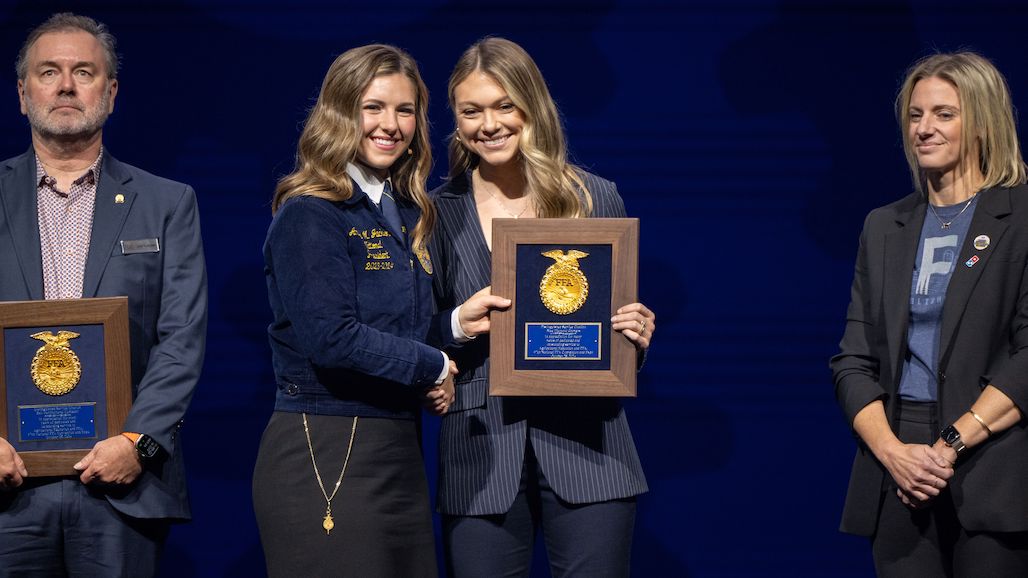
Blue Diamond Growers was recently awarded the prestigious Distinguished Service Citation by the National FFA Organization at the 97th National FFA Convention and Expo in Indianapolis, Ind.
The Distinguished Service Citation is an esteemed award honoring organizations, agencies, businesses, or other groups who have made outstanding contributions to FFA and agricultural education. Awardees must be nominated by a state association. Blue Diamond Growers was among the four awardees acknowledged at this year’s National FFA Convention.
This year, the California Association FFA nominated Blue Diamond Growers, paying homage to their longstanding partnership on Giving Tuesday. This day is an annual tradition for FFA alumni, friends, and supporters to rally behind the California FFA Foundation’s “Give the Gift of Blue” initiative, which provides FFA jackets and uniform essentials to deserving FFA members.
Set to be held on December 3 this year, the contributions made on Giving Tuesday are multiplied by the unwavering support of Blue Diamond Growers, who, since 2017, have pledged to match every donation up to $25,000.
“This marks our eighth Giving Tuesday, a tradition of raising funds to ‘Give the Gift of Blue,’ in partnership with Blue Diamond Growers,” said Emily Rooney, chair of the California FFA Foundation and president of the Agricultural Council of California. “With the support of Blue Diamond Growers, we have raised over $463,785, providing 5,293 FFA jackets to members throughout California. We are delighted to see their efforts recognized by National FFA with the Distinguished Service Citation.”
With California’s record-breaking membership of more than 104,000 middle and high school students, the demand for blue jackets has never been greater. The iconic blue jacket stands as more than just a part of the official FFA uniform; it also embodies the values of leadership and rich agricultural tradition instilled in FFA members for over 96 years.
“We are extremely honored and grateful to have received the Distinguished Service Award from FFA,” said Steve Van Duyn, chairman of Blue Diamond Growers. “As a farmer-owned cooperative, we have a long history of supporting the next generation of agriculturists and food producers and are proud to continue this effort through our partnership with FFA.”
Beyond Giving Tuesday, Blue Diamond Growers has been a steadfast ally to FFA and agricultural education, extending support through sponsorships of various proficiencies and awards. With 114 years of agricultural history in Northern California, and the participation of approximately 3,000 family growers responsible for producing almonds for the world, Blue Diamond Growers epitomizes a legacy of excellence.
California FFA Foundation serves more than 104,000 California students and strives to make a difference in their lives by developing their potential for premier leadership, personal growth, and career success through educational education. To learn more about the California FFA, visit calaged.org.
About Blue Diamond Growers®
Blue Diamond Growers, a grower-owned cooperative representing over 3,000 of California’s almond growers, is the world’s leading almond marketer and processor. Established in 1910, it created the California almond industry and opened world markets for almonds. Blue Diamond is dedicated to delivering the benefits of almonds around the world and does so by providing high-quality almonds, almond ingredients, and branded products. Headquartered in Sacramento, the company employs more than 1,600 people throughout its processing plants, receiving stations and gift shops. To learn more about Blue Diamond Growers, visit www.BlueDiamond.com and follow the company on Facebook, Instagram, LinkedIn and Twitter.
Oregon hazelnut growers are pleased with improving market conditions this year, especially after wrapping up potentially a record large 2024 harvest. Pacific Nut Producer Editor Matthew Malcolm met with Terry Ross from the Hazelnut Growers Bargaining Association to discuss factors influencing what growers will be receiving in return for their crop and the association’s critical role in negotiating fair prices. Watch this brief interview and stay current on hazelnut industry news by reading your monthly issue of Pacific Nut Producer Magazine.
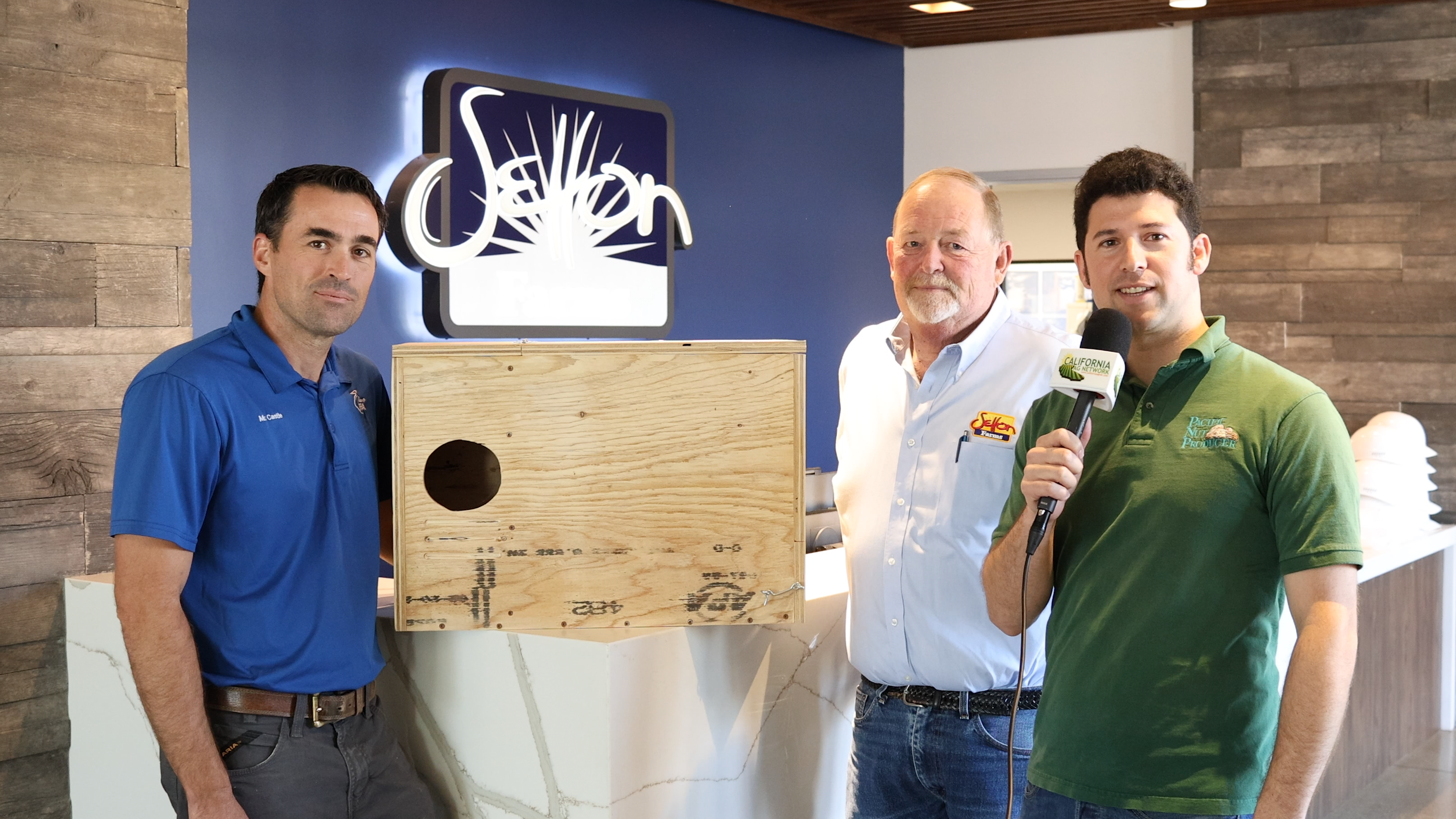
Supporting the next generation of farmers in sustainable stewardship of the land is a priority for Setton Farms, the second largest pistachio processor in the United States. That is why they have partnered with the Future Farmers of America Tulare Chapter to support their agricultural programs while distributing 50 student-made owl boxes across their farming operations. Watch this brief interview with Mike Smith and Jared Castle meeting with Matthew Malcolm on California Ag Network during the owl box exchange to learn more.
To kick off the holiday season, Blue Diamond, the world’s leading almond marketer and processor, today announced the launch of a new seasonal flavor: Blue Diamond Frosted Brownie Almonds. A]er exploring over 60 different holiday flavors and experimenting with 11 variations of frosted brownie, Blue Diamond has crafted a unique, festive treat that combines the flavors of rich chocolate and creamy frosting with the signature crunch of almonds creating an irresistible holiday snack.
“We like to consistently test different flavor innovations, especially around the holidays, to expand our product portfolio based on what we know consumers are craving,” said Maya Erwin, Vice President of Marketing & Innovation at Blue Diamond. “Chocolate and the holidays go hand in hand, so we created Frosted Brownie to lean into this seasonal flavor, allowing snackers to enjoy the rich and creamy indulgence of a brownie, all with the crunch and goodness of an almond.”
This is the third year Blue Diamond has released limited-edition holiday flavors, following last year’s soaring sales of Blue Diamond’s returning flavor, Snickerdoodle, highlighting the strong consumer demand for seasonal flavor offerings. Returning once again for 2024, consumers can enjoy the delicious cinnamon sugar cookie taste of Blue Diamond Snickerdoodle Almonds that they’ve come to love over the past two years.
Blue Diamond is known for its unique lineup of craveable flavors such as Ranch, Thin Dipped and Chilé ‘N Lime and will increase its lineup of 20+ flavors with this latest holiday flavor expansion.
From now through December 2024, holiday fanatics can find these holiday almond flavors in 6oz cans at major retailers nationwide and Amazon.com (MSRP: $4.29). For more information on existing and new products, visit BlueDiamond.com.