Category: Almonds

  • Heat Illness Prevention Education, Training Resources and Publications​​​​​​​

    Heat Illness Prevention Education, Training Resources and Publications​​​​​​​

    Almond Alliance of California — Harvest is here and so is the heat!  Heat illness is deadly so prevention education is critical for protecting your employees. Make heat safety part of your overall safety program.

    Some essentials ALL employers should have are:

    • Plan – Develop and implement an effective written heat illness prevention plan that includes emergency response procedures (Almond Alliance provides a template if requested).
    • Training – Train all employees and supervisors on heat illness prevention (Almond Alliance provides pre-season trainings upon request).
    • Water – Provide drinking water that is fresh, pure, suitably cool and free of charge so that each worker can drink at least 1 quart per hour, and encourage workers to do so.
    • Shade – Provide shade when workers request it or when temperatures exceed 80 degrees. Encourage workers to take a cool-down rest in the shade for at least five minutes when they feel the need to do so to protect themselves from overheating. They should not wait until they feel sick to cool down.
    Cal/OSHA’s Heat Illness Prevention protocols include enforcement of heat regulations as well as multilingual outreach and training programs for California’s employers and workers.

    Below are links to heat illness prevention online resources, materials and printable flyers to use in your workplace this season. If you have any questions, please contact staff@almondalliance.org. Keep your employees safe and hydrated!
    For Employers:
    For Workers:
    • Pocket Guide: Protect Yourself from Heat Illness (English/Spanish), Click Here.
    • Heat Safety Fact Sheet (English), Click Here.
    • File a Health & Safety Complaint (English), Click Here.
    • Additional Heat Illness Prevention Resources, Click Here.
    Training and Education:  
    Materials available for order by email at heat@dir.ca.gov to order copies of the below materials at no cost. (99 Calor campaign page) Material is also available for download, including Heat Illness Prevention videos and discussion guides in multiple languages.
    Additional Heat Illness Links: 
    • FedOSHA Quick Card: Protecting Workers from Heat Stress, Click Here.
    • National Weather Service: California Information, Click Here.
    • Centers for Disease Control: Heat Stress, Click Here.
    • Centers for Disease Control: Tips for Preventing Heat Related Illness, Click Here.

    Note: This document is provided for informational purposes only and does not constitute legal advice. Almond Alliance of California does not advise on the application of law to an individual’s or company’s specific circumstances. Although we go to great lengths to make sure our information is accurate and useful, we recommend you consult a lawyer if you want professional assurance that our information, and your interpretation of it, is appropriate to your particular situation.
  • Progress on Navel Orangeworm Sterile Insect Technique Research

    Progress on Navel Orangeworm Sterile Insect Technique Research

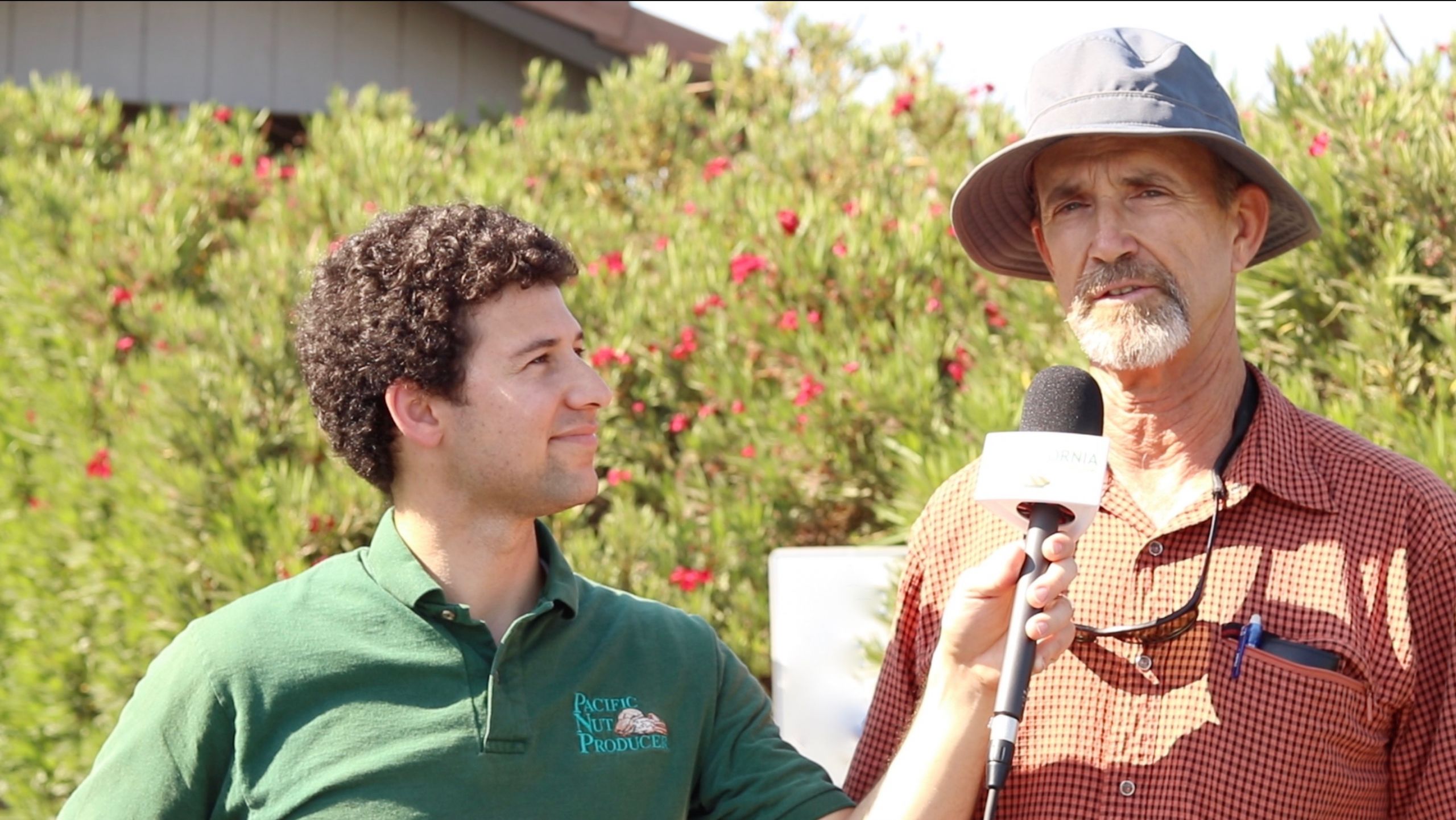
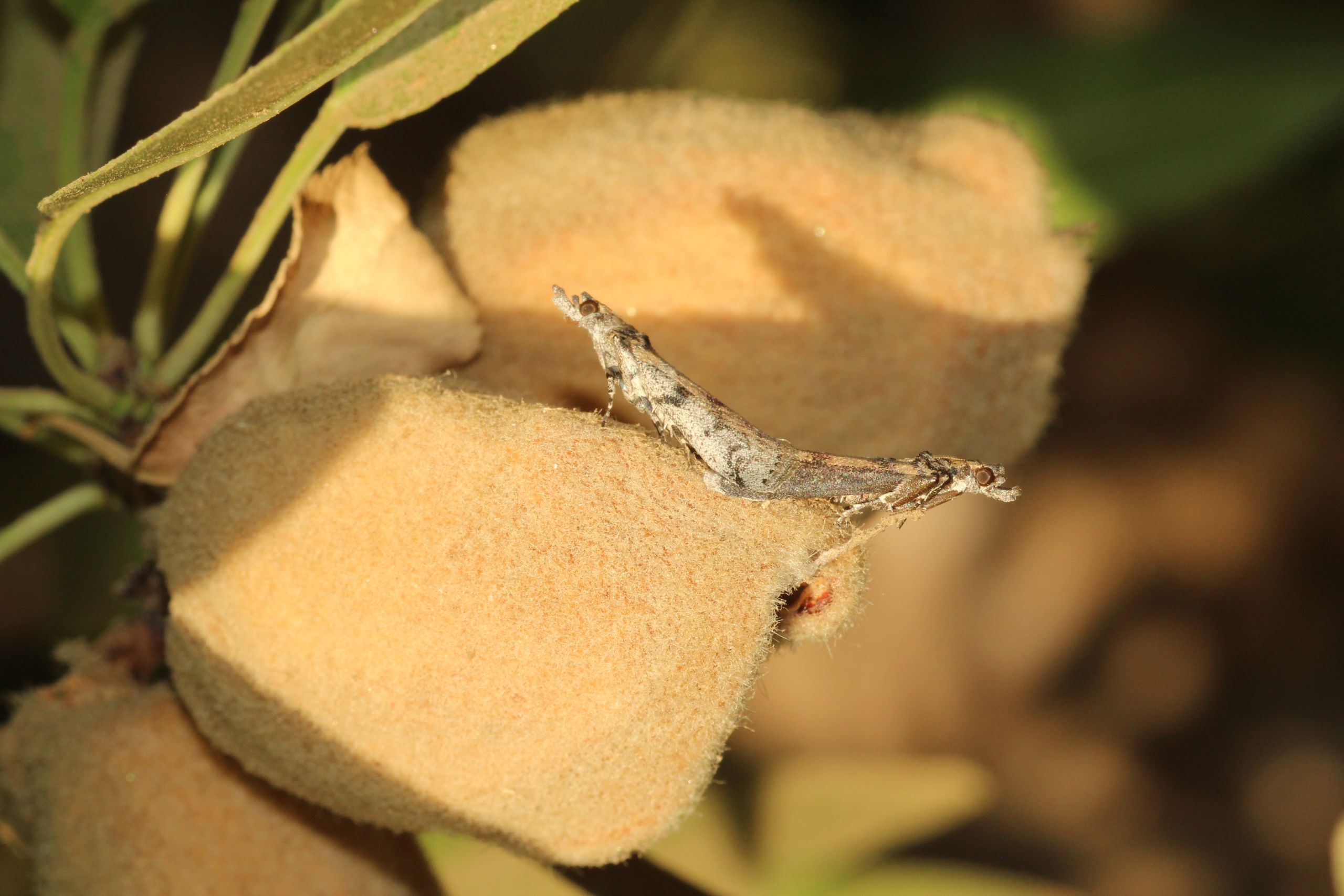
    Most tree nut growers have heard about the sterile insect technique research underway to combat Navel Orangeworm, the number one pest threat to almond and pistachio growers.  But what is the progress on this program and how soon can we expect to see these sterile insects released on a large scale to support California growers?  Watch this brief interview with Houston Wilson from the Kearney Ag Research & Extension Center, UC Cooperative Extension, to learn more.
    Please thank this video’s sponsor Suterra by taking this brief Survey.
  • Pacific Nut Producer August Issue

    [btn btnlink=”https://malcolmmedia.com/order-a-back-issue/back-issue-pacific-nut-producer-magazine/” btnsize=”full” txtcolor=”#ffffff” color=”#FFF” bgcolor=”#492500″ btnnewt=”1″ nofollow=”1″]Order A Back Issue[/btn]

    [btn btnlink=”http://malcolmmedia.com/pacific-nut-producer-magazine-subscriptions/” btnsize=”full” txtcolor=”#ffffff” bgcolor=”#492500″ btnnewt=”1″ nofollow=”1″]Subscribe Free[/btn]
    [three_fifth_last]

    Contents of the August Issue:

    Mariani Nut Company
    They Are the First to Roll Out Walnut Milk

    Pollination Points
    Seeds for Bees Program Offers Free Cover Crop Seed

    Almond Board Updates
    Online Meeting Explores Factors that Define Yield

    Orchard Tasks
    Almonds, Hazelnuts, Pecans, Pistachios, Walnuts

    [/three_fifth_last]

  • Incentive Programs Make New Equipment Affordable

    Incentive Programs Make New Equipment Affordable

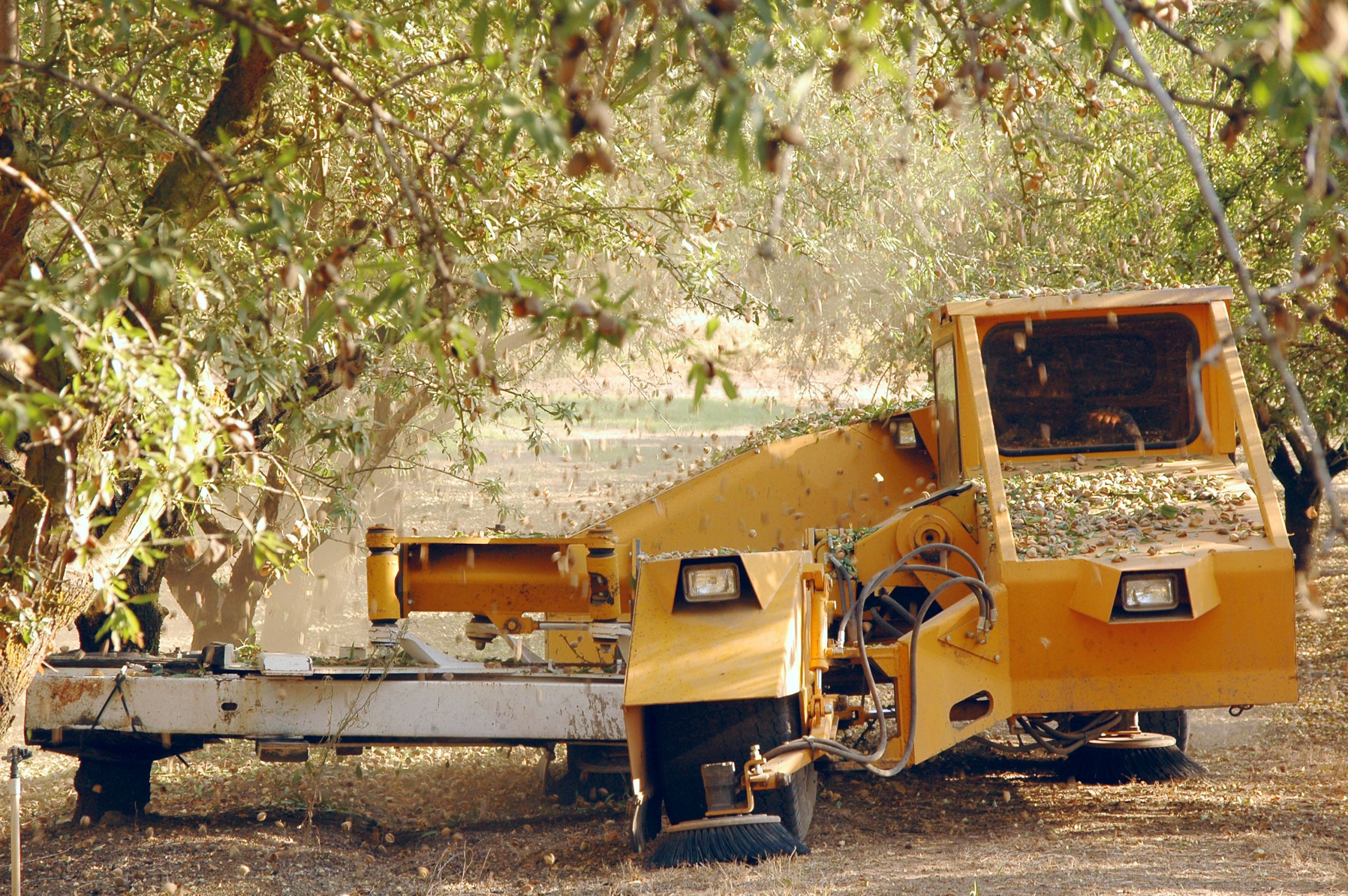
    Almond harvest 2020 is upon us in all its hectic glory. As growers in the southern San Joaquin Valley start shaking this week, equipment that has been largely resting for an entire year will be put to work in furious fashion to safely bring in this year’s crop. And while harvest 2020 is understandably the key focus of this time of year, it’s not too early for growers and their equipment operators and custom harvesters to begin considering what old equipment may need to be upgraded or replaced entirely before the following harvest.

    The San Joaquin Valley Air Pollution Control District (air district) and the federal Natural Resources Conservation Service (NRCS) both provide a range of financial incentives that make the cost of replacing not only shakers, sweepers and harvesters, but also tractors, sprayers and irrigation pumps more affordable. Given the high cost of purchasing new equipment and implementing certain new orchard management practices, these incentives can help growers stretch their budgets and get the most machine for their money.

    By design, there are also important environmental improvement objectives behind each incentive program – objectives that are consistent with the almond industry’s Almond Orchard 2025 Goals that include reducing harvest dust by 25% and achieving zero waste in orchards by putting everything grown to optimal use by 2025.

    “I think these programs are important, and increasing grower applications can play a role in helping the industry achieve all four 2025 goals,” said Jesse Roseman, principal analyst for Environmental and Regulatory Affairs at the Almond Board of California (ABC). “Growers who participate in these programs reduce their out-of-pocket costs for new equipment and cutting-edge practices that act as benchmarks in the industry’s goals.”

    In a recent ABC California Almond Sustainability Program webinar, officials from the air district and NRCS discussed what machinery and practices their programs cover, how the programs work and how growers can apply.


    Covering up to 60% of the cost of a new tractor

    Since 2009, the air district has awarded more than $406 million in funding to growers and ranchers in the San Joaquin Valley to promote healthy air quality, according to Aaron Tarango, the district’s grant supervisor. That investment has been matched by more than $466 million in spending by growers to replace 7,550 tractors as well as thousands of pieces of older equipment and pumps. Tarango estimated that noxious emissions have been reduced by 50,819 tons in the past 11 years through district incentives matched by funds from Central Valley farmers. 

    The air district prioritizes replacing older, lower-tier equipment through their programs. Growers are encouraged to replace tractors and other machinery in tiers 0, 1 or 2 (purchased in or before 2006) with tier 4 equipment, that is, “the latest and greatest technology” available, according to Tarango.

    Funds received are based on the horsepower (hp) of the engine being replaced. Here’s how it works: If a tier 0, 1 or 2 piece of equipment is 100hp, the district will help fund the purchase of replacement equipment with up to 25% more hp. Depending on the piece of equipment and the size of its engine, payments will range from $300 to $650 per hp and can cover up to 60% of the cost of a new model. 

    In 2019, the district piloted the Low Dust Harvester Replacement Program, which will cover 50% of a grower’s cost to replace older harvesting equipment with newer, low-dust models. That year, the air district funded 29 projects worth $1.9 million, Tarango said. The program was so popular that in June 2020 the Environmental Protection Agency set aside another $10.3 million to extend the program into 2021.

    Tarango said that money “might not help [growers] with this year’s harvest, but it will be available for subsequent harvests down the road.”

    Beyond harvest itself, another air district incentive program – the Alternative to Agricultural Open Burning Incentive Program – offers funds to growers who grind up old orchards, rather than burning their trees, and then incorporate that woody biomass back into the soil (a.k.a., Whole Orchard Recycling). Growers participating in this program are eligible to receive $300-$600 per acre, with a maximum of $60,000 per grower. Incentive recipients are typically paid four-to-six weeks after their completion of Whole Orchard Recycling, and after an invoice has been sent to the air district.1

    Tarango strongly encourages growers with older equipment or older orchards to take advantage of the district’s incentive programs.

    “We’re still going,” he said. “The money is still there.”

    More information is available at www.valleyair.org/grants/ and applications can be submitted at grants@valleyair.org. Growers who would like to speak with Tarango directly may contact him at aaron.tarango@valleyair.org or (559) 230-5873.


    NRCS programs have broad reach

    Similar to the District, NRCS offers two programs to help growers achieve and maintain their growing goals. The Environmental Quality Incentives Program (EQIP) helps participants cover the cost of planning and installing conservation practices. The Conservation Stewardship Program (CSP) offers additional opportunities for those already meeting a baseline level of stewardship. Projects might include improving irrigation systems, planting a cover crop for bees or soil health, or integrating better pest management systems. Growers can apply at any time of the year for either program.

    In addition, growers who have participated in the Market Facilitation Program or in the new Coronavirus Food Assistance Program – both of which are provided via USDA’s Farm Service Agency – have a leg up in filling out NRCS applications as their confidential information is accessible to the NRCS. This means that during the application process, growers have already completed the first step in qualifying for the NRCS incentive program because of the eligibility for other USDA programs.

    Ted Strauss is NRCS’s air quality resource conservationist for California. He said the NRCS programs target a range of environmental issues, from air to soil health to water quality.

    “Our primary role is conservation planning,” he said. “Participation is totally voluntary and always confidential. We’re not a regulatory body.”

    For growers, EQIP funding can be used to help replace a diesel-powered piece of equipment, with incentives based off horsepower and ranging from $325.61 to $507.17 per horsepower. That amount translates to $32,000 for a 100hp tractor or $114,000 for a 200hp tractor, Strauss said. The same rates apply to all self-propelled equipment.

    In addition, almond growers who hire out their harvesting each year can collect $39.98 per acre for up to three years if low-dust harvesting equipment is used.

    “Some producers have used those funds to purchase their own equipment, which is great because it helps with permanent reduction of emissions,” Strauss said. “So even if you don’t own the equipment currently being replaced, you’re still a good candidate for this program.”

    Like the air district, NRCS offers CSP incentive funds to growers who find alternatives to burning old trees, providing $238.36 per acre if the chips are sent to a biomass power plant or $766.94 per acre if the chips are recycled back into the soil, used for animal bedding or applied as mulch on another piece of ag land.

    NRCS also provides EQIP incentives ranging from $3,238.13 to $39,734 to replace motors on pumps. Funds are also available to help treat unpaved roads with lignin derivatives, oil or polymer emulsions.


    More information on NRCS’s CSP may be found on this handout and growers can submit applications year-round at local USDA service centers. Those looking to speak with Strauss may reach him at ted.strauss@usda.gov or (559) 490-5129. — Article Courtesy of the Almond Board of California

  • New Employer Playbook & Standards for Determining when Employees Can Return to Work

    New Employer Playbook & Standards for Determining when Employees Can Return to Work

    Almond Alliance of the California — Today, Governor Newsom announced that the State has issued a new Employer Playbook for a Safe Reopening, which contains guidance regarding all of the following:

    • Requirements employers must satisfy to provide safe and clean work environments. This guidance expands on the existing industry specific guidance and checklists, the most current versions of which can be viewed using the following link: https://covid19.ca.gov/industry-guidance/

    • What to do if there is a case of COVID-19 in the workplace. Importantly, this section contains the most current guidance to help employers determine when employees should be permitted to return to work after they have been diagnosed with COVID-19 or have been exposed to COVID-19 (pages 13 – 15).  Please note that the CDC’s guidance has changed since the last time our office provided our General Guidance materials.  In addition to reviewing the standards set forth in the Employer Playbook, you should look at the websites of all Counties in which you operate, as the Counties are permitted to issue varying standards.  Employer reporting obligations and employee leave rights (paid and unpaid) are also described in this section.  You should document each employee’s COVID-19 circumstance, your response, the employee’s leave rights and standard you used to allow the employee to return to work. 

    • Worker education topics and enforcement of mask requirements. The guidance summarizes the COVID-19-related issues employees are expected to understand, which establishes the criteria for your training obligations.  Links are provided to assist in your training efforts.  You should also continue to refer to the industry-specific guidance for your operation.  Be sure to keep records of all of your training sessions, including who attended, the topics discussed and all written materials distributed to your employees.The Employer Playbook for a Safe Reopening can be viewed using the following link:  https://files.covid19.ca.gov/pdf/employer-playbook-for-safe-reopening–en.pdf.  The Employer Playbook contains many links to additional websites, which should also be reviewed as applicable to your operation.As we have explained in previous emails, although the documents issued by the State are described as “Guidance” you should treat the standards described in the documents as Orders and ensure that your operation and employees strictly comply with all applicable requirements.  The Labor Commissioner’s Office, CalOSHA, ABC and other agencies are conducting enforcement visits to determine whether businesses are complying with the applicable standards and are issuing citations to those who are not.

      In addition to the Employer Playbook, Governor Newsom announced he is working with the Legislature and key stakeholders to expand critical protections for employees, including paid sick leave.  The Governor’s announcement can be viewed using the following link:  https://www.gov.ca.gov/2020/07/24/governor-newsom-announces-new-supports-for-california-workers/.

      Today’s announcements, and the new information contained in the Employer Playbook, is a reminder that the requirements and standards with which employers must comply continue to evolve on a regular basis.  Please be sure to always check the relevant websites for the most current information and contact your counsel anytime you have a question about how to respond to a COVID-19 issue in your operation.

      If you have any questions regarding this industry alert please contact staff@almondalliance.org.

  • Resources for Employers Amidst COVID-19 Outbreaks at Ag Facilities

    Resources for Employers Amidst COVID-19 Outbreaks at Ag Facilities

    Almond Alliance of California There have been multiple COVID-19 outbreaks at agricultural facilities and operations throughout the State.  Several of the outbreaks in agricultural areas have been reported in farmworker housing facilities, fields and processing facilities.  CalOSHA, Department of Health Services and the Attorney General’s office have been engaged in situations with multiple positive cases.  Many of our peer agricultural organizations and individual employers have received letters from the Attorney General’s office reminding about the need to provide guidance to our membership on the health and safety of the agricultural workforce. 

    Many grower and employer associations, local farm bureaus, and health and safety compliance businesses have shared resources with their members to help agricultural operations conduct an examination of workplaces to ensure that adequate measures are being undertaken to protect the health and safety of agricultural workers. 

    Below are resources for almond growers, huller shellers and processors.  As these materials are updated, the Almond Alliance will distribute revisions. Please post COVID-19 safety materials in Spanish and English throughout the workplace. Please call the Almond Alliance team if you have any questions or need additional information.

    Responding to COVID-19 in the Workplace:

    This guidance and checklist are for use by employers experiencing an outbreak of COVID-19 in their workplace. Employers should be proactive and keep in mind that identification of even a single positive case among employees may quickly develop into an outbreak. As outbreak circumstances and work practices vary, employers may need assistance from their local health department (LHD) to plan and coordinate a response to the outbreak that meets the needs of the workplace.

    • Industry Guidance:  Agriculture and Livestock: Click Here.
    • COVID-19 General Checklist for Agriculture and Livestock Employers: Click Here.

    COVID-19 Safety Posters and Materials for you to Place in the Workplace in English and Spanish to Reduce the Risk of Employee Exposure in the Workplace:

    • CDC Symptoms of Coronavirus (COVID-19) English Poster: Click Here.
    • CDC Síntomas del coronavirus (COVID-19) Spanish Poster: Click Here.
    • CDC Share facts about COVID-19 English Factsheet: Click Here.
    • CDC Comparta la información sobre el COVID-19 Spanish Factsheet: Click Here.
    • OSHA Ten Steps All Workplaces Can Take to Reduce Risk of Exposure to Coronavirus English Poster: Click Here.
    • OSHA Diez Medidas que Todos los Lugares de Trabajo Pueden Tomar para Prevenir la Exposición al Coronavirus Spanish Poster: Click Here.

    Cal/OSHA Guidance and Resources:

    • COVID-19 Daily Checklist for Agricultural Employers: English | Spanish
    • COVID-19 General Checklist for Agricultural Employers: English | Spanish
    • Infection Prevention for Agricultural Employers and Employees: English | Spanish
    • COVID-19 Worker Protection Video – Infection Prevention for Agricultural Workers (Video Transcripts:  English | Spanish | Mixteco

    What to Do if You Have COVID-19 Confirmed Positive or Exposed Workers:

    This document recommends a consistent approach in how a company can continue operations in the event an individual has tested positive, given the global COVID-19 pandemic and high transmissibility of this respiratory virus from person to person.

    U.S. Food and Drug Administration (FDA):  What to Do if You Have COVID-19 Confirmed Positive or Exposed Workers in Your Food Production, Storage, or Distribution Operations Regulated by FDA: Click Here.

    Food Industry Recommended Protocols When Employee/Customer Tests Positive for COVID-19:

    This summary, derived from Centers for Disease Control and Prevention (CDC) recommendations, outlines key steps that employers and workers can take to help stay open, prevent and slow the spread of COVID-19, and support continuity of essential operations if workers are diagnosed with or exposed to COVID-19, or show symptoms associated with COVID-19: Click Here.

    Additional Materials:

    • Agricultural Employer Checklist for Creating a COVID-19 Assessment and Control Plan: Click Here.
    • Testing Strategy for Coronavirus (COVID‐19) in High‐Density Critical Infrastructure Workplaces after a COVID‐19 Case is Identified: Click Here.

    Note: This document is provided for informational purposes only and does not constitute legal advice. Almond Alliance of California does not advise on the application of law to an individual’s or company’s specific circumstances. Although we go to great lengths to make sure our information is accurate and useful, we recommend you consult a lawyer if you want professional assurance that our information, and your interpretation of it, is appropriate to your particular situation.

  • USDA Confirms Record 3 Billion Pound CA Almond Crop Forecast

    USDA Confirms Record 3 Billion Pound CA Almond Crop Forecast

    The California Almond Objective Measurement Report, published today by the United States Department of Agriculture (USDA) National Agricultural Statistics Service (NASS), estimates that the 2020 crop will be 3.00 billion meat pounds, up 18% from the 2019 crop production of 2.55 billion pounds.[1] This estimate is even with the 3.00 billion pounds estimated in the California Almond Subjective Forecast, published in May 2020.

    According to the 2020 Objective Report, the average nut set per tree is 5,645, up 21% from the 2019 almond crop. The Nonpareil average nut set is 5,621, up 27% from last year’s set. The average kernel weight for all varieties sampled was 1.51 grams, down 2 percent from the 2019 average weight.

    “This year’s crop is proof that California is the perfect place to grow almonds,” said Holly A. King, Kern County almond grower and Chair of the Almond Board of California (ABC) Board of Directors. “Perfect weather during bloom, coupled with the steps almond growers have taken to ensure our orchards provide a healthy environment for honey bees and other pollinators, resulted in the abundant crop we are seeing on the trees up and down the Central Valley.”

    Recent disruptions in global trade due to COVID-19, and ongoing trade disputes and negotiations with China and other key markets extending into the year, have caused some short-term challenges with the current crop, but the long-term outlook remains positive.

    “As a shelf stable and nutritious food enjoyed by consumers around the world, we’ve weathered these disruptions in pretty good shape,” said Almond Board President and CEO Richard Waycott. “Domestic and export shipments are up year-to-date, and we expect global demand to be stronger than ever as we market this year’s record crop.”

    While the Subjective Forecast provides an initial estimate of the 2020/2021 crop, the Objective Report is based on actual almond counts and uses a more statistically rigorous methodology to determine yield. In Dec. 2019, ABC’s Board of Directors approved a modified sampling protocol to further improve the accuracy of USDA-NASS’s reporting. From this year forward, the Objective Report will include measurements from 1,000 target orchards throughout the state (an increase of 150 samples from 2019) and provide nut counts on not one but two branches per tree. The Objective Report will also provide the weight, size and grade of the average almond sample broken down by growing region – no longer growing district – and variety.

    USDA-NASS conducts the annual Objective ReportSubjective Forecast and Acreage Report to provide the California almond industry with the data needed to make informed business decisions, and thanks all farm operators, owners and management entities for their time in providing the information necessary to create these reports. These reports are the official industry crop estimates. —Article & Featured Image Courtesy of the Almond Board of California

    [1] USDA-NASS. 2020 California Almond Objective Measurement Report. July 2020.

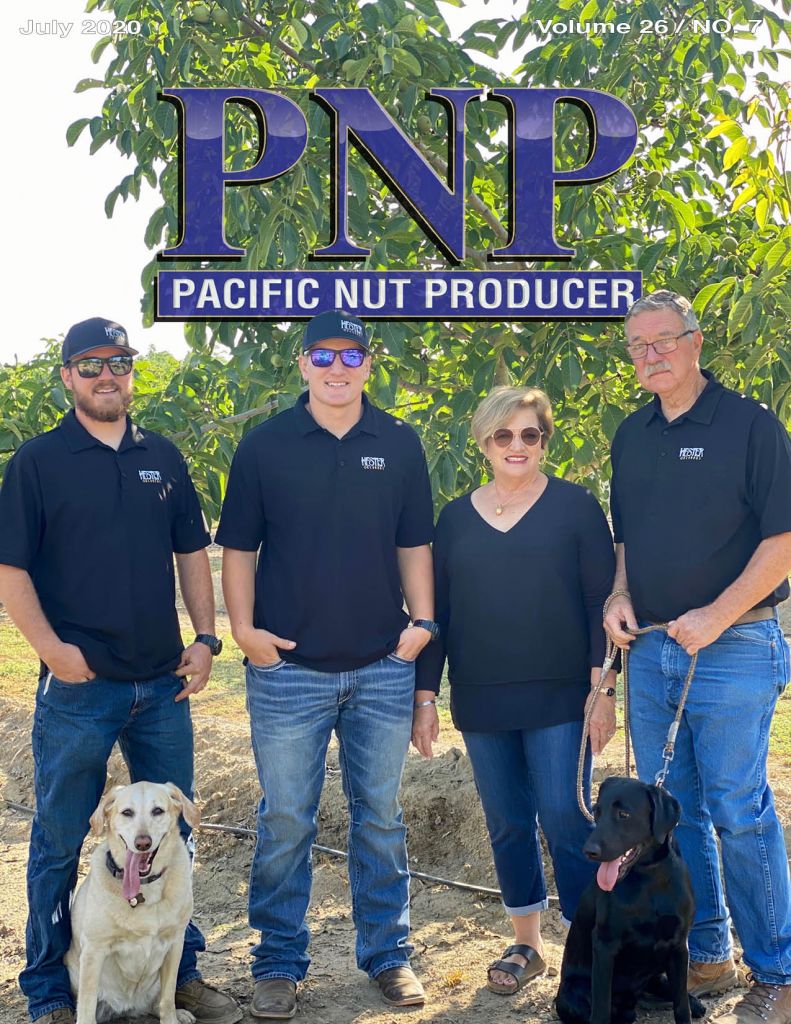
  • Pacific Nut Producer July Issue

    Pacific Nut Producer July Issue

    [btn btnlink=”https://malcolmmedia.com/order-a-back-issue/back-issue-pacific-nut-producer-magazine/” btnsize=”full” txtcolor=”#ffffff” color=”#FFF” bgcolor=”#492500″ btnnewt=”1″ nofollow=”1″]Order A Back Issue[/btn]
    [btn btnlink=”http://malcolmmedia.com/pacific-nut-producer-magazine-subscriptions/” btnsize=”full” txtcolor=”#ffffff” bgcolor=”#492500″ btnnewt=”1″ nofollow=”1″]Subscribe Free[/btn]
    [three_fifth_last]

    Contents of the July Issue:

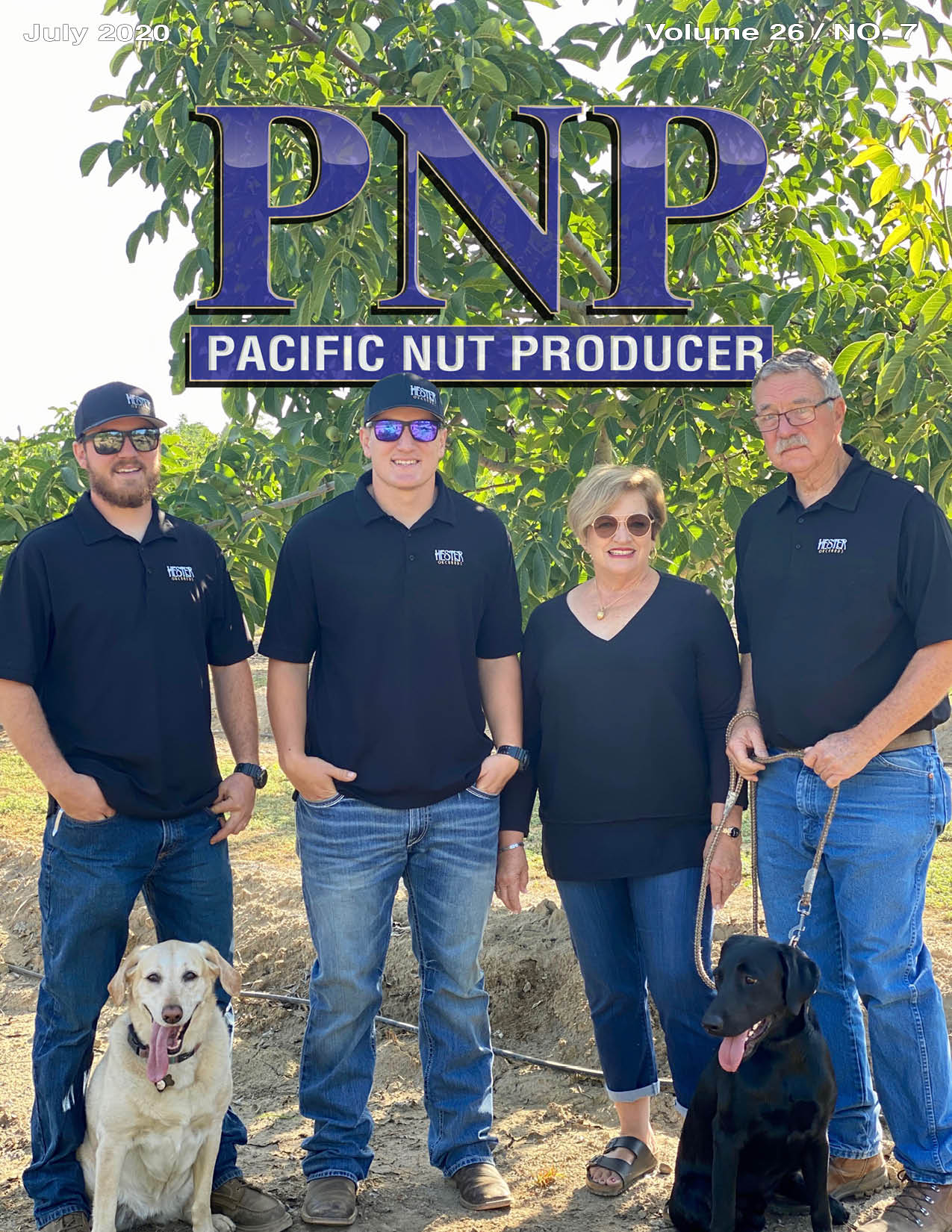
    Farming & Managing Walnuts in Tulare County
    Gary Hester is Fourth Generation Farmer

    Coronavirus Food Assistance Program for Growers
    FSA Accepting Applications Through August 28th

    Orchard Tasks
    Almonds, Hazelnuts, Macadamias, Pecans, Pistachios, Walnuts

    [/three_fifth_last]

  • Coronavirus Food Assistance Program Almond Webinar, June 22

    Coronavirus Food Assistance Program Almond Webinar, June 22

    In an effort to address almond industry questions about the Coronavirus Food Assistance Program (CFAP) the Almond Alliance, Almond Board of California and Farm Service Agency (FSA) will be hosting a 2nd webinar to respond to the frequently asked questions by the industry. FSA has begin accepting applications and there has been some confusion we would like to address and provide clarity to the pooling issues. FSA will continue to accept applications through August 28, 2020. We are hosting this one hour webinar to provide California almond growers with the information you need to apply for all available assistance so please ask your questions during the webinar.

    Click HERE to join the webinar Monday, June 22 at 10:00 AM.
    +1 213-262-7443 United States, Los Angeles (Toll) (866) 629-0965 United States (Toll-free) Conference ID: 382 170 011#

    For more information contact Bunnie Ibrahim P: 209.343.3228 E: bibrahim@almondboard.com

  • Three Ways to Prevent Almond Hull Rot

    Three Ways to Prevent Almond Hull Rot

    As almond growers in California prepare for hull split, almond hull rot is often a problem on their minds during this time. As UC Cooperative Extension Orchard Systems Farm Advisor Franz Niederholzer says, prevention is key.  Watch this brief interview with Franz as he shares three tips on avoiding this costly issue in the orchard, and read more about it in Pacific Nut Producer Magazine. Don’t currently receive the magazine? Subscribe for free at: https://malcolmmedia.com/pacific-nut-producer-magazine-subscriptions/