Hazelnuts have become a pretty hot commodity in the Pacific Northwest. If you ask most farmers in the area, though, that have converted from growing other crops like grass seed to growing hazelnut trees in recent years, there was quite a learning curve to adjust to. Many hear that growing hazelnuts is less labor-intensive and more profitable than other crops in the region. “Just plant your trees and watch them grow!” some may assume. They soon find though that there is much more to growing hazelnuts than meets the eye. Watch this brief interview with Erica Chernoh from the Lane County Horticulture Extension at Oregon State University (OSU) as she shares a few things growers should know before planting the crop. Read monthly tips from OSU on growing hazelnuts in Pacific Nut Producer Magazine. Subscribe for free at: https://malcolmmedia.com/subscribe/
In November 2022, the newly realigned 13th Congressional District of California elected to send a farmer to represent them in congress. Representative John Duarte has been at the job for about a year in a half and has been working on a number of bills to support California’s specialty crop industries, which are in desperate need of recovery from many challenges brought on by the pandemic and drought, among other global trade, inflation, and invasive pest pressures. Watch his brief interview with Matthew Malcolm from California Ag Network to learn more.
As brown marmorated stink bug becomes a bigger problem in the Pacific Northwest, hazelnut growers are searching for better tools to manage this invasive pest. Matthew Malcolm met with Edwin Harris from the Vaughn Walton Lab at Oregon State University, who is evaluating a promising new monitoring trap to help growers combat this pest. Watch this brief interview and read more about it in Pacific Nut Producer Magazine. Don’t currently receive the magazine? Subscribe for free at: https://malcolmmedia.com/subscribe/
Growers required to have a Conservation Management Practice (CMP) plan in the San Joaquin Valley for dust reduction have received some favorable news. The San Joaquin Valley Air Pollution Control District (SJVAPCD) announced an update to their list of approved practices to reduce dust emissions, now including the use of low-dust harvesters.
The SJVAPCD Conservation Management Practices, Rule 4550, was adopted in 2004. The purpose of the program is to reduce dust emissions, both PM10 and PM2.5, from agricultural sites. Growers with 100 acres or more in the district must provide a CMP plan, choosing to participate in dust-reducing practices across several categories. In April 2024, the SJVAPCD approved the addition of Low-Dust Nut Harvesters as an approved practice for the nut crops harvest category.
Benefits of Low-Dust Harvesters
Low-dust harvesters are designed to minimize the amount of particulate matter released into the air during the harvesting process. These machines employ advanced technologies that reduce the turbulence and agitation of soil and debris, which are primary sources of dust. The benefits of using these harvesters extend beyond regulatory compliance:
Improved Air Quality: Reduced dust emissions lead to better air quality, benefiting both agricultural workers and neighbors.
Enhanced Worker Health: Lower dust levels mean fewer respiratory issues and related health problems for farmworkers, promoting a safer working environment.
Environmental Impact: Decreasing dust emissions helps protect the local ecosystem, including plant and animal life that can be affected by poor air quality.
Implementation and Cost Considerations
Growers can take advantage of low-dust harvest technology by either contracting with a custom harvester who uses the equipment or replacing a conventional harvester or sweeper they currently use. For both options, there are incentive programs available to growers.
If a grower is interested in purchasing low-dust harvest equipment, both NRCS and the SJVAPCD offer significant cost-share assistance to help purchase the equipment:
Through NRCS’s EQIP program to replace old in-use harvesting equipment, low-dust harvesters can receive up to $1,174.80 per horsepower (hp), while tractors and most other equipment can receive payments of $517.85 per brake horsepower (bhp) for 25-160 bhp and $806.60 per bhp for greater than 160 bhp.
Through the SJVAPCD’s program to replace conventional harvesters or sweepers, growers can receive 50% of the equipment cost and up to a maximum of $150,000 per unit. Growers can also apply for up to five pieces of equipment.
If growers currently use or are interested in using a custom harvester that has low-dust equipment, USDA-NRCS offers a by-acre cost-share incentive to help pay for the practice at a rate of $66.82 per acre.
For both incentive options, applications should be submitted well in advance of using or buying the equipment, and both programs also have several eligibility requirements. Contact your local San Joaquin Valley Air District Office or local NRCS office for more information.— By the Almond Board of California
Pistachio acreage in California has been steadily increasing in recent years. A recent report by the Administrative Committee for Pistachios puts the bearing acreage of pistachio in California at about 461,000 acres, and the non-bearing acreage at about 144,000 acres. The average acreage for new yearly plantings for the last five years is about 29,000 acres. Much of the new plantings are in areas in the southern San Joaquin Valley that have moderate to high salinity. Generally, young pistachio trees are those that of non-bearing age.
In California, pistachio is usually planted at row spacings of 20 to 22 feet and tree spacings of 15 to 20 feet. In ideal circumstances, the tree grows to cover most of this space by the time it reaches maturity. The amount of orchard space that the tree canopies shade at any given time is a critical component that goes into the estimation of how much water the trees need as they mature. For mature pistachio trees, the intermittent estimation of the crop water requirement (evapotranspiration) is relatively easier to determine due to the availability of research-developed water use curves (crop coefficients) for pistachio trees. In the southern San Joaquin Valley, a mature pistachio tree requires about 46 inches of water every season; with a peak daily demand of about 0.34 inches per day during hottest summer days. Research has shown that the evapotranspiration of tree crops generally tends to reach its maximum by the time the orchard floor area shaded by the tree canopies is between 50 and 60%. Young pistachio evapotranspiration is estimated by multiplying that of a mature tree by an adjustment factor. For example, the crop water demand of a first-leaf pistachio tree, on a peak evapotranspiration summer day is about: 0.34 in./day multiplied by an adjustment factor of 0.1, which yields a value of 0.034 inches per day. Adjustment factors for drip irrigated pistachio in the southern San Joaquin are as follows: 0.10 for year 1; 0.20 for year 2; 0.30 for year 3; 0.40 for year 4; 0.52 for year 5; 0.65 for year 6; 0.78 for year 7; 0.90 for year 8; 1.00 for year 9 and older. For more information on these adjustment factors, visit the website of the University of California Cooperative Extension Kern County Office.
Figure 1 Button dripper installed on an irrigation lateral
Like many orchard crops grown in California today, pistachio trees are mainly irrigated using microirrigation devices; which are designed to ensure irrigation efficiencies of at least 90% and above. Microirrigation devices operate at low pressures (3 to 20 psi), apply water at low rates (as low as 0.5 gph to highs of 10 to 20 gph), and more precisely compared other pressurized irrigation methods. Examples of microirrigation devices include: inline drip, micro-sprinklers and micro-sprays (sometimes called fan-jets), button drippers.
In the first years of its growth, a young pistachio tree spends most of its energy on vegetative growth. Its canopy is very small and only covers a small fraction of its assigned tree area; implying that it has a relatively small evaporative surface. To efficiently irrigate a young pistachio tree, it is important to ensure that water is directly applied to the area close to the base of the tree and is concentrated to the rootzone. This approach mitigates water and nutrient loss through deep percolation and/or evaporation, and is generally recommended for widely spaced crops. Effort should be made to avoid applying water to the spaces where there isn’t significant root growth – such as the midway point between successive young trees – and this can be achieved by selecting the appropriate irrigation device. For young pistachios, button drippers are recommended because they can be installed close to the tree. Button drippers usually have flow rates ranging from 0.5 to 2 gph. To install a button dripper, the irrigation lateral is punctured to create a small hole which is then plugged with the emitter. For newly potted trees, the dripper should be positioned to apply water directly to the root ball for about 30 days. After the roots have grown into the surrounding soil, one or two button drippers can be installed at least one foot off either side of the trunk. As the tree grows each year, additional button drippers are added onto the lateral; much further away from the trunk. It is important to take note of the flow rate of the drippers, peak evapotranspiration of the tree and soil water holding capacity vis-à-vis state of root growth, when deciding the number of emitters to install as the tree grows. If a grower prefers, the button drippers could be replaced by micro-sprinklers or micro-sprays when the trees are mature and/or when most of the orchard canopy is closed.
To promote root growth in young established trees, it is recommended that they are not frequently irrigated as an imposition of mild stress conditions spurs roots to grow in search of water and nutrients. However, newly transplanted trees may require more frequent irrigation during the initial stages while their roots grow into their immediate soil surroundings. In irrigation practice, the amount of water applied, when it is applied, is determined by the water storage capacity of the managed rootzone, and in accordance with an allowable water depletion rate. This is called irrigation scheduling. The rootzone water storage capacity is mainly determined by soil texture. It is therefore important to find out what type of soil is found in the orchard when determining an irrigation schedule. This is especially important when microirrigation methods are managed to apply water only to the rootzone of young trees. Light (sandy) soils tend to have lower lateral water redistribution and retention capacities. In such soils, more frequent but low volume irrigation may be recommended. On the other hand, very heavy clay soils – though having higher water retention abilities – may also require frequent irrigation because a significant bit of much of the water stored in them is not available to the trees. Soils with the highest water storage capacity tend to be silt-loams.
To aid irrigation management, it is recommended that growers utilize soil moisture probes. These are widely available in the market. Stem water potential of young pistachio trees can be monitored using the hand-held pump-up pressure chamber since their stems are usually thin for high-tech plug-in sensors. Although there is no research developed baseline values of SWP for pistachio trees – unlike almonds for example –, it is recommended that the irrigation strategy for young trees should be to avoid prolonged conditions of water stress. To this, the SWP should be maintained between -9 to 10 bars often. It is also advisable to monitor soil moisture close to the base of tree and at multiple points of the rootzone. To do this, for an example, a probe could be placed within one foot of the tree or dripper, and soil moisture monitored at depths of one and two feet. If funds permit, and depending on the type to device chosen, a longer soil probe – 4 to 6 feet – could be installed to monitor moisture at greater depths, in the long run as the tree grows to maturity. In order to get an orchard-wide overview of the soil moisture status at any time, it is recommended to install several sensors at different locations within the field. To determine the number of sensors and installation locations within a field, a soil map such as that provided by as the USDA’s Web Soils Survey, or UC Davis’s SoilWeb application is helpful. Alternatively, a lab test of soil samples taken from different locations in the field, could be used to guide soil probe installation. Most sensors available in the market report soil moisture either as volumetric water content, or as a soil tension force. Irrespective of units, from an irrigator’s perspective, the values of interest are the field capacity and permanent wilting point of soil at the site and the reading returned by the probe at any given time. For orchards on loamy soils, moisture depletion up to the midpoint value between field capacity and permanent wilting point (or 50% moisture depletion), before resumption of irrigation is considered to be acceptable.
Lastly, the performance of an irrigation system can also be limited by the general state of the “health” of the soil of an orchard site. For example, soils which are highly compacted and/or sodic significantly limit soil water infiltration; leading to water loss. Therefore, when establishing new orchards in “tough” soils, it may be beneficial to carry out some practices to improve the physical, chemical and biological properties of the soil. This may involve actions like tilling to break soil crust, applying amendments to reduce salinity or sodicity and adding organic matter.
Many factors are part of the equation of economically sustainable pistachio production. Efficient water use is one of those, which is particularly important in a state like California where production is heavily reliant on irrigation.
For more information about pistachio irrigation, please call the UCCE-Kern Soils and Irrigation Advisor or visit the website of the University of California Kern County Cooperative Extension office. — By Tobias E. Oker, Soils & Irrigation Advisor, UC Cooperative Extension, Kern County
University of California, Agriculture and Natural Resources
Did we get enough chill over the winter? What are yields going to look like this fall? One relatively new area of research, carbohydrate dynamics, is shedding light that may help answer these questions. Recent years of research by the Zwieniecki lab (the Z Lab) at UC Davis, including the Carbohydrate Observatory, have been providing exciting new insights to better explain how pistachios may be counting winter chill, when budbreak occurs, and how much pistachios will yield in a given year. While many areas remain to be investigated, this research is starting to provide insight into how management can influence carbohydrates, which in turn influence dormancy, budbreak and yield.
What Are Carbohydrates?
A few definitions are helpful before we dive into discussion. Non-structural carbohydrates (NSC) are carbohydrates that are not part of structures like cell walls. NSC are utilized by the tree for energy, as building blocks for cell growth, as an osmolyte to influence water dynamics, and as signals for multiple physiological activities. NSC are either in the form of sugars or starch. Sugars are the product of photosynthesis, and the building blocks of starch. Sugars are also an active part of biological cell activity and their level in cells are under strict control. Starch is the storage form of carbohydrates and can later be broken down to provide sugars.
How Do Carbohydrates Vary Over the Year?
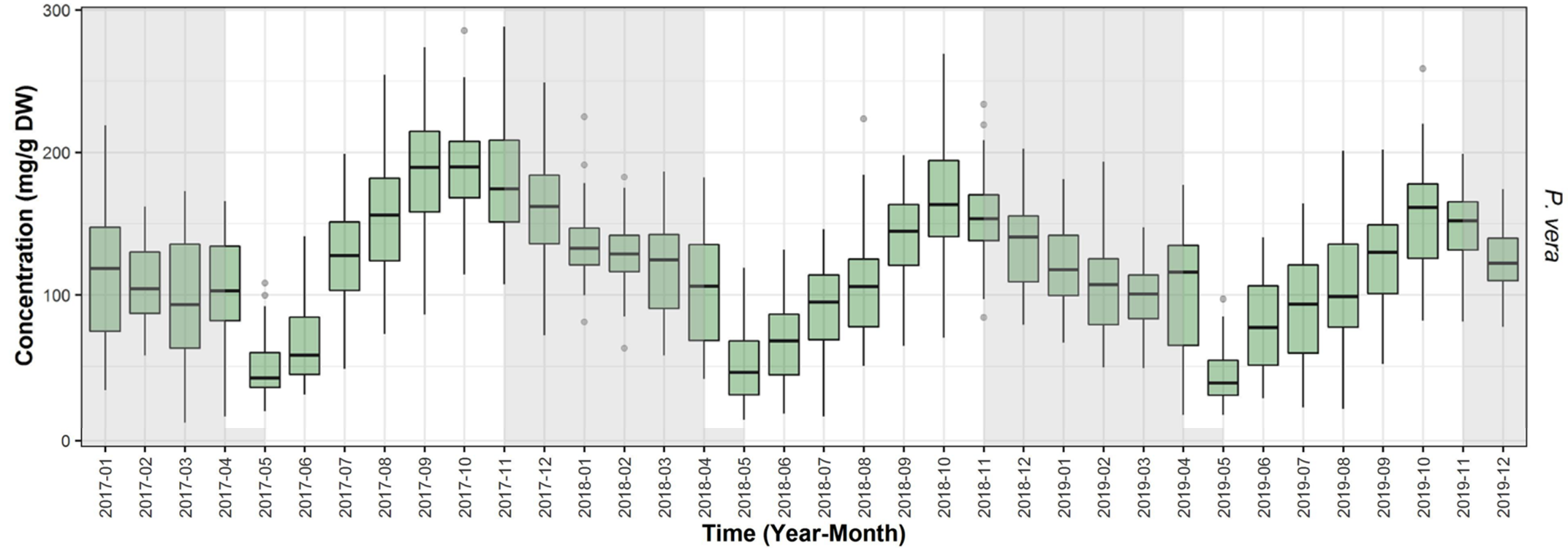
An intensive sampling was conducted of carbohydrates of almonds, pistachios and walnuts in the twig, branches and trunk over the course of a year. As has been seen in other temperate trees, it was found that NSC varies with changing stages of growth or phenology, and concurrent climatic conditions. NSC decreases following bud break, reaches the lowest levels during the growing season, and then increases starting mid-to-late summer to reach maximum levels in fall or early winter (Figure 1). By following the amounts of NSC in a plant over time, we can build a better understanding of how trees are using carbohydrates for current opportunities (vegetative and fruit growth) or future challenges (dormancy, defense against pathogens and other stressors).
Carbohydrate Dynamics Predict Bloom
Exactly how trees track the accumulated experience of winter cold and spring heat to “know” it’s time to break dormancy in the spring has remained somewhat mysterious. The Carbohydrate Observatory has found that in almonds, pistachios, and walnuts, shortly before bud break, there is a surge in starch and a dip in sugar concentration. The Z Lab has used this knowledge to create a model for bloom timing, based on fall and winter carbohydrate and temperature dynamics. This bloom prediction model integrates some important aspects about how plants balance sugar and starch concentrations. When it is warm, trees turn sugars into starch, and when it’s cold, trees turn starch into sugar. For trees to keep sugar levels in an optimum range, they adjust the concentration of the enzymes responsible for this starch synthesis and degradation. Because starch synthesis is very temperature sensitive, but starch degradation is not, trees can quickly respond to too much sugar at warm temperatures but can’t respond as quickly to too little sugar. When conditions warm up in the spring, starch synthesis quickly takes off, pulling sugars out of circulation, resulting in a dip in sugar. This dip in sugar and upsurge in starch is predictive of (and may even trigger) bud break.
Figure 1. Average concentration of NSC (sugars and starches) from more than 40 pistachio orchards from January 2017 to December 2019. The center bar of each green box shows the average for that month, the box shows the zone where half of all the values from that month lie (25% above and below the average) and the whisker lines show more extreme values. Grey shading reflects the dormancy period. (Davidson et al., 2021. Sci. Reports)
Because of the different temperatures sensitivities of the different enzymes, cold winters, somewhat counter-intuitively, would amplify accumulation of starch synthesis enzymes, resulting in less warm time necessary in the spring to trigger a sharp sugar drop and bloom. Warmer winters would downregulate starch synthesis, requiring more warmth than normal in the spring to achieve low sugar levels. By integrating this knowledge of the principles of carbohydrate dynamics and specific thresholds and ranges learned from the Carbohydrate Observatory, pistachio budbreak was predicted within 7 days on average (Sperling et al 2021). While this may not be accurate enough for management decisions, it’s close enough to support integrating these carbohydrate dynamics into our understanding of how trees count the passing of winter and spring.
Using this model, they could then extrapolate the impacts of sugar concentrations going into winter. Going into winter with higher sugars, a metric of having built up higher NSC reserves over the growing season, results in earlier bloom, functioning almost like having experienced more chill. Lower sugars results in later bloom. This is supported by other recent research (Amico Roxas et al, 2021), that found that early defoliation in the fall decreased NSC going into winter and delayed budbreak in the spring, whereas girdling branches in October (which keeps more carbohydrates in the shoots) moved budbreak earlier.
Carbohydrates and Yield
Because carbohydrates are both the energy currency of plants and are used to make structures like cell walls, they are critical to growing pistachio fruit during the summer. NSC concentrations stay low during the growing season, as the carbohydrates made by photosynthesis get channeled into growing the crop, and sometimes into growing vegetation. New research is showing this interplay of carbohydrate sinks, photosynthesis and nitrogen demands may help explain alternate bearing habits of pistachio. UCCE Orchard Specialist Giulia Marino has recently looked into these dynamics by either partially defoliating bearing branches to reduce carbohydrate sources, or partially stripped off growing fruit to reduce carbohydrate sinks. She found that branches with a lot of leaves relative to the number of fruits actually increased photosynthesis during kernel fill, presumably in response to the strong carbohydrate demand of nearby fruit. However, branches with a lot of fruit set decreased photosynthesis after kernel fill. This may seem counter-intuitive (shouldn’t they ramp up photosynthesis even more?), until they found that nitrogen in the leaves of those branches was decreasing at the same time that photosynthesis was dropping. This is likely because nitrogen was remobilized from the leaves to the kernels, hindering the nitrogen-related components of the photosynthetic process. Why does this concern us, from a production standpoint? Because this change would then result in lower carbohydrate availability for buds being created for the following year’s crop, leading to alternate bearing.
Relatedly, Dr Zwieniecki, looking across almonds, pistachios and walnuts data from the Carbohydrate Observatory and yields provided by growers, sought to see if there was a relationship between NSC in different months of the year and yield (Zwieniecki et al 2023). He found that in pistachios there’s a strong, consistent correlation between NSC in wood and bark in the fall and winter (October through March) with yield the following year, particularly the starch component of total NSC,. This relationship was most pronounced in December, shortly after leaf drop. The higher the starch in the wood of pistachio twigs, the higher the yield turned out to be the following year. Given Marino’s findings of how carbohydrates relate to alternate bearing, this high starch-high yield relationship is likely in part a matter of correlation – following a low set “off” year, Marino’s research indicates you’d go into winter with more female flower buds and more carbohydrates. However, higher winter NSC was also found to be related to higher yields in almond and walnut, which don’t have this alternate bearing complication. This indicates that yields are likely also higher following a high carbohydrate winter because there’s more gas in the carbohydrate tank to fuel the growth needs of the crops the following season.
What’s this all mean for production?
The relationship between chill, heat and carbohydrates helps us understand why warm winter temperatures, and warmed wood and buds in low fog winters lead to delayed and protracted budbreak. This also explains why chemical sprays that interfere with respiration (cells turning sugar into energy) and reflectants (e.g. kaolin clay) that keep wood temperature lower could help compensate for lower chill. More work is needed to help fine tune the use of this knowledge, say to know how warm temperatures need to be to make reflectants worth the expense, or when the optimal time is for spraying dormancy breaking treatments.
The strong relationship between high NSC going into winter, strong yields and normal bloom timing suggest that late season management that helps send orchards into dormancy with higher amounts of NSC leads to positive outcomes of budbreak timing and yield. Irrigation and foliar disease management that can keep leaves healthy and producing new sugars well into October should benefit this NSC accumulation. Stresses that lead to early defoliation would have the opposite effect. The next step in research is to look into other factors can influence this relationship (Variety or rootstock selection? Nutrient management to keep leaves healthy and photosynthesizing?), and whether they have enough influence to merit the expense. — By Katherine Jarvis-Shean (UCCE Orchard Advisor, Sacramento, Solano & Yolo Counties) and Maciej Zwieniecki (Dept. Plant Sciences, UC Davis)
Oakville Bluegrass Cooperative opened enrollment for the inaugural year of the USDA climate-smart partnerships incentive to plant Oakville bluegrass, a summer-dormant perennial cover crop. Because Oakville bluegrass is dormant from April through September, it doesn’t compete with cash crops for water or nutrients making it ideal for California permanent crops. Planted on over 900 acres of vineyards and tree nut orchards, this low growing, drought tolerant cover crop will last over ten years when well managed, significantly reducing labor and input costs for growers. When well managed, this low growing, drought tolerant cover crop will last over ten years significantly reducing labor and input costs for growers.
The first cohort of growers who take advantage of the USDA incentive can receive a $100/acre incentive per seeded acre of the cover crop on up to 150 acres. The incentive is part of the USDA’s Climate Smart Commodities Program to equip growers with resources to implement climate smart practices.
In addition to the USDA incentive, Oakville Bluegrass Cooperative is offering free seed shipping and waiving install fees for a limited time for growers who commit to planting at least 20 seeded acres. Growers who are interested in participating in the USDA incentive and this special offer are encouraged to submit their preliminary plans soon in order to take advantage of these opportunities.
“Oakville bluegrass occupies a unique place in the market as a permanent cover solution,” Mike Morgenfeld, Managing Director for Oakville Bluegrass Cooperative shared. “When established correctly, it reduces operating costs over time while also building soil health and conserving water. Due to its low profile and drought resistance, it’s a unique solution for specialty crop growers in California. We’re excited to offer a way for growers to start their journey with this novel cover crop at a reduced cost.”
It’s that time of the year as pistachio harvest nears that American Pistachio Growers (APG) gathers its members together at the Visalia Convention Center. But this year, growers are invited to more than just your typical Summer Luncheon. This longtime tradition has been reinvented into an all-day event to support the booming western pistachio industry. APG’s Wes Wilson met with Matthew Malcolm on California Ag Network to share a sneak preview of what growers can expect in attending thePistachio Industry Insights Day. Watch this brief interview and be sure to come see Pacific Nut Producer Magazine there as a proud sponsor of this event.
The 2024 California Almond Objective Measurement Report published July 10th by the U.S. Department of Agriculture’s National Agricultural Statistics Service (USDA-NASS) estimates that the crop harvested in 2024 will come in at 2.80 billion meat pounds.
The estimate is down 7 percent from USDA-NASS’s Subjective Forecast in May. It follows a generally solid bloom as well as a year in which growers faced a range of economic challenges. It also comes when the carryout is projected to drop to levels not seen in years as almond shipments set a record of 10 months straight of at least 212 million pounds shipped.
“The Objective Measurement is in line with what the industry expected and a drop from the Subjective Estimate. It reflects both a good bloom and hard work by California almond growers during trying times,” said Clarice Turner, president and CEO of the Almond Board of California. “For perspective, demand has been strong, consistent and continues to grow, which has reduced the carryout to what may be the smallest in years. California almonds shipped at least 212 million pounds each of the first 10 months of this crop year and averaged 230 million pounds a month. Never before has the industry shipped even 200 million pounds 10 months in a row in the same crop year.”
Turner said the Almond Board expects the almond supply to be similar to what was available in the past 2023-24 crop year.
“The actual supply of California almonds available for the market is the combination of crop size and carryout from the previous year,” she said, “We expect only minor changes, if any, to the supply for market this next crop year because the forecasted increase in crop size will mostly be offset by the smaller carryout. Clearly, global demand is strong and consistent. We will continue to work hard to meet growing demand.”
The 2023 harvest yielded 2.47 billion pounds, 5% below the 2023 Objective Report estimate, reflecting the difficulty of precisely forecasting crop size given the current fluctuations in weather and economic factors.
USDA-NASS said the 2024 harvest is expected to be on schedule. “The 2024 almond crop experienced mostly favorable weather during the bloom period,” the report said. “Bee hours were reported to be significantly higher than last year. Wet and warm weather in April increased pest and disease pressure, but dry conditions and mild temperatures in May helped the developing crop. Multiple heat waves across the state during June and July required growers to increase irrigation on their orchards.”
USDA-NASS’ forecasted yield is 2030 pounds per acre, up from 1,790 in 2023. The forecast for the average nut set per tree is 4,072 up from 3,953 in 2023, while the average kernel weight for all varieties sampled was 1.61 grams, down from the 1.67 grams in 2023. The Nonpareil average nut set of 4,137 is up from 4,004 last year, and the average Nonpareil kernel weight was 1.64, down from 1.69 grams last year.
The 2024 Objective Report is based on actual almond counts using a statistically rigorous methodology. The survey was conducted from May 25 to June 28 and 1,904 trees were sampled in 952 orchards, the most ever, USDA NASS said. It was 40 more orchards than in 2023. USDA-NASS conducts the annual Objective Report, Subjective Forecast and Nursery Survey to provide the California almond industry with the data needed to make informed business decisions.
American Pistachio Growers (APG) has announced a new President & CEO to lead their organization — veteran sports marketing leader Zachary Fraser. Following the Interim services of Joel Nelsen, Fraser has taken the helm with a new vision to expand the influence and consumption of American pistachios around the world. Watch this brief interview as Matthew Malcolm from California Ag Network meets with Fraser and APG Chair Rich Kreps to get to know the new dynamic leadership and vision of the organization.