Tag: Almond Board of California

  • Almond Acreage Increases in 2022 but Pace of Growth Slows

    Almond Acreage Increases in 2022 but Pace of Growth Slows

    Almond Board of California — California’s almond acreage continues to grow, but at a gradually slowing rate, according to two new reports. While the number of almond orchards removed also increased over the previous year, it was not enough to offset the overall acreage gains.

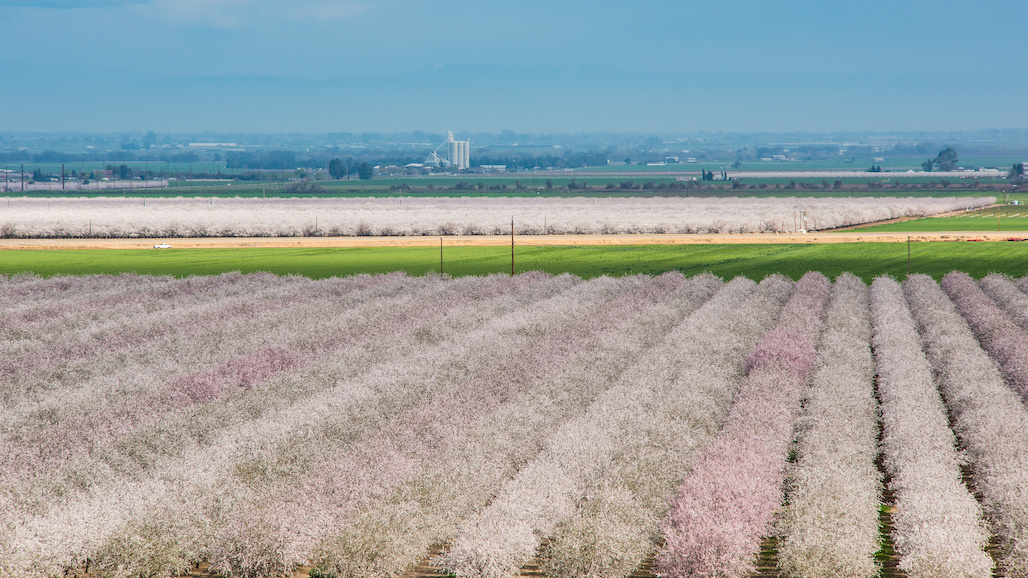
    According to an estimate from Land IQ, bearing almond orchards at harvest will cover 1.338 million acres across California, an increase of 29,000 acres – or about 2.2% – over last year. This estimate looks at orchards that will be productive and harvested in 2022. In addition, the report estimates 59,732 acres of orchards will be removed before harvest, nearly 12,000 acres more than last year.

    These estimates from Land IQ’s 2022 Standing Acreage Initial Estimate look at bearing acreage – orchards that have matured enough to produce a crop – for the current 2021-22 crop year. In addition, the U.S. Department of Agriculture-National Agricultural Statistics Service (USDA-NASS) 2021 California Almond Acreage Report released today gives a comprehensive look at last year.

    The USDA-NASS report for the 2020-21 crop year estimated there were 1.32 million bearing acres in 2021, up 5.6 percent from 2020. Total almond acreage in 2021, which includes non-bearing trees, was estimated at 1.64 million, up 2.5 percent from the previous year. It also said the 320,000 non-bearing acres in 2021 is a total down 8.6% from 2020.

    The USDA-NASS report gave a preliminary estimate for bearing acreage in 2022 at 1.37 million acres, but cautioned that a major source of data for this estimate is a survey mailed to growers and is unlikely to be 100 percent accurate.

    USDA-NASS said nonpareil continued to be the leading variety, followed by Monterey, Butte, Carmel, and Independence.

    These reports are being issued side by side by the Almond Board of California (ABC) to provide a complete picture of California’s almond acreage.

    Neither of these reports offer any estimate on the actual almond yield this 2021-22 crop year. The first look at yield will come on May 12 with USDA-NASS’ Subjective Estimate. A fuller picture of crop size will come with USDA-NASS’ Objective Report in July.

    Bearing acres reflect plantings from 2019 or earlier. The removal estimates cover orchards taken out beginning in 2021 through March 31, 2022, added to acreage projected to be removed through Aug. 31, the end of the crop year. The projection uses historical data and present conditions.

    “These estimates show that California almond production will remain strong,” said ABC President and CEO Richard Waycott. “Demand for almonds in California, the U.S. and around the globe continues to grow and California almond growers are prepared to meet that demand.”

    Land IQ’s Initial Estimate and its Final Acreage Estimate in November, along with USDA-NASS’s April Acreage Report, May’s Subjective Estimate and the Objective Report in July are all commissioned by ABC to provide statistical transparency and a robust picture of California almonds to industry stakeholders around the world.

    In 2018, ABC first commissioned Land IQ, a Sacramento-based agricultural and environmental scientific research and consulting firm, to develop a comprehensive, living map of California almonds. The map is the result of nearly a decade of research and has an accuracy of 98% or greater.

    Data for USDA-NASS’s acreage reports comes from a number of sources including voluntary responses from almond growers’ to mailed questionnaires with telephone and field follow-ups. USDA-NASS also uses Land IQ data to fine tune its reports.

  • Heart-Friendly Focus Fuels Almonds in Mexico

    Heart-Friendly Focus Fuels Almonds in Mexico

    Almond Board of California — Almond exports from the U.S. to Mexico increased 25% in 2021, reflecting a growing appetite for the nuts by health-conscious consumers in that market. 

    Wellness is top of mind for many Mexicans, who increasingly have gravitated to almonds for several health benefits. Almonds contain magnesium to support a healthy immune system, vitamin E to support skin care (vitamin E may help protect cells from the damaging effects of free radicals, caused by pollution, UV rays from the sun, cigarette smoke and other environmental and intrinsic factors) and good fats (to support heart health). One serving of almonds (28g) has 13g of unsaturated fat (healthy fat) and only 1g of saturated fat.

    Since 2018, the Almond Board of California has conducted consumer advertising and public relations in Mexico under the “Ponte Almendra” campaign. Ponte Almendra is a play on words in Spanish, adapted from the colloquial “ponte las pilas,” a popular idiom to tell people to work harder or make a bigger effort – essentially to get going. The message in Ponte Almendra is that a handful of almonds contains the natural energy-giving protein to help active people get through their busy days.

    Clearly, the marketing efforts are paying off. Last year, almond shipments to Mexico increased to 30 million pounds, making Mexico one of the up-and-coming countries ABC staff are most excited about.

    “The Almond Board is enthusiastic about the emerging growth of this market,” said Becky Jeffers, ABC’s manager of North American marketing. “Consumers are looking for healthy snacks as their lifestyles have changed and diseases of affluence such as obesity, diabetes and cardiovascular disease are increasing.”

    Marketing efforts have leveraged the popularity and credibility of Mexican TV stars and trusted medical experts. ABC also has partnered with the Mexican Heart Foundation to underscore the value of almonds in a heart-healthy diet.

    A consumer survey funded by the Almond Board showed that 68% of Mexican consumers were motivated to eat almonds if they understood that almonds as part of a heart-healthy diet could potentially help with improving cholesterol levels.

    In 2021, the Ponte Almendra campaign featured TV ads that aired during major sporting events, such as the broadcast of the Super Bowl in Mexico and national soccer championships, and award shows such as the Grammy’s in Mexico. One TikTok video posted on Feb. 16, 2021 (designated as Almond Day in Mexico) garnered an impressive 2 million organic (un-sponsored) views in one day.

    ABC’s research revealed that consumers ranked almonds high in overall preference and said it is the nut they’ve seen the most positive stories about.

    “There is more opportunity to drive consumer awareness and perception of almonds’ specific heart health benefits. In fact, according to the U.S. Food and Drug Administration, scientific evidence suggests, but does not prove, that eating 1.5 ounces of nuts as part of a diet low in saturated fat and cholesterol may reduce the risk of heart disease,” Jeffers said. “The survey showed 82% of Mexican consumers rate knowing that almonds are good for your heart would make them more likely to eat almonds. However, only 33% of respondents said that almonds are the best nut for their heart, showing the opportunity to amplify the nutrition research on heart health that is motivating to consumers.”

    The Almond Board has already shifted the communications to focus on heart health while keeping Ponte Almendra as the overarching campaign slogan. For example, for World Heart Month in September 2021, ABC partnered with credible doctors for TV media interviews and social media posts – including a 30-minute interview between a health coach and a doctor on Instagram Live. The heart health efforts will continue throughout 2022.

  • “Cautiously Optimistic” about Leaffooted Bug Lure & Trap

    “Cautiously Optimistic” about Leaffooted Bug Lure & Trap

    Almond Board of California — With the rise of leaffooted bug damage showing up in almond kernels at the handler, the bottom line of growers is at stake. Research funded by the Almond Board of California and conducted at UC Riverside, is expanding much needed tools for effective IPM monitoring protocol to combat the pest.

    Across the industry, handlers have seen higher rates of brown spot damage caused by leaffooted bug – and true bugs, such as stink bug – which has led to increased rejection rates.

    Growers are limited to the best monitoring protocols available today, but they can be time and labor intensive, often pointing out damage after it’s too late to act.

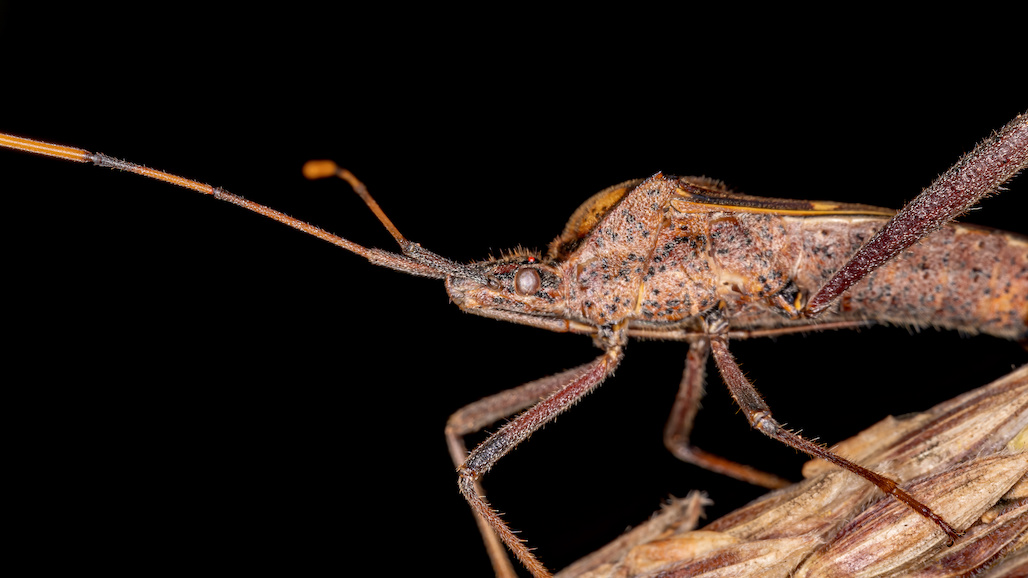
    leaffooted bug on Almond (Photo Courtesy of the Almond Board of California)

    A multiyear effort led be UC Riverside Entomology Professor Jocelyn Millar – and funded by the Almond Board of California – has worked to improve the monitoring options for the pest.  

    “You can take beat samples of the crop canopy to look for adults or nymphs, but we’ve never established any kind of treatment threshold for that practice,” said Houston Wilson, assistant cooperative extension specialist in the Department of Entomology at UC Riverside and collaborator on the project. “You can look for signs of feeding damage, which manifests in gummosis, which can also be caused by a number of things.”

    Wilson said growers can cut gummy nuts open to look for evidence of leaffooted bug penetration of the kernel.

    “Identifying gummosis is easier because you can look for the signs, but it’s an artifact – by the time you see it, the leaffooted bug has already damaged the nuts,” Wilson said. “We don’t have a passive sampling system for leaffooted bug, like for navel orangeworm, where a pheromone attracts the insect to a trap,” Wilson said. “What we’re trying to develop is a lure – a pheromone – and a better trap.”

    leaffooted bug damaged nuts (Photo Courtesy of the Almond Board of California)
    First, the pheromone

    Over the past five years, Millar and his team have been isolating and identifying compounds that make up the leafooted bug pheromone. Nine compounds were identified, and the team began work to synthesize each one. Wilson said that some of the compounds were relatively easy to identify, but others were not, “the last pheromone compound we identified was entirely new to science.”

    In the latest project update, Millar noted that this new compound was a relatively small part of the overall pheromone composition but it packed the biggest punch, triggering the strongest responses from the bugs. Over the last two years, Millar’s team has been able to collect enough material to identify the compound and effectively synthesize it.

    Second, the trap

    At the same time as the pheromone work, the team at UC Riverside – and other collaborators such as Cooperative Extension Specialist Kent Daane – began looking at the best trap for the application. They tested multiple styles of traps and colors, ultimately identifying that a hanging cross-vane panel trap coated with a sticky substance – yellow or blue in color – performed the best for trapping leaffooted bug.

    With a fully recreated pheromone and an effective trap, the team ran trap trials in commercial almond, pistachio and pomegranate orchards in the Central Valley. Based on in-field trials, the team concluded that the trap and pheromone were both very effective and will look to the private sector to commercialize the new monitoring system.

    What’s next?

    “We demonstrated in field trials last summer and this spring that the synthetic pheromone blend is highly attractive to females,” Wilson said. “Now we’re looking at what minimal blend of compounds are needed to attract the pest. If we want this to be a commercially viable lure, we have to find the most cost-effective composition. In many cases, it’s not necessarily required to have the full bouquet of compounds in a pheromone blend to have a functional lure.”

    Once the right balance is determined for a synthetic blend that lures leaffooted bugs to a trap the next step is understanding what trap catch means on population density in an orchard. This will define treatment thresholds, giving growers guidance on timing to combat leaffooted bug before damage occurs on kernels. Private industry will likely takeover at this point to develop the traps for the industry. For Wilson, this prospect has him cautiously optimistic.

    “We’re very fired up with this pheromone blend, but I’m also trying not to get ahead of myself before we know what the cost will be for a commercial and scalable lure.”

    More information about best management practices of leaffooted bug is available at the UC Statewide IPM website.

  • California Almond Subjective Forecast Estimates Smaller Crop

    California Almond Subjective Forecast Estimates Smaller Crop

    The 2022 California Almond Subjective Forecast published by the U. S. Department of Agriculture’s National Agricultural Statistics Service (NASS) estimates that the crop harvested in 2022 will come in at 2.8 billion pounds, 4 percent below last year’s 2.92 billion pounds.

    Forecasted yield is 2,040 pounds per acre, 8 percent below the 2021 yield of 2,210 per acre.

    Richard Waycott, Almond Board of California

    “A lower crop estimate was not totally unexpected versus last year’s 2.9 billion pounds,” said Richard Waycott, president and CEO of the Almond Board of California (ABC). “Some growers’ crops this spring were impacted by frost, while all growers are managing continuing concerns about water availability. However, demand for California almonds around the globe remains strong and California almond growers are prepared to meet that demand.”

    The Subjective Forecast is the first of two production reports from NASS for the coming crop year. It is based on opinions from a phone survey conducted from April 19 to May 6 of randomly selected California almond growers. The sample of growers, which changes every year, is spread across regions and different sized operations.

    On July 8, NASS will release its second production estimate, the 2022 California Almond Objective Report, which is considered more accurate and is based on actual almond counts using a more statistically rigorous methodology to determine yield.

    This Subjective Forecast comes two weeks after NASS released the 2021 California Almond Acreage Report, which gave a preliminary estimate for bearing acreage in 2022 at 1.37 million acres, about 3.8 percent larger than its estimate for 2021 of 1.32 million bearing acres.

    NASS conducts the annual Subjective Forecast, Objective Report and Acreage Report to provide the California almond industry with the data needed to make informed business decisions. These reports are the official industry crop estimates.

  • Drought Impact on Almonds in the Sacramento Valley

    Drought Impact on Almonds in the Sacramento Valley

    Growers in the San Joaquin Valley are not alone in dealing with the harsh impacts of drought.  The Sacramento Valley has been hit pretty hard as well, and almond growers are concerned with how this will affect the quality of their crop over the next few years. Watch this brief interview with UCCE Orchard Systems Advisor Luke Milliron as he shares his insights, based on his presentation at The Almond Conference, and read more about in Pacific Nut Producer Magazine.
    Please thank this video’s sponsor Trece for their industry support.
  • Almond Board Increases Market Investment in India by 80%

    Almond Board Increases Market Investment in India by 80%

    India has quickly become the number one export market for the California almond industry, and the Almond Board has increased its marketing investment there by 80%.  Watch this brief interview with Emily Fleischmann from the Almond Board of California, as she shares details about their strategic partnerships there and how these funds are being used to drive demand. Read more about it in Pacific Nut Producer Magazine.
    Please thank this video’s sponsor Trece for their industry support.
  • Getting California Almond Hulls into China’s Animal Feed Market

    Getting California Almond Hulls into China’s Animal Feed Market

    The trade dispute with China has proved challenging for tree nut exports into China, but the California almond industry has even more to provide the Chinese market — almond hulls.  Almond hulls have long been used on California dairies, but the potential to reach China’s animal feed market brings promising opportunity and value for this byproduct. Watch this brief interview with Keith Schneller, Trade Policy Specialist for the Almond Board of California, as he shares the progress on getting approval to start shipping hulls. Read more about it in Pacific Nut Producer Magazine.
    Please thank this video’s sponsor Trece for their industry support.
  • New Documentary Explores Origins of Whole Orchard Recycling

    New Documentary Explores Origins of Whole Orchard Recycling

    Brent Holtz, author of Pacific Nut Producer Magazine’s monthly Almond Tasks column, grew up on the farm his grandfather bought in the 1940s, six miles north of Modesto at the time. By the 1970s, the land was on the urban edge of the city, surrounded by houses. Holtz’s family had to farm differently, and they could no longer burn their brush. Holtz was a UC Berkeley plant pathology graduate student in the late ‘80s. “I felt a responsibility to help my family find a solution for ag burning,” he says now.

    One idea was to turn clippings, brush and even whole trees into wood chips and recycle them into the soil. Holtz and his father first tried it with garden clippings, grinding prunings into wood chips and watching the rich mulch help their trees. Holtz expanded to a small scientific trial in his own orchard, then to a full-blown commercial trial recycling almond trees into the soil just before replanting a new orchard.

    “I have to admit, I was nervous,” Holtz says. He funded some of the work from his own pocket. Over 13 years, he and other researchers examined the data. “We saw increased soil organic matter, we saw increased water holding capacity, we saw less water stress, and ultimately – what growers want to know the most – we saw increased yields with Whole Orchard Recycling.”

    The inspiring story of Brent Holtz’s journey to help his family, his industry and his community is the subject of a six-minute documentary produced by the Almond Board of California (ABC) called, “RESILIENCE: The Whole Orchard Recycling Origin Story.”

    It’s available on YouTube and shows how the power of an idea can change and benefit an entire industry and even the planet. Whole Orchard Recycling (WOR) eliminates burning and keeps carbon in the ground, a goal that world leaders established as part of the 2015 United Nations Climate Change Conference agreement.

    The goal of the short film is to inspire even more growers to recycle their orchards when replanting and to reassure them that there is a long, thorough history of research and scientific trials proving both the value and the benefits of WOR for them and their communities.

    Holtz was the principal investigator on the first WOR project – research conducted by UC Cooperative Extension that was initially funded and supported by ABC and later by the California Department of Food and Agriculture. It identified significant advantages of WOR to the soil, crop yields and air quality.

    Thanks to Holtz’s vision and dedication to research, WOR has become a widely-adopted best practice among California almond growers. San Joaquin Air Pollution Control District data shows that since 2018, in the San Joaquin Valley alone, more than 500 growers have recycled 26,000-plus acres and diverted nearly 750,000 tons of wood from being burned.

    Holtz is now the UC Cooperative Extension County Director and Farm Advisor for San Joaquin County. He says he hopes his story and his research will inspire more WOR and show growers how researchers and growers are on the same team with the same goals – to help almond growers produce more sustainable, better yields.

    “My grandfather would be very proud of the solution that came from his farm and his grandson,” Holtz says in the film. “I owe the growers who believed in me and recycled their orchards a great debt and I thank you very much.”

    A Whole Orchard Recycling Grower Guide, a “How To” video featuring Holtz, and much more information can be found at Almonds.com/WOR. — Almond Board of California 

  • Almond Board of California Announces 2022 Elections

    Almond Board of California Announces 2022 Elections

    Elections for the Almond Board of California (ABC) Board of Directors have kicked off for the 2022-2023 crop year with the call to all candidates to file their petitions or declarations of candidacy by April 1, 2022.

    There are two independent grower positions and one independent handler position on the ABC Board of Directors to be decided in voting that starts April 21 and ends May 26. Alternate seats for those spots are also open.

    To be considered for an independent grower or alternate seat, candidates must be a grower and must submit a petition signed by at least 15 independent almond growers (as verified by ABC). Independent handler and alternate candidates must declare their intention in writing to ABC.

    All petitions and declarations must state the position for which the candidate is running and be filed by mail with ABC at 1150 9th St., Suite 1500, Modesto, CA 95354. The deadline for all filings is April 1. Potential candidates who’d like more information can contact Toni Arellano at tarellano@almondboard.com.

    “The ABC Board of Directors is such an important and vital part of our industry,” said ABC president and CEO Richard Waycott. “It guides the work of the Almond Board and is key to overseeing the welfare of the industry and of more than 7,600 growers and 100 handlers.”

    Richard Waycott, CEO, Almond Board of California

    The ABC board sets policy and recommends budgets in major areas, including marketing, production research, public relations and advertising, nutrition research, statistical reporting, quality control and food safety.

    Getting involved provides an opportunity to help shape the future of the almond industry and to help guide ABC in its mission to promote California almonds to domestic and international audiences through marketing efforts, funding and promoting studies about almonds’ health benefits, and ensuring best-of-class agricultural practices and food safety.

    ABC encourages eligible women, minorities and people with disabilities to consider running for a position on the Board of Directors to reflect the diversity of the industry it serves.

  • DPR/EPA Approves Section 18 Emergency Registration for Kasugamycin on Almonds

    DPR/EPA Approves Section 18 Emergency Registration for Kasugamycin on Almonds

    Almond Board of California — Today, the California Department of Pesticide Regulation (DPR) issued a Section 18 SPECIFIC exemption for the use of Kasumin 2L to control bacterial blast in almonds. The exemption is effective February 1, 2022 through April 15, 2022. In the announcement, DPR advised operations to use the chemical number for kasugamycin (6197) for their “Restricted Material Permit Program.”

    The approval applies to the counties of Butte, Colusa, Fresno, Glenn, Madera, Merced, San Joaquin, Stanislaus, Sutter, Tehama, Yolo and Yuba.

    Growers interested in this application are heavily encouraged to reference the Almond Board of California’s Honey Bee Best Management Practices as well as the Quick Guide for Applicators (in English & Spanish) to ensure pollinator health is maintained. As stated in these practices, growers should only use applications when absolutely necessary and should only make applications in the late afternoon or evening, when bees and pollen are not present.

    Please contact your local County Ag Commissioner’s office for further details if interested in using this product. This emergency exemption may also be viewed on the DPR website at http://apps.cdpr.ca.gov/section18

    Visit the California Department of Food and Agriculture website for a full list of County Ag Commissioners’ offices as well as contact information for each.