Supporting the next generation of farmers in sustainable stewardship of the land is a priority for Setton Farms, the second largest pistachio processor in the United States. That is why they have partnered with the Future Farmers of America Tulare Chapter to support their agricultural programs while distributing 50 student-made owl boxes across their farming operations. Watch this brief interview with Mike Smith and Jared Castle meeting with Matthew Malcolm on California Ag Network during the owl box exchange to learn more.
Category: Pistachios
-
Smoke from Megafires Reduces Nut Crop Yields
Long-term smoke exposure from massive wildfires lowers the energy reserves of orchard trees and can cut their nut production by half, researchers at the University of California, Davis, found. The smoke can affect trees for months after a megafire, depressing their bloom and the next season’s harvest. This finding reveals a new danger from wildfires that could affect plant health in both agricultural and natural environments.
Nature Plants published the study on Oct. 2nd.
“A lot of research focuses on the impact of smoke on humans but there is less study on the effects of smoke on plant health,” said lead author Jessica Orozco, a postdoctoral researcher with the UC Davis Department of Plant Sciences. “Our study suggests that trees are just as vulnerable as humans.”
Wildfire smoke blocks sunlight
Scientists studied almond, pistachio and walnut trees at 467 orchard sites in California’s Central Valley from 2018 to 2022. In 2020, megafires scorched more than 4.2 million acres in California, filling the skies with smoke and ash. At the time, researchers were studying how trees store energy, in the form of carbohydrates, to cope with heat and drought. But Orozco said the team saw an opportunity to study how smoke affects carbohydrate levels.
“Photosynthesis produces carbohydrates, which are critical elements for tree survival,” said Orozco. “Trees need carbohydrates not just to grow but to store energy for when they’re under stress or when photosynthesis isn’t happening.”
Photosynthesis changes under smoke-filled skies. Smoke particles block some sunlight but also reflect light, creating more diffused light. The diffused light can help trees make more carbohydrates. However, Orozco said the study found that while diffused light increased, the smoke was so thick that it likely didn’t compensate for the loss of direct light.
Megafires have lingering effects on tree health
The team found that megafire smoke not only reduced the amount of carbohydrates in trees but also caused losses that continued even after the fires were out. This led to nut yield decreases of 15% to as much as 50% in some orchards. The most active time for wildfires also coincides with the time trees start storing carbohydrates to sustain them through winter dormancy and spring growth.
“We were expecting to see some impact especially in the months when the smoke was really dense, but we weren’t expecting the smoke to have such a lingering effect and result in a significant drop in yield,” Orozco said.
Orozco said researchers still don’t know what components in megafire smoke caused the decrease in tree carbohydrates. During the 2020 megafires, the smoke reduced light and increased both ozone and particulate matter levels, all of which affect photosynthesis. One or a combination of these factors could have led to the drop in tree carbohydrates.
Additional authors on the study are Professor Maciej A. Zwieniecki and postdoctoral researcher Paula Guzmán-Delgado of the UC Davis Department of Plant Sciences.
The Almond Board of California, the California Pistachio Research Board, the California Walnut Board and the California Department of Food and Agriculture supported the research.
-
Setton Partners with FFA Tulare Chapter to Enhance Environmental Education
Setton Pistachio of Terra Bella, Inc., the nation’s premier pistachio grower and processor, collaborated with the Future Farmers of America (FFA) Tulare chapter, including Mission Oak, Tulare Union, and Tulare Western high schools, to acquire 50 student-made owl boxes to help promote natural pest control in its orchards. For more information about Setton’s sustainable farming initiatives, visit SettonFarms.com.
“We are thrilled to support the talented students of the Tulare FFA Agriculture Mechanics Program and their innovative approach to environmental stewardship,” said Jeff Gibbons, Senior Director of Grower Services & Farming. “Through this collaboration, we are reinforcing our commitment to our local community, sustainable farming practices, and supporting the next generation of farmers.”
The owl boxes, crafted as part of the students’ 2024 curriculum, promote natural pest control by providing safe habitats for owls in agricultural areas, such as pistachio orchards. Owls are regarded for their role in sustainably managing pest populations, thus avoiding artificial pest control methods.
The owl boxes will be strategically placed within several of Setton’s organic pistachio orchards and Deer Creek Citrus’s citrus orchards to promote natural pest control methods. This collaborative effort is part of Setton’s broader sustainability plan – which includes water conservation and recycling, soil health, regenerative farming techniques, and alternative clean energy sources – t0 further its commitment to support education, environmental stewardship, and community engagement.
“We are grateful for Setton’s support, which enables our students to bring their projects to life and make a tangible difference in our community,” said Jared Castle, Chair of the Tulare Agriculture Department. “This partnership benefits our local environment and inspires our students to continue their education in the trade, allowing the 450 agriculture mechanics students enrolled in our program to continue to build projects.”

About Setton Farms:
Setton Pistachio of Terra Bella Inc., the second largest pistachio grower-processor in the United States, is a family-owned and operated company located in the heart of Central Valley, California since 1986. Highly regarded as “America’s Best Tasting Pistachios” and widely recognized for its superior quality and tradition of excellence, Setton Farms grows, harvests, processes and manufactures pistachios using renewable energy, and eco-friendly and sustainable practices. Setton Farms, its retail brand, offers an established line of premium in-shell and kernel pistachio products that are non-GMO project verified, certified gluten-free, organic and kosher, while a select variety features the AHA heart-check mark. Setton provides pistachios to more than 60 foreign markets worldwide and distributes to wholesalers and retailers throughout the United States. For more information, visit settonfarms.com.
-
Record Turkish Pistachio Production Volumes Anticipated
Turkey’s pistachio production in marketing year (MY) 2024/25 is forecast to reach a new record due to multiple factors. Higher production volumes and larger-than-normal carryover stocks are expected to prompt sizeable export volumes of Turkish pistachios for the first time. While Turkey’s production of tree nuts continues to grow, the country is expected to import substantial volumes of almonds and walnuts in MY 2024/25 to meet steady consumer demand. Imports of U.S. tree nuts continue to be disadvantaged by a 10 percent retaliatory tariff that was imposed because of U.S. Section 232 duties on Turkish steel and aluminum. However, despite this additional tax and growing competition, the United States is still the one of the top suppliers of walnuts, almonds and pistachios to Turkey.
I. PISTACHIOS a. PRODUCTION
Turkey’s pistachio production in marketing year (MY) 2024/25 is forecast to more than double year- over-year to a record of 385,000 metric tons (MT). There are multiple factors contributing to this projected increase, the most notable of which is this year is considered an “on-year” in the production cycle for pistachios. The growth in production is also linked to an increase in the number of bearing trees, higher yields as trees reach optimal bearing age, and favorable weather conditions during the growing season.
According to the Turkish Statistical Institute (TurkStat), there were an estimated 60.5 million bearing pistachio trees at the beginning of the current marketing year, up nearly 4 percent from last year. Market sources confirmed that many of these trees are now approaching ten-years in age, which when yields start reaching their optimal range. This age-related yield factor will contribute to higher production volumes this year and in the years ahead.
At the same time, there are about 26.6 million non-bearing trees, which is about 4.5 percent higher than a year ago. Turkey’s production of high-quality pistachios is predicted to increase in the future with the increasing number of young trees.
Market sources indicate that TurkStat might be undercounting the actual number of bearing and non- bearing trees. However, even if the number of trees is being undercounted, TurkStat’s figures reconfirm the expansionary trend in the country’s production of pistachios.
Over the last 10-15 years, pistachio growers have invested in developing and expanding their orchards, replacing old trees (some of which are 50-years old) and introducing modern growing techniques. These more sophisticated orchards with their newer trees, which are less affected by the periodicity in production, are expected to achieve higher yields and production volumes in the future. For the new trees being planted, market sources confirmed that growers are planting more of the Siirt variety compared to earlier years, known to be less periodical than the Antep variety. However, the Antep variety still accounts for most of the pistachio trees being grown.

Good rainfall conditions in the spring of this year also contributed to the increase in pistachio production in MY 2024/25. Timely and adequate precipitation is critical since most pistachio production across Turkey is rain-fed.
As seen in the Map 1, rainfall this spring in the southeastern part of the country, where most of the pistachios are grown, was near normal. A sunny summer, with no major weather events, and no unexpected pest attacks also promoted higher yields this year.
Pistachio yields and production levels can vary dramatically from year-to-year with average yields during an on-year ranging from 4-6 kilograms (kg) per tree and 2-3 kg per tree during off-years. However, periodicity effects on yields have decreased in recent years with the planting of new trees, on- farm investments, and the introduction of good agricultural practices. At the same time, with the help of outside training provided by different institutions, farmers have learned how to reach higher yields by taking better care of the soil and trees. As a result of these improvements, average yields are expected to continue to slowly increase in the coming years.
One of the more notable and ongoing training programs, called “May you have abundant pistachios,” was launched back in 2011 by the Turkish Foundation for Combating Soil Erosion, Forestation, and Protection of Natural Habitats (TEMA), with contributions from private companies. The initiative trains farmers in Gaziantep and Sanliurfa – the two biggest pistachio-producing provinces in the country – to properly care for their trees through improved pruning and trimming techniques, and better practices for applying fertilizer and pesticides. Farmers applying this training report seeing their yields double or even triple at times, while also reducing periodicity effects in off-years. In parallel to this training program, local universities in the major pistachio growing regions have developed better production methods and plant protection measures to help farmers improve yields.
The two southeastern provinces of Gaziantep and Sanliurfa account for 80 percent of the country’s total production of pistachios. The southeastern provinces of Adiyaman, Siirt, Kilis, Kahramanmaras, Mardin, and Diyarbakir account for another 15 percent of total production. The remaining five percent is thinly spread across the Aegean, Mediterranean, and Marmara regions.

There are two main types of pistachios grown in Turkiye, the Gaziantep (Antep) and Siirt varieties. Both are unique to Turkey and differ in size and shape compared to the pistachios grown in Iran and the United States. The Antep variety accounts for 85 percent of pistachios grown in Turkey. The Siirt variety makes up the remaining 15 percent of production; the Siirt variety is considered a higher-yielding variety than the Antep variety.
The quality standards for Turkish pistachios are directly related to the size of the nut. 90 nuts or fewer per 100 grams is considered first quality; 90-100 nuts are second quality; 100-120 nuts are third quality; and more than 120 nuts are fourth quality.
CONSUMPTION
MY 2024/25 consumption is forecast higher year-on-year at 235,000 MT, based on a projected increase in domestic pistachio production and the expectation that traders will want to draw down their record- sized stock levels as much as possible.

Turkiye continues to grapple with high inflation, including rising food prices. In August, the annual consumer price index (CPI) inflation was nearly 52 percent and annual food inflation reached almost 45 percent. See Post’s latest Exporter Guide for more information about the current economic conditions in Turkiye.
In the case of pistachios, retail (and bulk) prices during the month of August were nearly 30 percent higher in terms of Turkish Lira (TL) than the same time last year. By comparison, though, the price in U.S. dollars (USD) was almost unchanged. See table 1.
The reason retail (and bulk) pistachio prices (30 percent) did not increase as much as general food inflation (45 percent) was primarily due to the downward pressure on pistachio prices resulting from the anticipated record in production and large carryover stocks in MY 2023/24 and 2024/25. While still high, these relatively lower retail prices for pistachios will encourage increased consumption, especially among the upper-and higher-income households who are less impacted by the difficult economic realities in the country.

Historically, most of the country’s pistachio crop is consumed domestically, though Turkiye is expected to export a share of its crop this year because of an anticipated oversupply. Consumption levels vary year-to-year depending on the availability of domestic supplies. About 35 percent of pistachios are consumed as snacks and the remaining 65 percent are used in making confectionary products, especially traditional desserts like baklava. In addition, during the last decade, more pistachios are being used in other desserts, such as chocolate and ice cream.
In the last few years, consumers in larger cities increasingly prefer to buy packaged pistachios and other nuts from retail supermarkets instead of buying them from a traditional bulk nut store. This trend is expected to continue as consumers demand greater convenience and as more supermarkets spread across the country. For more information about the latest retail sector trends, please refer to Post’s latest Retail Food Report.
Approximately half of the pistachios that are consumed for snacking are packaged. This percentage is expected to increase in the future as consumers demand greater convenience and shop at discount retail outlets where packaged food products are the norm. With this shift towards increased consumption of packaged pistachios, per capita consumption (2 kg/year) and overall consumption is expected to grow.
b. TRADE
Exports
MY 2024/25 exports are forecast at a record 80,000 MT, assuming steady demand for re-exported pistachios and the potential for Turkiye to export domestic pistachios. Given the anticipated oversupply of domestic pistachios this year, Post expects Turkiye will export a sizeable amount of domestic pistachios to overseas markets this year. Up until this year, Turkiye only exported minor amounts of domestic pistachios, mostly in processed products. The bulk of Turkiye’s exports have historically consisted of U.S. and Iranian pistachios, which are sorted and packed in Turkish free trade zones and re- exported to third markets. Looking ahead, given the yearly fluctuations in domestic pistachio production, Post expects that the re-export business will continue to dominate overall exports for the foreseeable future.
Turkiye predominantly exports shelled pistachios. The leading export destinations are Italy, Germany, Iraq, Syria, Malaysia and Saudi Arabia.
Imports
MY 2024/25 imports are forecast at 35,000 MT, which is down about 27 percent from the previous year’s newly revised figure as import demand is expected to slacken because of a record domestic harvest and large pistachio stocks.
MY 2023/24 pistachio import volumes are revised higher to 48,000 MT in line with the latest trade data. The United States and Iran were the largest sources of imported pistachios, with U.S. pistachios accounting for 80 percent of total imports. According to market sources and Post observations, imported pistachios are typically not sold on the domestic market because of the high import taxes but are instead brought into free trade zones for processing and re-export. The absence of a bilateral phytosanitary protocol also discourages imported pistachios from entering the market for domestic consumption.
The Most Favored Nation (MFN) duty on imported pistachios is 43.2 percent. However, since May 2019, imported pistachios from the United States have been subject to an additional 10 percent retaliatory tariff, bringing the total applied tariff rate to 53.2 percent. The retaliatory duty was imposed in response to U.S. Section 232 tariffs on Turkish steel and aluminum.
c. STOCKS
With the record harvest, year-end stocks for MY 2024/25 are forecast to more than double from last year’s newly revised estimate to 200,000 MT. This prediction assumes that traders will only sell off a portion of their inventories because stock levels are so large.
MY 2023/24 ending stocks are revised higher to 95,000 MT based on an upward revision to the pistachio production number and in alignment with market expectations.
Pistachio stocks vary considerably from year to year, in line with the cyclical nature of production. This cyclicality and the fact that neither the government of Turkiye (GoT) nor producer associations maintain ending-stock numbers leads to speculation, price fluctuations, and artificially inflated prices. According to industry insiders, pistachio traders intentionally hold onto inventories longer than normal to drive domestic prices higher. Accurate end-stocks data would help stabilize price fluctuations and consumption levels, especially in off-years.

Municipal governments in Gaziantep and Sanliurfa have taken steps to increase transparency of pistachio stock levels in hopes of reducing speculation in the market. In June 2021, the Gaziantep Commodity Exchange (GCE) built Turkiye’s first licensed pistachio warehouse with a capacity of 10,000 MT. The warehouse has an electronic trading platform as well as a laboratory for quality testing. Sanliurfa Commodity Exchange has also invested in a licensed pistachio warehouse project with 10,000 MT of storage capacity.2 As these licensed warehouses represent just a small fraction of overall production, more of these facilities are needed to increase market transparency on the status of domestic stock levels. The government operates licensed warehouses for other crops, such as wheat, sunflowerseed, and cotton to create price stability.
Scientists from various local universities continue supporting research applications to improve storage conditions, which is important in maintaining the quality of pistachios and in helping minimize food safety concerns, such as aflatoxin.
d. POLICY
Changes on the Horizon for Agricultural Support Payments
While the central government does not provide specific, direct support payments to pistachio or other tree nut growers, the government does offer generic subsidies that are available to all registered farmers. The amount of generic subsidies in 2024 were up year-over-year in Turkish Lira but were nearly unchanged in USD. Pistachio growers and other farmers continue to complain that the subsidy this year, like the past several years, is inadequate to cover the rising cost of inputs, such as electricity, labor, and water.

On August 29, 2024, the GoT announced in a Presidential Decision Decree (PDD) that it was instituting
a new support system that would come into effect for 2025-2027. The payment under the new system is based on a calculation in which a standard coefficient amount per decare (da) for all crops that is multiplied by a multiplier factor depending on the crop. For 2025, the coefficient has been set at 244 TL/da and the multiplier for tree nuts is fixed at the lowest level of just one. (Note: Other crops, which are considered more strategic like wheat, have a higher multiplier factor.) Thus, tree nut farmers will receive 244 TL/da (=244 TL/da x 1). The coefficient may be updated each year, depending on the overall market conditions and economic situation in the country.
Additionally, a subsidy payment will be paid for some products each year. The products and amount of the subsidy to be paid will be declared each year depending on needs of the country. Tree nuts are not expected to get a subsidy but only the basic support (as defined in this paragraph) starting 2025.
Grower Groups Advocate for Gov’t to Set Purchase Prices for Pistachios
 Some agriculture-related non-governmental organizations (NGOs) in the Sanliurfa and Gaziantep provinces are demanding that the GoT, through the Turkish Grains Board (TMO), establish official purchase prices for pistachios like it does for hazelnuts. These groups argue that pistachios are just as strategic as hazelnuts to the wellbeing of the Turkish economy. These groups are also advocating for specific, direct government subsidy for pistachio producers.
While the national government has not actualized these demands, the Metropolitan municipality of Gaziantep – one of the two largest pistachio- producing provinces – appears to have taken some small steps towards establishing a set price when purchasing pistachios from local growers. In late August 2024, the municipality started purchasing pistachios for making baklava and storing these nuts in the licensed pist
achio warehouse that is operated by the Gaziantep Chamber of Commerce. At the same time, the Sahinbey district municipality in Gaziantep also started purchasing pistachios for making baklava.
The Mayor of Sahinbey announced that the municipal government had started purchasing pistachios to keep traders from manipulating the market and stabilize prices. Supermarket chains and nut retailers have lodged similar complaints in the past. Post concurs with these claims, though prices in MY 2024/25 should soften due to increased supplies.
Gaziantep metropolitan municipality’s purchase price is between 250 to 310 TL/kg (7.35 – 9.12 USD/kg), depending on product quality. The price for same product in Gaziantep Commodity Exchange is between 265 to 320 TL/kg. (7.79 – 9.41 USD/kg), as of early September.
Pistachio Imports for Consumption Considered One Potential Solution to Artificially High Prices
According to industry analysts, there are some traders and retail chains that are advocating for the GoT to remove/lower the import tariffs and other trade barriers that would enable price-competitive, imported pistachios to enter the local market and, thereby, help stabilize the domestic price for pistachios. From Post’s perspective, imports for consumption would definitely have a stabilizing effect considering that exports of in-shell U.S. pistachios from January-July of this year cost about 6.80 USD/kg whereas the retail price in Turkiye for domestic pistachios is currently around 17 USD/kg.
At the same time, market sources report that nut traders have petitioned the government to allow pistachios to be imported duty-free for processing and re-export under the Inward Processing Regime (IPR). The IPR allows companies to bring in certain goods tax free for processing inside the country and re-export. At present, pistachio imports can only enter duty free inside a tax-free zone. The IPR customs arrangement offers companies greater flexibility to process and re-export from anywhere in the country.

Training Growers and Processors to Comply with EU Standards
The Gaziantep Commodity Exchange (GCE), in cooperation with the German Institute of International Cooperation (GIZ), is conducting trainings for people who work or would like to work in the pistachio industry. These trainings include processing and roasting, marketing, foreign trade, and sustainability. Additionally, there are trainings, in cooperation with GIZ, for GCE member companies on topics covering the EU Green Transformation Agreement, EU Carbon Decreasing Mechanisms, EU Field to Fork Strategy, and EU Supply Chain Regulations. For farmers, there will be trainings about smart agriculture applications, reducing the use of pesticides and fertilizers, and pest management.
For the full article from USDA Foreign Ag Service, including details on the Turkish almond, hazelnut, and walnut markets, click HERE.
-
Low, Late Water Allocations Undercut California Ag, Pistachio Grower Aims to Make a Difference

After years of drought conditions, California has finally had a couple years of great rainfall and snowpack — yet that has not translated to much better water availability for California growers responsible for feeding the world with some of the safest most nutrient-dense crops. With the Sustainable Groundwater Management Act (SGMA) taking effect in the state as well, growers are very concerned for the future of their family operations. Crippled by gov’t regulations and delayed water allocations, watch this brief interview with pistachio grower Rebecca Kaser, who farms in Westlands Water District and aims to make a difference.
Special thanks to American Pistachio Growers for sponsoring this video.
-
Smaller Pistachio Crop This Year – Can Growers Expect Higher Prices?
American Pistachio Growers held their first ever Pistachio Industry Insights Day, expanding upon their annual Summer Luncheon from years past. During this well-attended event in Visalia, CA, Jim Zion from Meridian Growers met with Matthew Malcolm on California Ag Network to discuss the current state of the pistachio market. As pistachios are in their “off-year” and with weaker chill hours over the winter, growers are expecting a much smaller crop than last season. The big question that’s on everyone’s mind is whether this will translate to a higher pistachio price and where the market is heading. Watch this brief interview with Jim and read more about it in Pacific Nut Producer Magazine.
Special Thanks to American Pistachio Growers for sponsoring this video.
-
Carbohydrates, Dormancy, and Yield in Pistachios
Did we get enough chill over the winter? What are yields going to look like this fall? One relatively new area of research, carbohydrate dynamics, is shedding light that may help answer these questions. Recent years of research by the Zwieniecki lab (the Z Lab) at UC Davis, including the Carbohydrate Observatory, have been providing exciting new insights to better explain how pistachios may be counting winter chill, when budbreak occurs, and how much pistachios will yield in a given year. While many areas remain to be investigated, this research is starting to provide insight into how management can influence carbohydrates, which in turn influence dormancy, budbreak and yield.
What Are Carbohydrates?
A few definitions are helpful before we dive into discussion. Non-structural carbohydrates (NSC) are carbohydrates that are not part of structures like cell walls. NSC are utilized by the tree for energy, as building blocks for cell growth, as an osmolyte to influence water dynamics, and as signals for multiple physiological activities. NSC are either in the form of sugars or starch. Sugars are the product of photosynthesis, and the building blocks of starch. Sugars are also an active part of biological cell activity and their level in cells are under strict control. Starch is the storage form of carbohydrates and can later be broken down to provide sugars.
How Do Carbohydrates Vary Over the Year?
An intensive sampling was conducted of carbohydrates of almonds, pistachios and walnuts in the twig, branches and trunk over the course of a year. As has been seen in other temperate trees, it was found that NSC varies with changing stages of growth or phenology, and concurrent climatic conditions. NSC decreases following bud break, reaches the lowest levels during the growing season, and then increases starting mid-to-late summer to reach maximum levels in fall or early winter (Figure 1). By following the amounts of NSC in a plant over time, we can build a better understanding of how trees are using carbohydrates for current opportunities (vegetative and fruit growth) or future challenges (dormancy, defense against pathogens and other stressors).
Carbohydrate Dynamics Predict Bloom
Exactly how trees track the accumulated experience of winter cold and spring heat to “know” it’s time to break dormancy in the spring has remained somewhat mysterious. The Carbohydrate Observatory has found that in almonds, pistachios, and walnuts, shortly before bud break, there is a surge in starch and a dip in sugar concentration. The Z Lab has used this knowledge to create a model for bloom timing, based on fall and winter carbohydrate and temperature dynamics. This bloom prediction model integrates some important aspects about how plants balance sugar and starch concentrations. When it is warm, trees turn sugars into starch, and when it’s cold, trees turn starch into sugar. For trees to keep sugar levels in an optimum range, they adjust the concentration of the enzymes responsible for this starch synthesis and degradation. Because starch synthesis is very temperature sensitive, but starch degradation is not, trees can quickly respond to too much sugar at warm temperatures but can’t respond as quickly to too little sugar. When conditions warm up in the spring, starch synthesis quickly takes off, pulling sugars out of circulation, resulting in a dip in sugar. This dip in sugar and upsurge in starch is predictive of (and may even trigger) bud break.
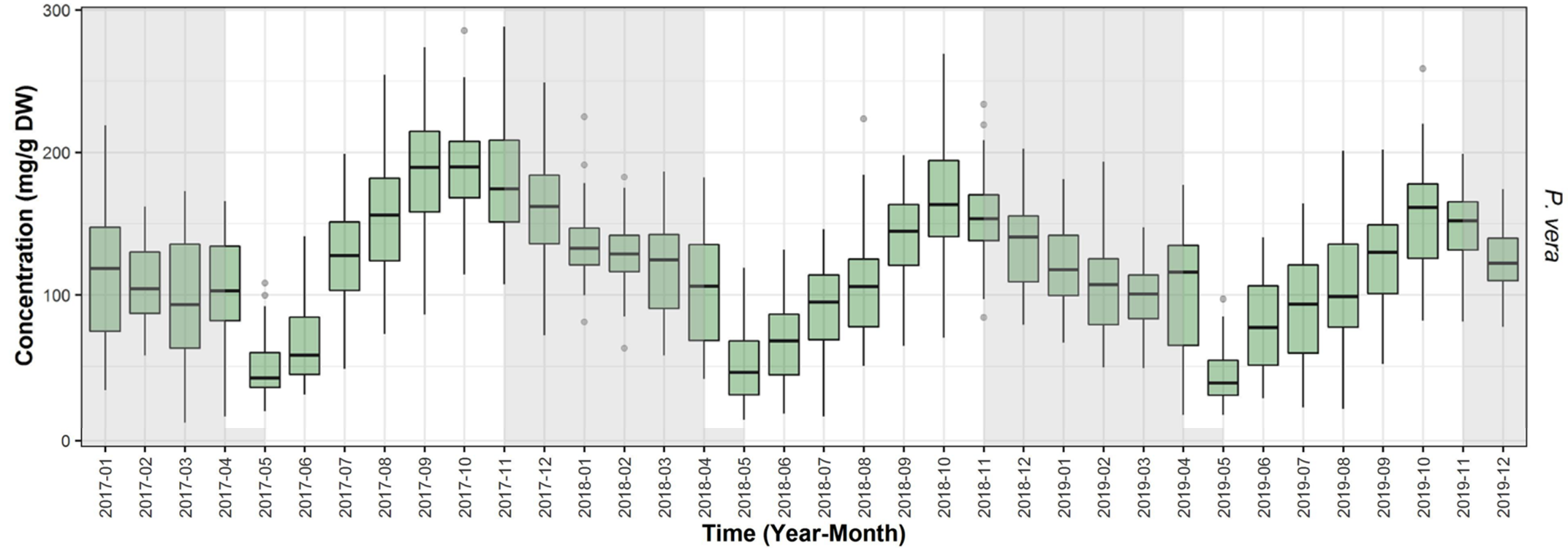
Figure 1. Average concentration of NSC (sugars and starches) from more than 40 pistachio orchards from January 2017 to December 2019. The center bar of each green box shows the average for that month, the box shows the zone where half of all the values from that month lie (25% above and below the average) and the whisker lines show more extreme values. Grey shading reflects the dormancy period. (Davidson et al., 2021. Sci. Reports)
Because of the different temperatures sensitivities of the different enzymes, cold winters, somewhat counter-intuitively, would amplify accumulation of starch synthesis enzymes, resulting in less warm time necessary in the spring to trigger a sharp sugar drop and bloom. Warmer winters would downregulate starch synthesis, requiring more warmth than normal in the spring to achieve low sugar levels. By integrating this knowledge of the principles of carbohydrate dynamics and specific thresholds and ranges learned from the Carbohydrate Observatory, pistachio budbreak was predicted within 7 days on average (Sperling et al 2021). While this may not be accurate enough for management decisions, it’s close enough to support integrating these carbohydrate dynamics into our understanding of how trees count the passing of winter and spring.
Using this model, they could then extrapolate the impacts of sugar concentrations going into winter. Going into winter with higher sugars, a metric of having built up higher NSC reserves over the growing season, results in earlier bloom, functioning almost like having experienced more chill. Lower sugars results in later bloom. This is supported by other recent research (Amico Roxas et al, 2021), that found that early defoliation in the fall decreased NSC going into winter and delayed budbreak in the spring, whereas girdling branches in October (which keeps more carbohydrates in the shoots) moved budbreak earlier.
Carbohydrates and Yield
Because carbohydrates are both the energy currency of plants and are used to make structures like cell walls, they are critical to growing pistachio fruit during the summer. NSC concentrations stay low during the growing season, as the carbohydrates made by photosynthesis get channeled into growing the crop, and sometimes into growing vegetation. New research is showing this interplay of carbohydrate sinks, photosynthesis and nitrogen demands may help explain alternate bearing habits of pistachio. UCCE Orchard Specialist Giulia Marino has recently looked into these dynamics by either partially defoliating bearing branches to reduce carbohydrate sources, or partially stripped off growing fruit to reduce carbohydrate sinks. She found that branches with a lot of leaves relative to the number of fruits actually increased photosynthesis during kernel fill, presumably in response to the strong carbohydrate demand of nearby fruit. However, branches with a lot of fruit set decreased photosynthesis after kernel fill. This may seem counter-intuitive (shouldn’t they ramp up photosynthesis even more?), until they found that nitrogen in the leaves of those branches was decreasing at the same time that photosynthesis was dropping. This is likely because nitrogen was remobilized from the leaves to the kernels, hindering the nitrogen-related components of the photosynthetic process. Why does this concern us, from a production standpoint? Because this change would then result in lower carbohydrate availability for buds being created for the following year’s crop, leading to alternate bearing.
Relatedly, Dr Zwieniecki, looking across almonds, pistachios and walnuts data from the Carbohydrate Observatory and yields provided by growers, sought to see if there was a relationship between NSC in different months of the year and yield (Zwieniecki et al 2023). He found that in pistachios there’s a strong, consistent correlation between NSC in wood and bark in the fall and winter (October through March) with yield the following year, particularly the starch component of total NSC,. This relationship was most pronounced in December, shortly after leaf drop. The higher the starch in the wood of pistachio twigs, the higher the yield turned out to be the following year. Given Marino’s findings of how carbohydrates relate to alternate bearing, this high starch-high yield relationship is likely in part a matter of correlation – following a low set “off” year, Marino’s research indicates you’d go into winter with more female flower buds and more carbohydrates. However, higher winter NSC was also found to be related to higher yields in almond and walnut, which don’t have this alternate bearing complication. This indicates that yields are likely also higher following a high carbohydrate winter because there’s more gas in the carbohydrate tank to fuel the growth needs of the crops the following season.
What’s this all mean for production?
The relationship between chill, heat and carbohydrates helps us understand why warm winter temperatures, and warmed wood and buds in low fog winters lead to delayed and protracted budbreak. This also explains why chemical sprays that interfere with respiration (cells turning sugar into energy) and reflectants (e.g. kaolin clay) that keep wood temperature lower could help compensate for lower chill. More work is needed to help fine tune the use of this knowledge, say to know how warm temperatures need to be to make reflectants worth the expense, or when the optimal time is for spraying dormancy breaking treatments.
The strong relationship between high NSC going into winter, strong yields and normal bloom timing suggest that late season management that helps send orchards into dormancy with higher amounts of NSC leads to positive outcomes of budbreak timing and yield. Irrigation and foliar disease management that can keep leaves healthy and producing new sugars well into October should benefit this NSC accumulation. Stresses that lead to early defoliation would have the opposite effect. The next step in research is to look into other factors can influence this relationship (Variety or rootstock selection? Nutrient management to keep leaves healthy and photosynthesizing?), and whether they have enough influence to merit the expense. — By Katherine Jarvis-Shean (UCCE Orchard Advisor, Sacramento, Solano & Yolo Counties) and Maciej Zwieniecki (Dept. Plant Sciences, UC Davis)
-
Sneak Preview of First Ever Pistachio Industry Insights Day Coming This Month
It’s that time of the year as pistachio harvest nears that American Pistachio Growers (APG) gathers its members together at the Visalia Convention Center. But this year, growers are invited to more than just your typical Summer Luncheon. This longtime tradition has been reinvented into an all-day event to support the booming western pistachio industry. APG’s Wes Wilson met with Matthew Malcolm on California Ag Network to share a sneak preview of what growers can expect in attending the Pistachio Industry Insights Day. Watch this brief interview and be sure to come see Pacific Nut Producer Magazine there as a proud sponsor of this event.
-
Introducing American Pistachio Growers’ New President and Vision
American Pistachio Growers (APG) has announced a new President & CEO to lead their organization — veteran sports marketing leader Zachary Fraser. Following the Interim services of Joel Nelsen, Fraser has taken the helm with a new vision to expand the influence and consumption of American pistachios around the world. Watch this brief interview as Matthew Malcolm from California Ag Network meets with Fraser and APG Chair Rich Kreps to get to know the new dynamic leadership and vision of the organization.
-
Veteran Sports Marketing Leader Zachary Fraser to Lead American Pistachio Growers
American Pistachio Growers, the non-profit association responsible for driving global awareness of the quality, nutrition, and brand power of American-grown pistachios, has hired sports-marketing leader Zachary Fraser as the organization’s new President & CEO. Fraser joins APG after four years with LEARFIELD, the influential media and technology company behind many of collegiate sports most influential brands, where he led the company’s Fresno State athletics (lower case) property.
“On behalf of the Board of Directors, we are very excited to welcome Zachary as the new president of American Pistachio Growers,” said APG Board Chair Richard Kreps. “We feel his successful track record as a leader in multiple industries coupled with his passion were just what APG needs at this time. After several years of working with Fraser in his capacity with his previous employer at our annual conference, we are very excited to have him lead our exceptional team in our time of significant growth in the pistachio industry.”
Fraser enjoyed success at the helm of Fresno State’s LEARFIELD team. As the company responsible for managing traditional and digital media rights, broadcast platforms, and media/sponsorship sales for the Fresno State Bulldogs, his team was recognized for multiple achievements across the entire landscape of collegiate sports-media. Fraser was instrumental in helping Bulldog sports properties win “Property of the Year” among peer athletic departments, following the 2022-23 varsity season. That same year, Fraser was recognized as the “Chairman’s Club” overall winner, among peer vice-presidents and general managers.
Prior to arriving in California’s Central Valley, Zachary was the founding general manager and managing partner at Pacific Baseball Ventures (PBV). PBV is an investment group which owns and operates summer collegiate baseball teams in Walla Walla, WA (Walla Walla Sweets), and Yakima Valley, WA (Yakima Valley Pippins). Under his stewardship, more than 30 players who were scouted and signed by PBV went on to play Major League Baseball–including Jarren Duran (Boston Red Sox), and Cody Poteet (New York Yankees).
While working amid the fertile valleys of Southeastern Washington, Fraser gained a significant appreciation for the region’s agricultural marketing initiatives. He also gained valuable non-profit operations and leadership experience, serving as board chair of Visit Walla Walla, as well as leadership positions on the boards of numerous other non-profits.
“I am humbled and excited to join such a talented and dedicated group of remarkable professionals, who are passionate about serving our 800-plus grower members in California, Arizona, New Mexico and Texas,” said Fraser. “I wake up every morning excited and grateful to meet with, and learn from, growers, processors, vendors, suppliers and consumers of the best nut in the world. How lucky am I that I get to work alongside some of the best people in the industry to educate and market a product that I am already a huge fan of? Let’s get every consumer eating the most nutrient-dense, protein-packed nut in the world – American-grown pistachios.”
Fraser looks forward to meeting APG members and the greater pistachio community on July 26th at APG’s annual member luncheon in Visalia. Pacific Nut Producer Magazine Editor Matthew Malcolm recently had the opportunity to meet with him, so stay tuned for a video introduction with Zachary to be released shortly.
Fraser is fluent in English and French. He and his wife JoLynn have three children, including a son who lives in Ghana, West Africa.
American Pistachio Growers is the non-profit trade association representing more than 865 growers and member processors in California, Arizona, New Mexico and Texas.